


A special feature consisting of six research papers has been published in the journal of the Astronomical Society of Japan, presenting scientific results from meteor observations made with the "Subaru–Asahi StarCam," along with a detailed description of the camera system itself. It is extremely rare for a camera originally designed for public outreach and environmental sky monitoring to produce a collection of full-fledged scientific research papers.
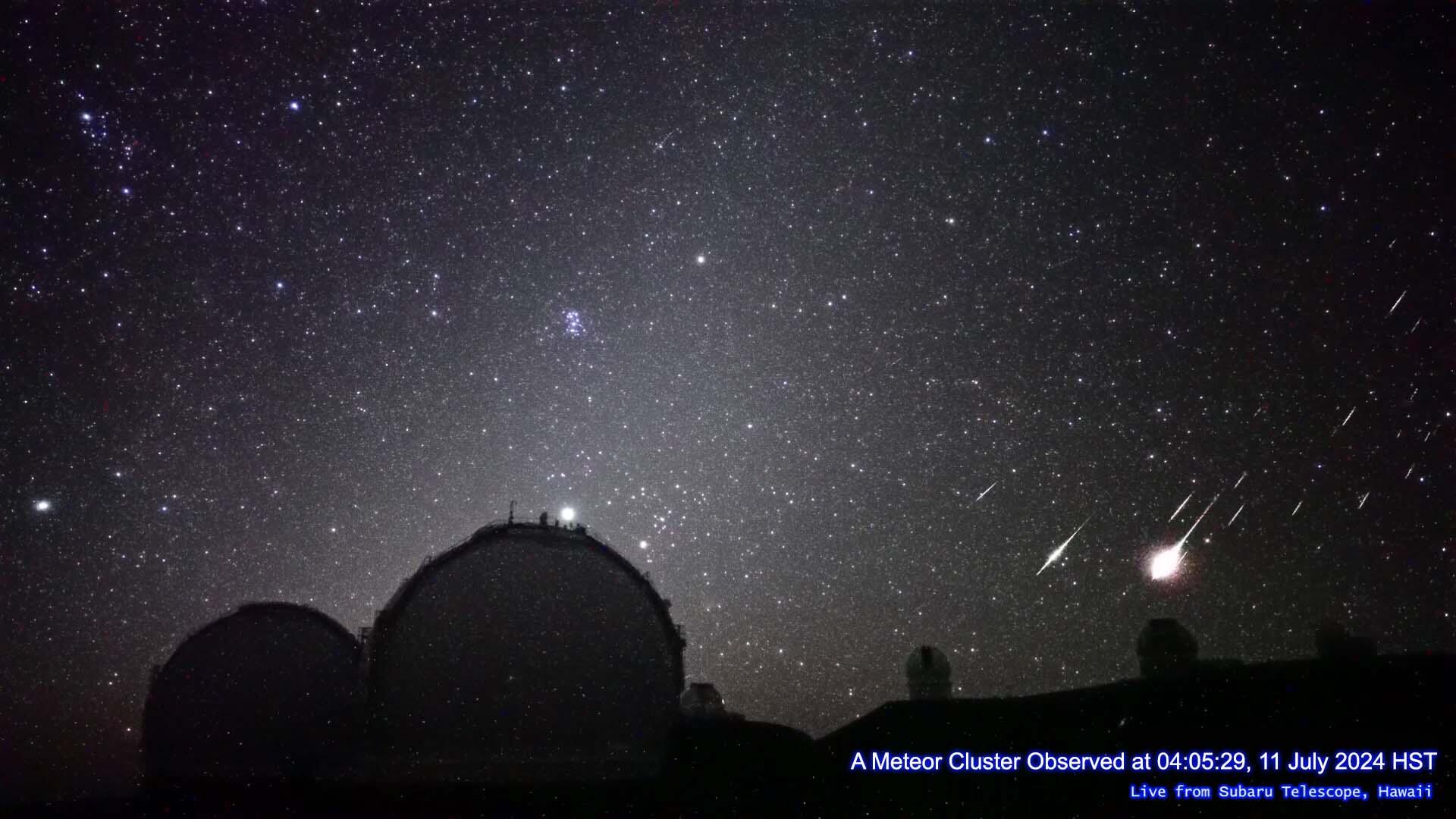
Figure 1: A meteor cluster captured by the Subaru–Asahi StarCam. (Credit: NAOJ & Asahi Shimbun)
The "Subaru–Asahi StarCam" is a live sky-monitoring camera installed at the Subaru Telescope facility through a collaboration between the National Astronomical Observatory of Japan (NAOJ) and
Asahi Shimbun, a Japanese Newspaper company. Since streaming began in April 2021, the camera has continuously broadcast the skies over Maunakea on YouTube 24 hours a day, 365 days a year, except during occasional technical interruptions.
Thanks to the combination of a state-of-the-art high-sensitivity camera and the exceptionally clear skies of Maunakea—one of the world’s premier astronomical observing sites—the Asahi Astro LIVE (Uchu-Bu) channel has become a popular destination for viewers worldwide.
By continuously monitoring the night sky, the camera has captured a wide range of rare phenomena, including meteor shower activity, total lunar eclipses, and satellite orbital insertion and deorbit activities. Among these, its contributions to meteor astronomy have been particularly remarkable
In July 2021, just three months after the start of operations, the camera recorded a "meteor cluster," a phenomenon in which many meteors appear almost simultaneously within just several
seconds. The dramatic sight astonished viewers watching the live stream, and the camera has since captured a few additional occurrences of this rare phenomenon.
Previously, meteor clusters had been detected only by chance, using various cameras
with differing performances and under varying observing conditions. As a result, data obtained through continuous monitoring from a single location by the StarCam are scientifically invaluable.
The achievements extend well beyond meteor clusters. During a detection campaign for the Arid meteor shower—an event marking the birth of a new meteor shower—volunteers from among the viewers took part in the successful detection of meteor activity as part of a citizen science effort. As one of the very few observing sites from the northern hemisphere, the StarCam provided crucial data.
The camera also detected sudden outbursts from two typically weak meteor showers: the 2022 τ-Herculid and the 2021 Andromedids. The former confirmed activity that had been predicted in advance by dust-trail model calculations conducted by NAOJ researcher Mikiya Sato and collaborators. In the latter case, detections by the StarCam prompted follow-up modeling studies that independently verified the meteor activity. Capturing such faint events—down to objects as faint as 7th magnitude—would have been extremely difficult without both the camera’s high sensitivity and Maunakea’s outstanding observing conditions.
These scientific results, together with a detailed overview of the camera system, have been compiled into a special issue titled "Meteor Science in a New Era of High-Sensitivity Live Cameras" in the journal Publications of the Astronomical Society of Japan (PASJ). The special issue appears in the February 2026 print edition of PASJ.
This April, the Subaru–Asahi StarCam will celebrate its fifth anniversary. In February last year, a second camera—the "CFHT–Asahi StarCam" —was installed at the Canada–France–Hawaii Telescope (CFHT), enabling live broadcasts that include the Subaru Telescope in the shot. More recently, in January of this year, a new live stream of the southern sky began from the ALMA Observatory site in Chile, through a collaboration between NAOJ’s ALMA Project and Asahi Shimbun.
As high-sensitivity live StarCam expands to world-class observing sites across the globe, it may open the door to even more exciting discoveries in meteor astronomy. We invite you to continue following and supporting these StarCam live broadcasts.
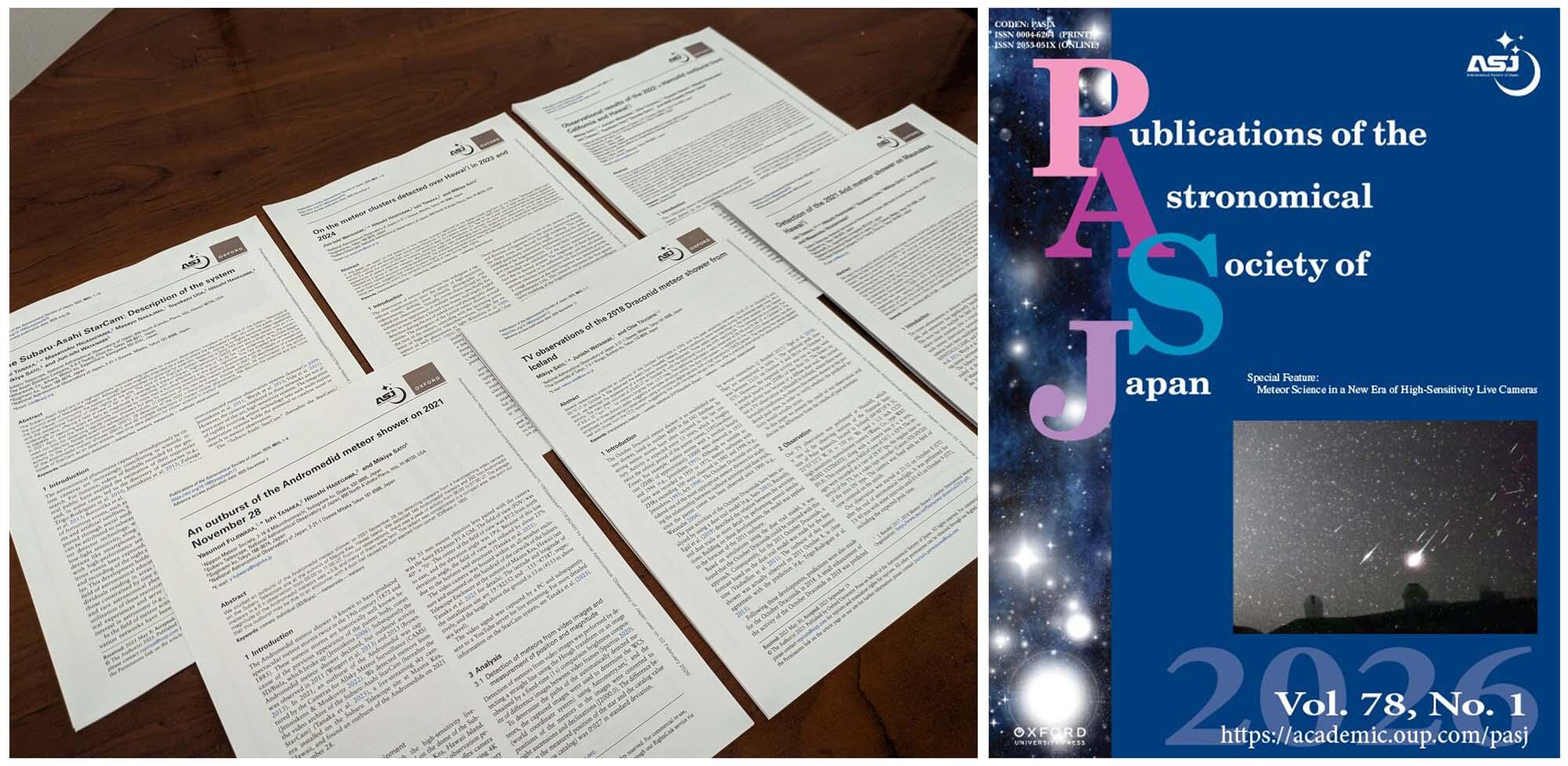
Figure 2: The six papers in the special issue "Meteor Science in a New Era of High-Sensitivity Live Cameras" (left; Credit: NAOJ) and the Journal cover featuring the special issue (right; Credit: Oxford University Press).
These research results were featured in a special section of six papers in the February 2026 issue of the Publications of the Astronomical Society of Japan.
1. Tanaka et al. "The Subaru-Asahi StarCam: Description of the System"
2. Watanabe et al. "On the meteor clusters detected over Hawai`i in 2023 and 2024"
3. Sato et al. "Observational results of the 2022 τ-Herculid outburst from California and Hawai`i"
4. Sato et al. "TV observations of the 2018 Draconid meteor shower from Iceland"
5. Fujiwara et al. "An outburst of the Andromedid meteor shower on 2021 November 28"
6. Tanaka et al. "Detection of the 2021 Arid meteor shower on Maunakea, Hawai`i"
 Guidelines for Use