Procedures for Target of Opportunity Observations
Target of Opportunity (ToO) observations are intended to conduct research for transient and/or rare phenomena as a part of the Subaru open use observations. ToO programs are classified by two independent features (1) response timescale (“rapid” or “non-rapid”) and (2) expected occurrence/trigger rate (“normal ToO” or “rare ToO”). Non-rapid ToO programs do not require immediate attention and can be executed after 24 hours or more. Rapid Too programs require immediate attention and need to be executed within 24 hours. Rare ToO programs are limited to observations for phenomena with a low expected occurrence/trigger rate using Subaru instruments only. Once approved, the rare ToO proposal remains valid either until the accepted number of nights has been triggered or up to 3 years.
Applicants to accepted ToO proposals can submit a request to use their allotted nights on the Subaru Telescope, except for UH time, Gemini time-exchange nights, time-critical programs, specific solar-system object events, and HSC narrow-band filter program nights. The Subaru Observatory will decide whether its request is accepted or not. Although a prompt decision is required for ToO observations, careful consideration should be given to any effect on the originally scheduled observations. ToO observations are generally conducted in half-night increments, except during HSC Queue mode, when observations can be undertaken in hourly increments, with a minimum observation time of 2 hours. PI or observers should attend the ToO observations. The Subaru Observatory will follow the procedure for handling ToO observations.
-
SUBARU Time Allocation Committee (TAC) meeting
- TAC can set conditions to issue each accepted ToO observation. TAC may suggest which ToO observation is (or isn't) allowed to be conducted during specific observations of the normal program.
- Open use (in Mitaka: Imanishi) or Science Operation Group lead (Aoki) will make a summary of the TAC discussion about ToO observations. The summary will be distributed to the Subaru Director (Miyazaki), the Operation Division Lead (Pyo), the Vice Director (Hayano), and the Science Operation Group Lead (Aoki).
- Time-critical observations of the normal program should be shown for clarity with a mark in the internal schedule calendar.
-
Notification to applicants of accepted ToO proposals
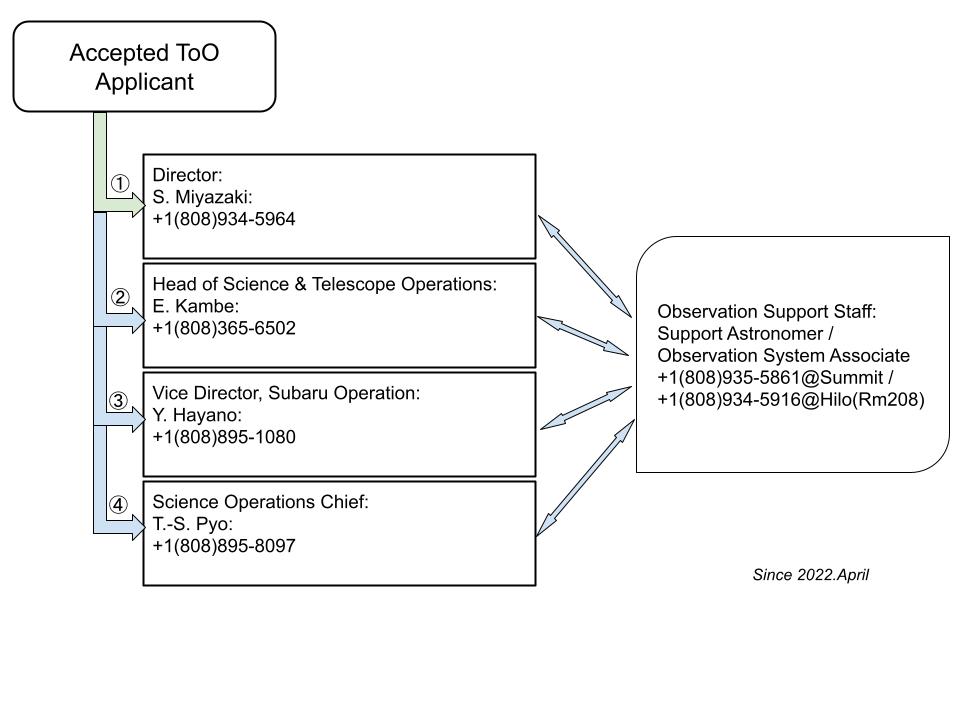
- Applicants of accepted ToO proposals will be informed of the conditions and procedures to issue their ToO observation. In the email notification, the telephone numbers of the Director, Operation Division Lead, Vice Director, and Science Operation Group Lead will be shown.
-
Observation request from accepted ToO applicants
- For non-rapid ToO programs, PIs need to submit their requests by 9:00 am Hawaii time one day before their observing night.
- For rapid ToO programs, PIs can submit their requests within 24 hours. Considering the practical approval procedure, we recommend that PIs trigger several hours before the observation.
- ToO observers should call the Director using the telephone numbers in the e-mail of notification when they request to issue their ToO observation. If the Director isn't available, they should call the person listed next in the order shown in the figure.
- In case of the Director's absence, the Operation Division Lead will be in charge of the decision.
- In case of the Director's and Operation Division Lead's absence, the Science Operation Group Lead and Vice Director will be in charge of the decision.
- The Director (or his deputy) will call at the site of the observation (mostly for the Support Astronomer) to inquire about the status of the scheduled observation.
- The Director (or his deputy) will decide whether the proposed ToO observation is accepted or not, considering its urgency and the impact on the scheduled observation. For an acceptance of the ToO observation, it should be required that at least one member of the Subaru Telescope staff (in Hawaii) is secured as a Co-I at the site of the observation. If the TAC process needs to be referred to assess scientific merit, the Science Operation Group Lead will provide any necessary comments.
-
Compensation for originally scheduled observations
- The Science Operation Group Lead will set dates to compensate observers for time lost due to ToO observations as soon as possible.
Approved by the Subaru Advisory Committee on April 17th, 2008.
Revised on June 1st, 2010.
Revised on October 1st, 2011.
Revised on April 1st, 2012.
Revised on December 5th, 2013.
Revised on April 1st, 2014.
Revised on September 13th, 2016.
Revised on April 1st, 2017.
Revised on April 19th, 2018.
Revised on February 1st, 2019.
Revised on January 21st, 2020.
Revised on April 5th, 2022.
Revised on February 1st, 2025.
Revised on January 27th, 2026.
Revised on May 12th, 2026,
Revised on August 4th, 2026.