


Everyone knows that finding the right sauce recipe can make or break a barbeque, but now astronomers are using BBQSORS (pronounced "barbecue sauce") as part of the recipe to explain quasars, some of the brightest objects in the Universe. These results were made possible by data from a new instrument on the Subaru Telescope. And yes, Subaru Telescope does have a barbeque grill in the courtyard of its main offices.
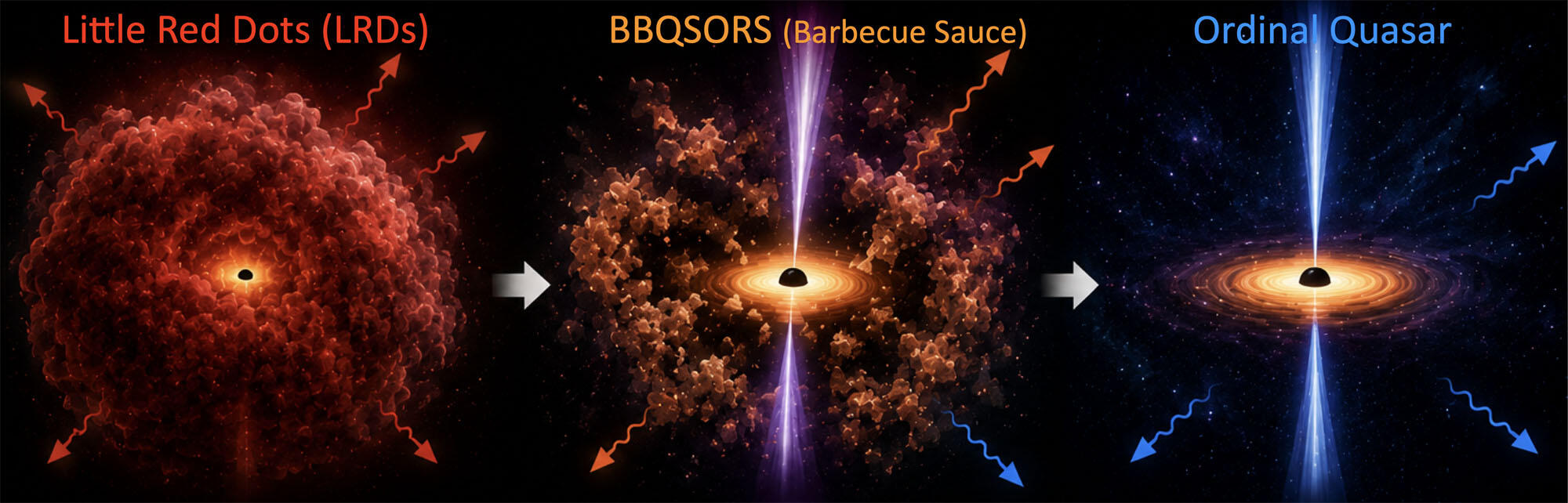
Figure: Schematic illustration of an evolutionary scenario connecting LRDs (left), BBQSORS (center), and ordinary QSOs (right). In LRDs, a supermassive black hole is thought to be surrounded by thick gas clouds. In BBQSORS, the surrounding clouds are being roasted off, and the region around the black hole may be partially emerging into view. In a QSO, the region around the black hole is visible. (Credit: Illustration generated by ChatGPT [OpenAI]; edited by Kohei Ichikawa)
Galaxies in the early Universe which shine brightly due to gas falling into a supermassive blackhole at the galaxy center were originally regarded as puzzling Quazi-Stellar Objects, abbreviated as QSO. Even though we now know that they are not stars, but entire galaxies, the abbreviation QSO, now pronounced as "quasar," is still used. QSOs are some of the brightest objects in the Universe, but the recipe nature uses to create them has remained a secret.
Now, thanks to data from the new wide-field multi-object spectrograph, ʻŌnohiʻula PFS, on the Subaru Telescope, astronomers think that they have discovered the special sauce needed to understand the secret recipe. The data comes from observations of an object known as "BBQSORS," which is an abbreviation for "Blackbody QSO and Radio Source," and is pronounced "barbecue sauce."
As the name implies, BBQSORS seems to be a QSO, but has some idiosyncrasies. It was originally identified as a radio-bright QSO candidate. Follow-up observations to determine the true nature of the candidate were conducted as part of ʻŌnohiʻula PFS’s filler observations program. Under this program, astronomers can request observations of an object when ʻŌnohiʻula PFS is scheduled to observe other targets in the same area of the sky. This filler observation program allows astronomers to make simultaneous observations, which use the instrument more efficiently without detracting from the main observations. The PFS observations revealed that BBQSORS shows the characteristic of high-speed gas around a black hole, but, unlike ordinary QSOs, also has features similar to black body emission from gas at around 10,000 degrees.
A research team including researchers from the Japanese institutions Tohoku University, Ehime University, and Ritsumeikan University analyzed data for BBQSORS from other observations and found that it has properties similar to those of a class of objects called "Little Red Dots" (LRDs). Researchers think that in LRDs, a growing supermassive black hole may be obscured by very dense clouds of gas which absorb the intense light from the center and re-emit it at different wavelengths. From this early "cloudy stage," LRDs are thought to change into QSOs.
BBQSORS seems to be shrouded in gas clouds, similar to LRDs, but the gas may be hotter than that surrounding LRDs. In other words, BBQSORS may be roasting off its surrounding clouds in the process of cooking up a QSR. If this interpretation is correct, BBQSORS is a valuable candidate object capturing the transition from a thick-gas-enshrouded stage to an ordinary quasar.
This research result was published on June 3, 2026, in The Astrophysical Journal Letters (Zhong, Chen, Ichikawa et al., "Blackbody Quasar and Radio Source (BBQSORS): A Candidate of Transitional Little Red Dots with a T ~ 104 K Blackbody Spectrum").
This research was supported by JSPS KAKENHI (Grant No. 25K01043), JST FOREST Program (JPMJFR2466), and the Inamori Foundation Research Grant.
The Subaru Telescope is a large optical-infrared telescope operated by the National Astronomical Observatory of Japan, National Institutes of Natural Sciences with the support of the MEXT Project to Promote Large Scientific Frontiers. We are honored and grateful for the opportunity of observing the Universe from Maunakea, which has cultural, historical, and natural significance in Hawai`i.
 Guidelines for Use