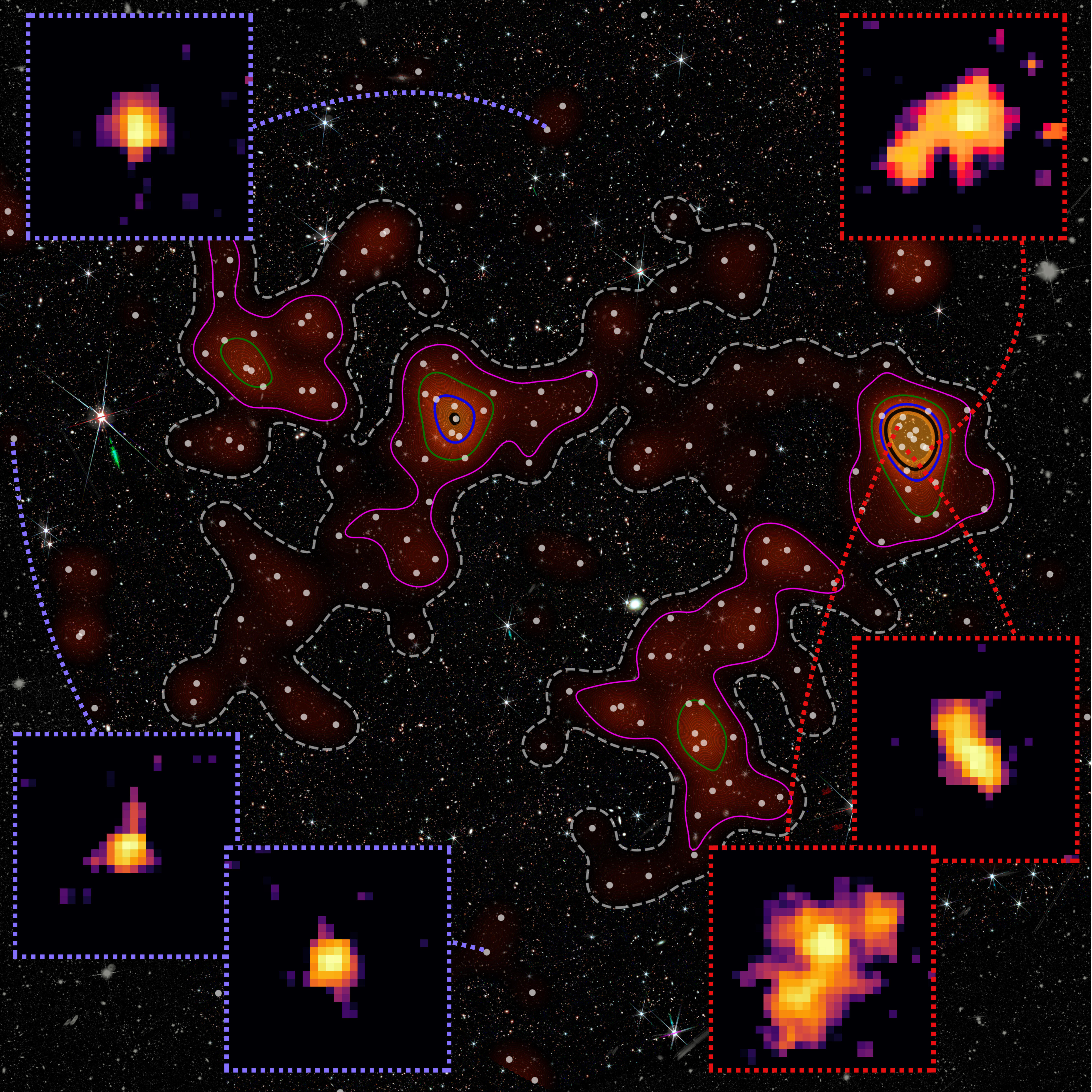
A large protocluster of galaxies that existed 12.6 billion years ago, first discovered with the Subaru Telescope, has been examined in detail using the James Webb Space Telescope (JWST). The study found that galaxies in crowded regions are more extended than similar galaxies in less dense environments. The result shows that even when the Universe was only 1.2 billion years old, environment was already influencing how galaxies grew.
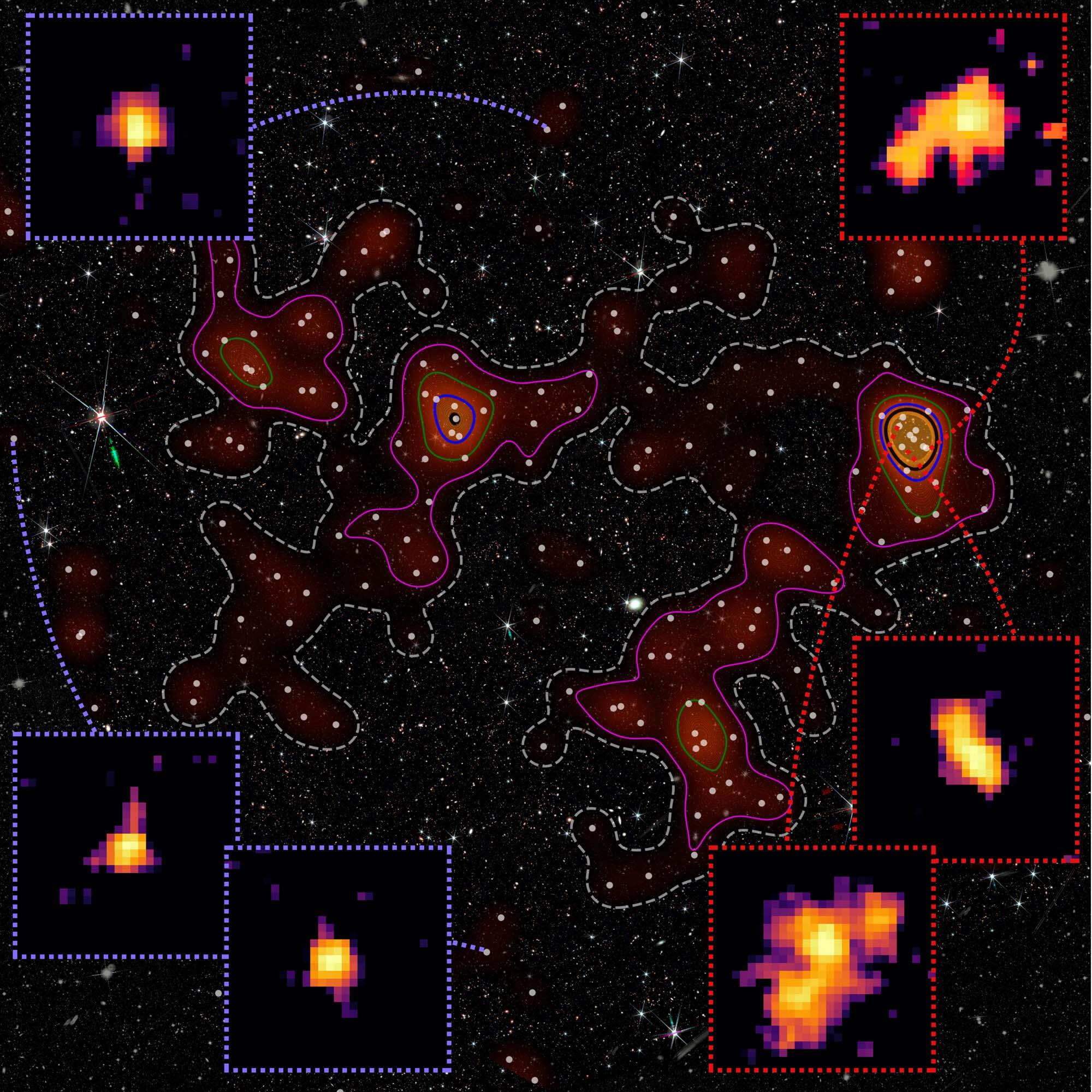
Figure 1: The Loktak Protocluster Region. A false-color composite image combining visible-light observations from the Hubble Space Telescope with infrared observations from JWST. White dots mark galaxies identified by the Subaru Telescope, while orange shading indicates regions where galaxies are densely concentrated. Colored contours show galaxy number density relative to the cosmic average at that time: 2 times (pink), 5 times (green), 8 times (blue), and 10 times (black). The white dashed line outlines the full extent of the Loktak Protocluster. The close-up images in the red and blue boxes show examples of galaxies in dense environments and in typical environments, respectively. A high resolution image is available here (5.2 MB). (Credit: Laishram et al./NAOJ/NASA/ESA/CSA)
How Did the Universe’s Largest Structures Form?
In today’s Universe, galaxies are not spread evenly through space. They have gathered into groups, and those groups form enormous galaxy clusters containing hundreds or even thousands of galaxies. But these giant structures did not exist at the beginning of the Universe.
In the early Universe, slightly denser regions of matter gradually grew under gravity and eventually developed into galaxy clusters. These "seeds" of galaxy clusters are known as protoclusters.
One of the key questions for astronomers is when did dense environments begin to influence how galaxies evolve.
In the modern Universe, galaxies in clusters often look very different from isolated galaxies. They tend to be more massive, have difficulty forming new stars, and have rounder shapes. This phenomenon—where galaxy growth depends on its surroundings —is known as an environmental effect.
However, it has remained unclear whether such effects were already present in the very early Universe, or whether they appeared only after galaxy clusters had fully matured.
The Loktak Protocluster Discovered by the Subaru Telescope
An international research team including astronomers at the National Astronomical Observatory of Japan (NAOJ) used the Subaru Telescope’s wide-field camera, Hyper Suprime-Cam (HSC), to conduct a large sky survey and discovered a massive protocluster that existed 12.6 billion years ago.
Young galaxies with active star-formation often emit a special type of light called Lyman-alpha emission. This emission is produced when radiation from hot young stars excites surrounding hydrogen gas. Galaxies found through this signal are called Lyman-alpha emitters, and they are useful markers for tracing structure in the early Universe.
Using a special filter tuned to detect this light, the team mapped a vast area of sky and identified a region where galaxies were strongly concentrated.
The newly discovered structure was named the Loktak Protocluster, after Loktak Lake in Manipur, India. The name reflects the way four separate galaxy concentrations are linked together into one larger structure, resembling the floating islands of the lake (Figure 1).
"Protoclusters are the construction sites of the most massive structures in the present-day Universe," says lead author Ronaldo Laishram of NAOJ. "Finding such a clearly organized system at this early epoch gives us a rare chance to study how environment affects galaxy growth in the young Universe."
JWST Reveals Differences in How Galaxies Grew
The team then used JWST infrared images to compare galaxies inside the protocluster with galaxies in more typical environments at the same cosmic epoch.
When observed in ultraviolet light—which traces regions where stars are forming—the two galaxy populations showed little difference in size. However, in optical light (Note 1), which traces the overall distribution of previously formed stars, galaxies in the protocluster were on average about 1.4 times larger than galaxies in normal environments (Figure 2, Note 2).
In other words, although the star-forming cores looked similar, the overall galaxies had grown differently. This suggests that star formation in galaxy centers proceeded similarly, but galaxies in dense environments built up their outer stellar structures earlier and more rapidly.
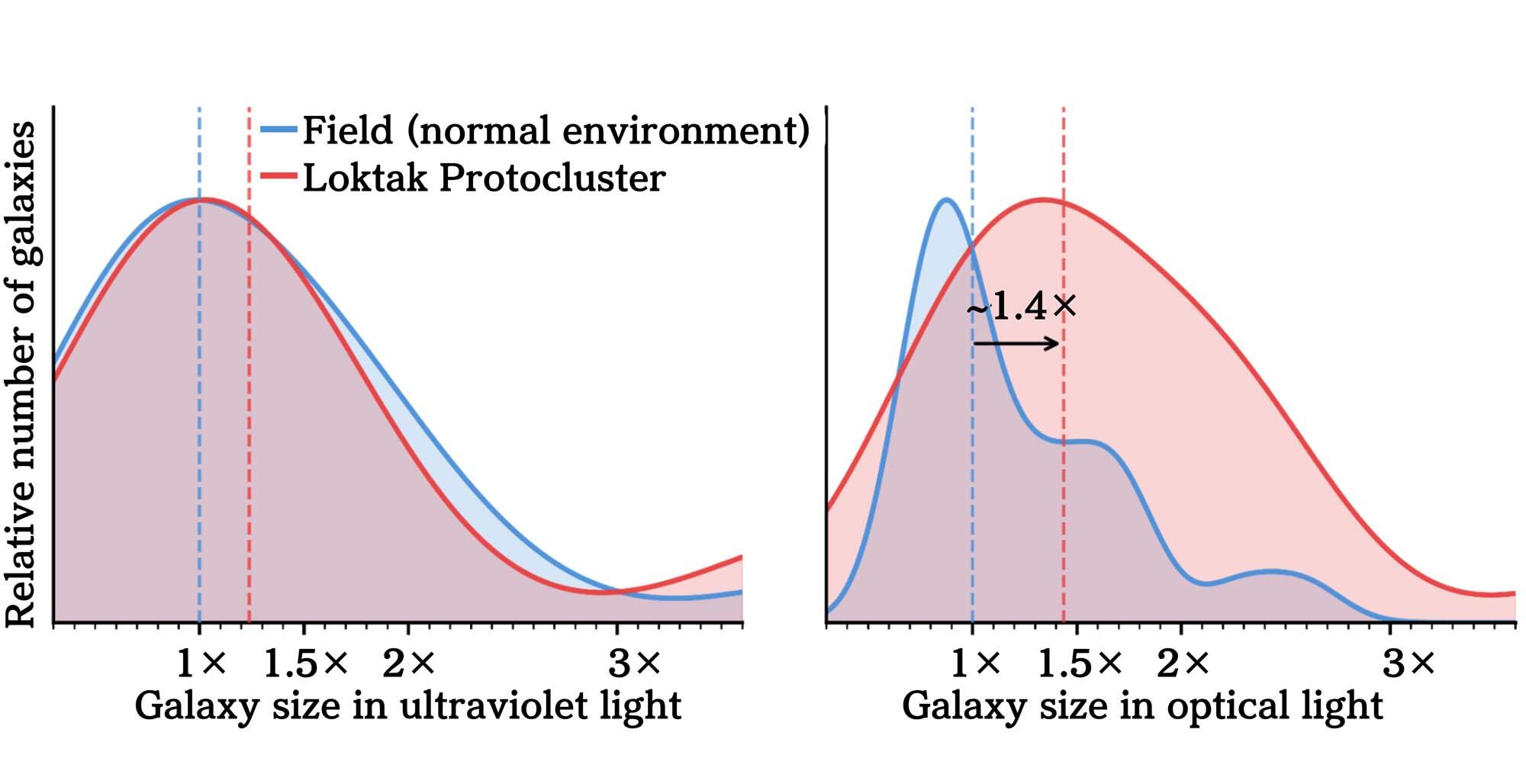
Figure 2: Distribution of galaxy sizes for galaxies in the central region of the Loktak Protocluster (red) and galaxies in average environments at the same epoch (blue). Left: ultraviolet measurements. Right: optical measurements. In optical light, galaxies in the dense environment are larger. A value of 1 on the horizontal axis corresponds to the typical galaxy size in average environments. (Credit: Laishram et al./NAOJ)
A Galaxy’s Fate Depends on Where It Lives
The importance of this result is that it clearly shows environmental effects were already shaping galaxies long before galaxy clusters were fully formed.
Out of the Universe’s current age of 13.8 billion years, the galaxies observed here are seen only 1.2 billion years after the Big Bang. Even at that very early time, how a galaxy grew depended on where it lived. This means galaxy evolution is determined not only by a galaxy’s own mass and internal properties, but also by its surroundings from an early stage.
The study suggests that the appearance of galaxies is shaped not only by what they are born with, but also by where they grow up—and that this process began in the earliest chapters of cosmic history.
Future observations using Subaru Telescope’s ʻŌnohiʻula PFS as well as the next-generation wide-field adaptive optics system (ULTIMATE), combined with continued JWST follow-up will help determine whether this kind of environmental effect was common in the early Universe or unique to the Loktak Protocluster.
These results appeared in The Astrophysical Journal Letters on April 27, 2026 (Laishram et al. "Discovery of a z ≃ 4.9 Lyα Emitter Protocluster: Wavelength-dependent Environmental Effects on Galaxy Structure").
This work was supported by JSPS KAKENHI grants (23H01219, 24H00002, 22K21349) and the JSPS Core-to-Core Program (JPJSCCA20210003).
(Note 1) Because light from distant galaxies is stretched to longer wavelengths by the expansion of the Universe, light emitted as visible light reaches Earth as infrared light. JWST’s highly sensitive infrared instruments make it possible to study the visible-light structure of distant galaxies.
(Note 2) In general, more massive galaxies tend to be larger. However, the size difference found in this study cannot be explained by mass differences alone.
The Subaru Telescope is a large optical-infrared telescope operated by the National Astronomical Observatory of Japan, National Institutes of Natural Sciences with the support of the MEXT Project to Promote Large Scientific Frontiers. We are honored and grateful for the opportunity of observing the Universe from Maunakea, which has cultural, historical, and natural significance in Hawai`i.
 Guidelines for Use