


The Subaru Telescope observed the interstellar comet 3I/ATLAS on January 7, 2026 (UT), after it made its closest approach to the Sun. By observing colors in the coma around the comet, astronomers could estimate the ratio of carbon dioxide to water. This ratio is much lower than that inferred from earlier observations by space telescopes. These findings suggest that the chemistry of the coma is evolving over time and offers clues to the structure of comet 3I/ATLAS.
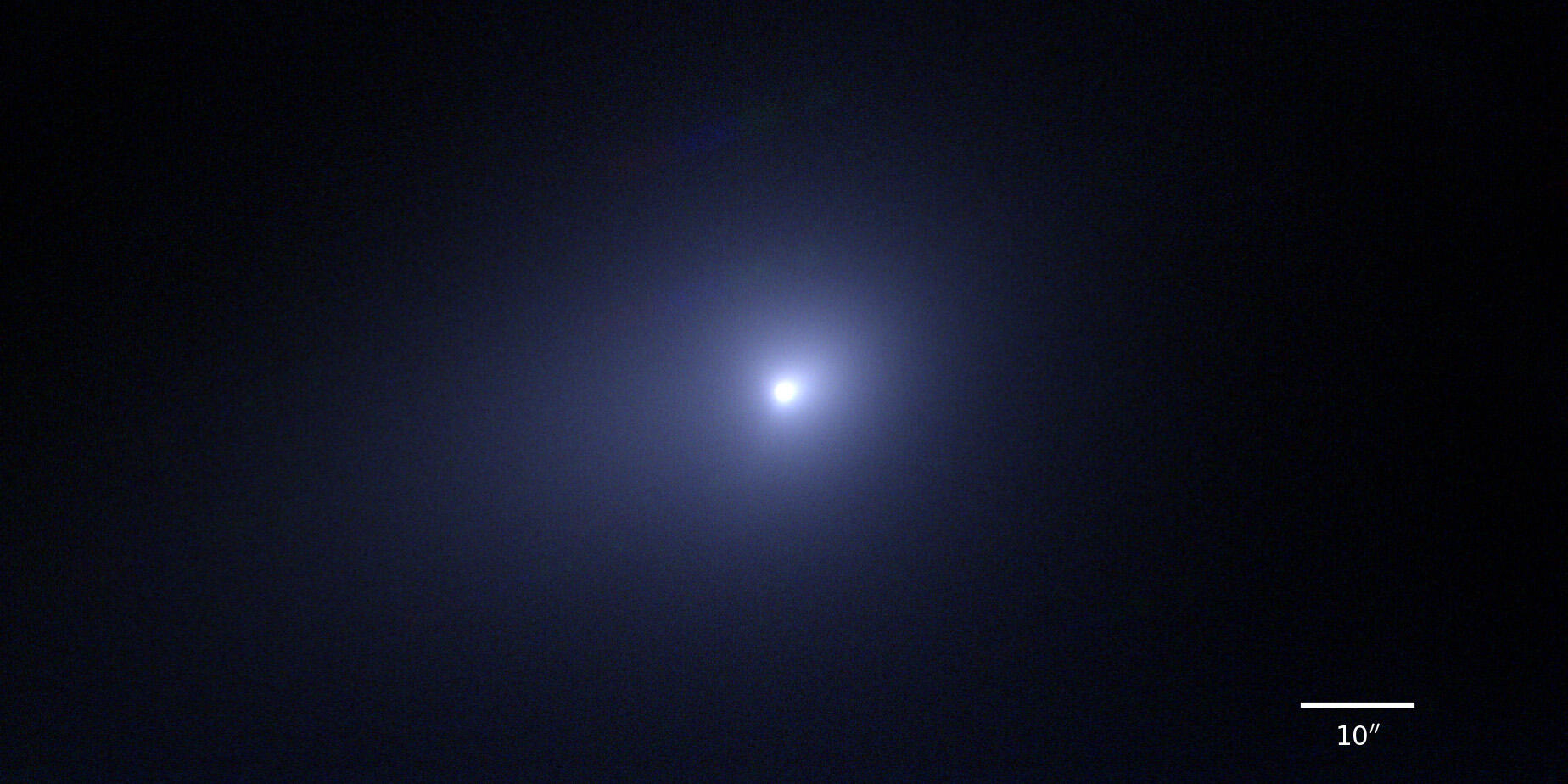
Figure 1: Interstellar comet 3I/ATLAS (C/2025 N1) captured by the Subaru Telescope on December 13, 2025 (Hawaii-Aleutian Standard Time). This image was created by combining three different wavelengths: V-band (550 nanometers, depicted in blue), R-band (660 nanometers, depicted in green), and I-band (805 nanometers, depicted in red). For more details about the image, please see here.(Credit: NAOJ)
Comet 3I/ATLAS (C/2025 N1) has garnered much attention as a comet which originated outside of the Solar System. A research group led by Yoshiharu Shinnaka of the Koyama Space Science Institute, Kyoto Sangyo University, used the Subaru Telescope to observe comet 3I/ATLAS after perihelion, the comet’s closest approach to the Sun. The team applied analytical methods and expertise accumulated through investigations of Solar System comets to the data.
From this analysis, the team was able to estimate the ratio of carbon dioxide (CO2) to water (H2O) in the coma, the cloud of gas around the nucleus of the comet. Because the gas in the coma comes from the nucleus, the coma composition provides hints to the composition of the nucleus.
Thanks to its notoriety, 3I/ATLAS had already been observed by space telescopes prior to perihelion. The CO2/H2O ratio calculated from the Subaru Telescope data was lower than the ratio suggested by the space telescope data. This change is consistent with the idea that the composition of the nucleus interior differs from that of the exterior, and as 3I/ATLAS heated up during its pass by the Sun, gas started to escape from different parts of the nucleus.
Shinnaka comments, " With the full-scale operation of survey telescopes in the coming years, many more interstellar objects are expected to be discovered. By applying the observational and analytical techniques we have developed through studies of Solar System comets to interstellar objects, we can now directly compare comets hailing from both inside and outside the Solar System and explore differences in their composition and evolution. Through studies of such objects, we hope to gain a deeper understanding of how planetesimals and planets formed in a wide variety of stellar systems, including our own Solar System."
This study will be published in The Astronomical Journal on April 22, 2026 (Shinnaka et al., "A post-perihelion constraint on the CO₂/H₂O ratio of interstellar comet 3I/ATLAS from [O I] forbidden lines"). A preprint is available here.
This research was supported by Japan Society for the Promotion of Science (JSPS) Grant Numbers JP20K14541 (YS), JP21H04498 (HK), JP23K25930 (TO), and JP26K00771 (HK). This research was partly supported by Koyama Space Science Institute of Kyoto Sangyo University.
The Subaru Telescope is a large optical-infrared telescope operated by the National Astronomical Observatory of Japan, National Institutes of Natural Sciences with the support of the MEXT Project to Promote Large Scientific Frontiers. We are honored and grateful for the opportunity of observing the Universe from Maunakea, which has cultural, historical, and natural significance in Hawai`i.
 Guidelines for Use