


Observations conducted with the Subaru Telescope and its first-generation wide-field camera, Suprime-Cam, have revealed new insights into the relationship between the color and size of Jupiter Trojan asteroids. While a bimodal color distribution has been well established for larger Jupiter Trojans, the new study shows that smaller Jupiter Trojans exhibit markedly different behavior. This discovery provides an important clue to understanding the origin and evolution of these enigmatic objects.
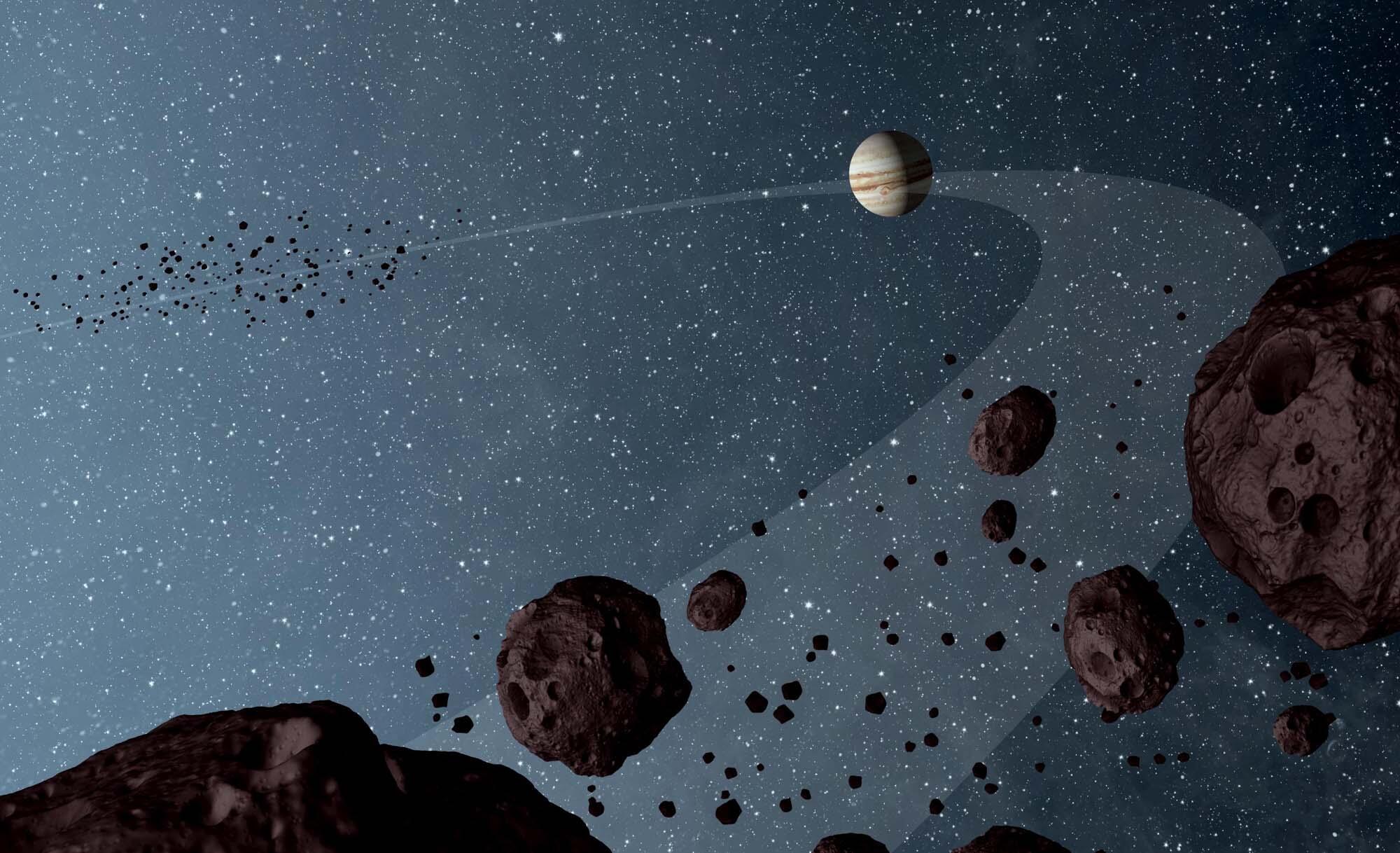
What Are Jupiter Trojan Asteroids?
Jupiter orbits the Sun, and there are stable regions along its orbit where asteroids are clustered ahead of and behind the planet. These groups of asteroids are known as Jupiter Trojans. These asteroids are believed to preserve information from the early Solar System and are often described as "fossils" of the Solar System.
Previous research has shown that large Jupiter Trojans can be classified into two types based on their reflectance properties: the red "D-type" and the less red "P-type/C-type." The color of an asteroid is believed to reflect its composition and its formation distance from the Sun, since temperature gradients in the early Solar System influenced the types of materials that could condense.
The Jupiter Trojan population contains two types of asteroids that may have formed in different regions, yet they coexist in the same orbital region today. The exact reason for this remains unclear, though it has been suggested that large-scale migration of the giant planets in the early Solar System transported distant small bodies into Jupiter’s orbital region.
Small Jupiter Trojans Hold the Key
To better understand the origin of these two asteroid populations, a research team from the University of Occupational and Environmental Health, the National Astronomical Observatory of Japan, and Kobe University focused on small Jupiter Trojan asteroids.
Asteroids have experienced multiple collisions over their histories. Many small asteroids are therefore thought to be fragments produced by the disruption of larger parent bodies. While the surfaces of large asteroids have changed over long periods of exposure to the space environment, smaller fragments are more likely to retain information about the interiors of their parent bodies. In this sense, studying the colors of small asteroids provides valuable clues to the original composition of their parent bodies.
Suprime-Cam's Final Night
Asteroid colors can be measured using spectroscopy or multicolor photometry. Small Jupiter Trojans are too faint for efficient spectroscopic observation, even with large telescopes. To overcome this limitation, the team conducted multicolor photometry using Suprime-Cam, the Subaru Telescope’s first-generation wide-field camera.
Suprime-Cam was scheduled to be retired when Hyper Suprime-Cam (HSC) operations began. HSC is a second-generation camera that offers a field of view approximately seven times larger than that of Suprime-Cam, dramatically improving survey efficiency. However, due to its larger size, it requires significantly more time to change filters.
Asteroids rotate, and the intensity of their reflected light changes with rotation; therefore, when measuring their colors, it is desirable to perform photometric measurements using multiple filters in as short a time as possible.
"Suprime-Cam was indispensable for this study, which required rapid multicolor observations over a wide area of the sky," says Fumi Yoshida (University of Occupational and Environmental Health/Chiba Institute of Technology), who led the research.
The observations were conducted in May 2017 during Suprime-Cam's "final night" on the Subaru Telescope (related article). On that night, many people who had been involved in the instrument development and operation gathered at the Subaru Telescope and the remote observation room in Mitaka to witness Suprime-Cam's final performance.
"I am deeply grateful that our research was carried out during such a special occasion. My work on small bodies in the Solar System began in 2000 with test observations from Suprime-Cam. Over the following 17 years, I continued using this instrument to study the size and spatial distributions of small Solar System bodies," Yoshida reflects.
Key Findings
The research team observed the region approximately 60 degrees ahead of Jupiter and detected 120 Jupiter Trojan asteroids. Their analysis of color and size relationships for kilometer-sized objects revealed two major findings:
No clear color bimodality among small asteroids
Unlike larger Jupiter Trojans, which show a clear division into "red" and "less red" groups, smaller Trojans exhibit a continuous color distribution. Overall, less-red objects are more abundant.
No color dependence in size distribution
Previous studies indicated that the size distributions differ between red and less-red groups among large Jupiter Trojans. However, this study found virtually no difference in size distribution between red and less-red asteroids (Figure 2). These results challenge the conventional hypothesis that red asteroids fragment into less-red objects, suggesting instead that both populations undergo similar collisional processes.
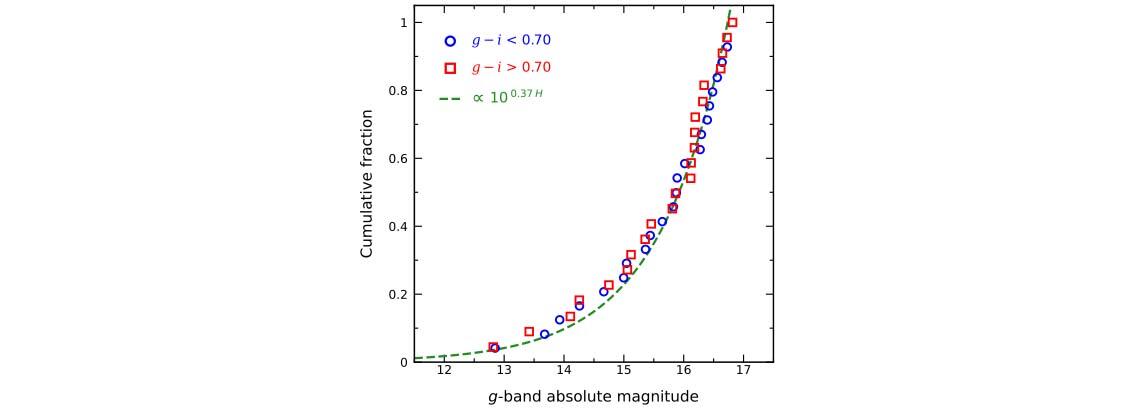
Figure 2: Size distribution of Jupiter Trojans obtained from this study. The horizontal axis (magnitude) indicates the size of the Jupiter Trojan asteroids. A magnitude of 13 corresponds to a diameter of about 16 kilometers, and a magnitude of 17 corresponds to a diameter of about 3 kilometers. The vertical axis shows the percentage of the total population accounted for by asteroids with magnitudes below a certain threshold. There is no difference in size distribution between red (□) and less-red (○) asteroids. (Credit: Yoshida et al. 2026).
Looking Ahead
These findings provide important constraints on the origin and evolution of Jupiter Trojan asteroids.
Ongoing spacecraft missions will further enhance our understanding. For example, the European Space Agency’s JUICE mission is exploring the Jovian system, while NASA’s Lucy mission will conduct the first flybys of Jupiter Trojan asteroids. Combining these spacecraft observations with the results of this study and theoretical modeling will significantly advance the fields and help uncover the formation history of these intriguing objects.
These results were published in The Astronomical Journal on March 20, 2026 (Yoshida et al., "Color and Size Distributions of Small Jupiter Trojans.")
The Subaru Telescope is a large optical-infrared telescope operated by the National Astronomical Observatory of Japan, National Institutes of Natural Sciences with the support of the MEXT Project to Promote Large Scientific Frontiers. We are honored and grateful for the opportunity of observing the Universe from Maunakea, which has cultural, historical, and natural significance in Hawai`i.
 Guidelines for Use