An international team led by a researcher at the Chiba Institute of Technology has discovered an extremely rare phenomenon: a galaxy about 10 billion light-years away whose brightness dropped to one-twentieth of its original level in just 20 years. By combining multiwavelength observations with archival data spanning several decades, the researchers concluded that the fading was caused by a rapid decrease in the gas flowing into the supermassive black hole at the galaxy’s center. The discovery shows that the activity of supermassive black holes can change dramatically on timescales short enough to be observed within a human lifetime.
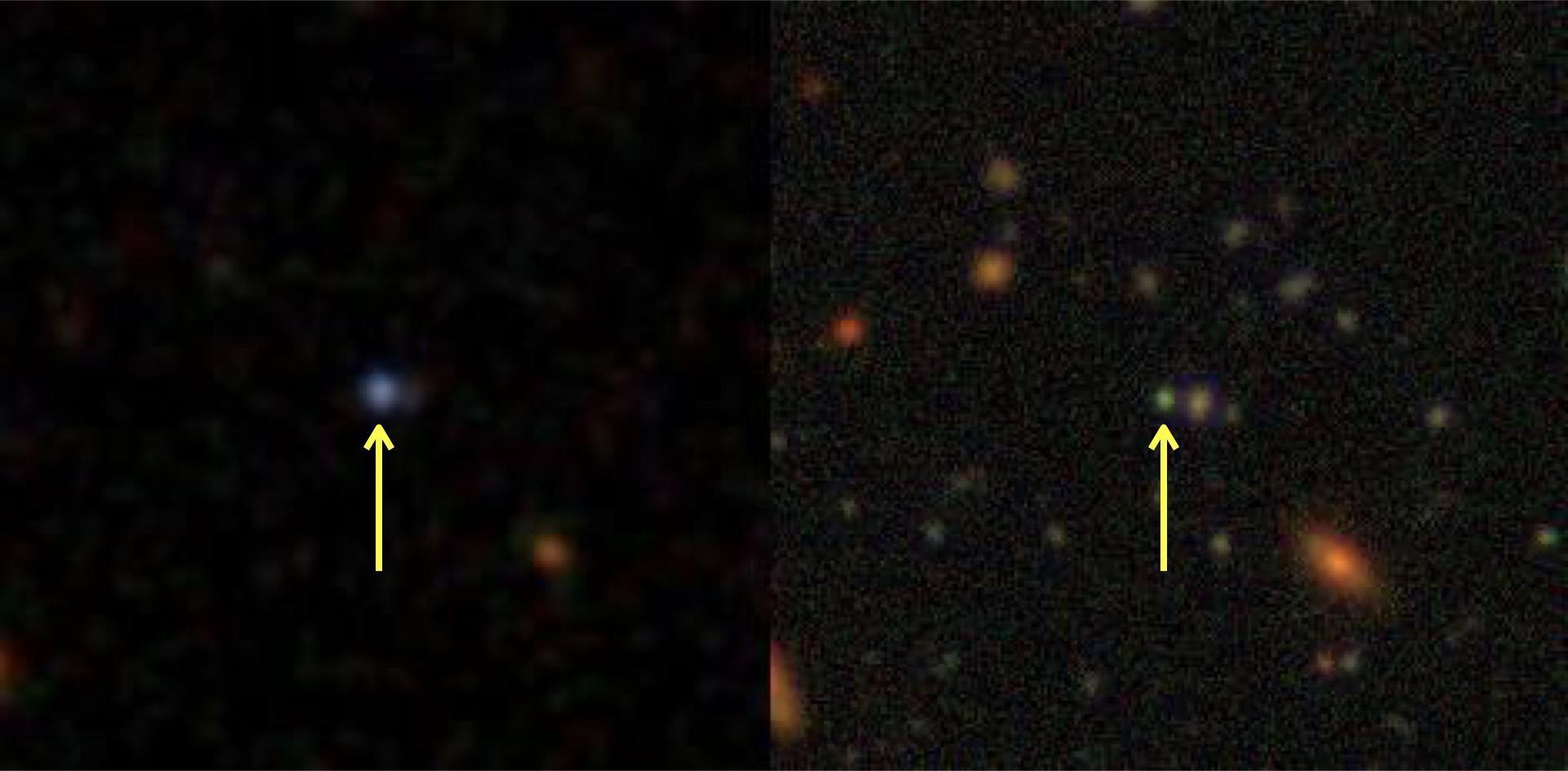
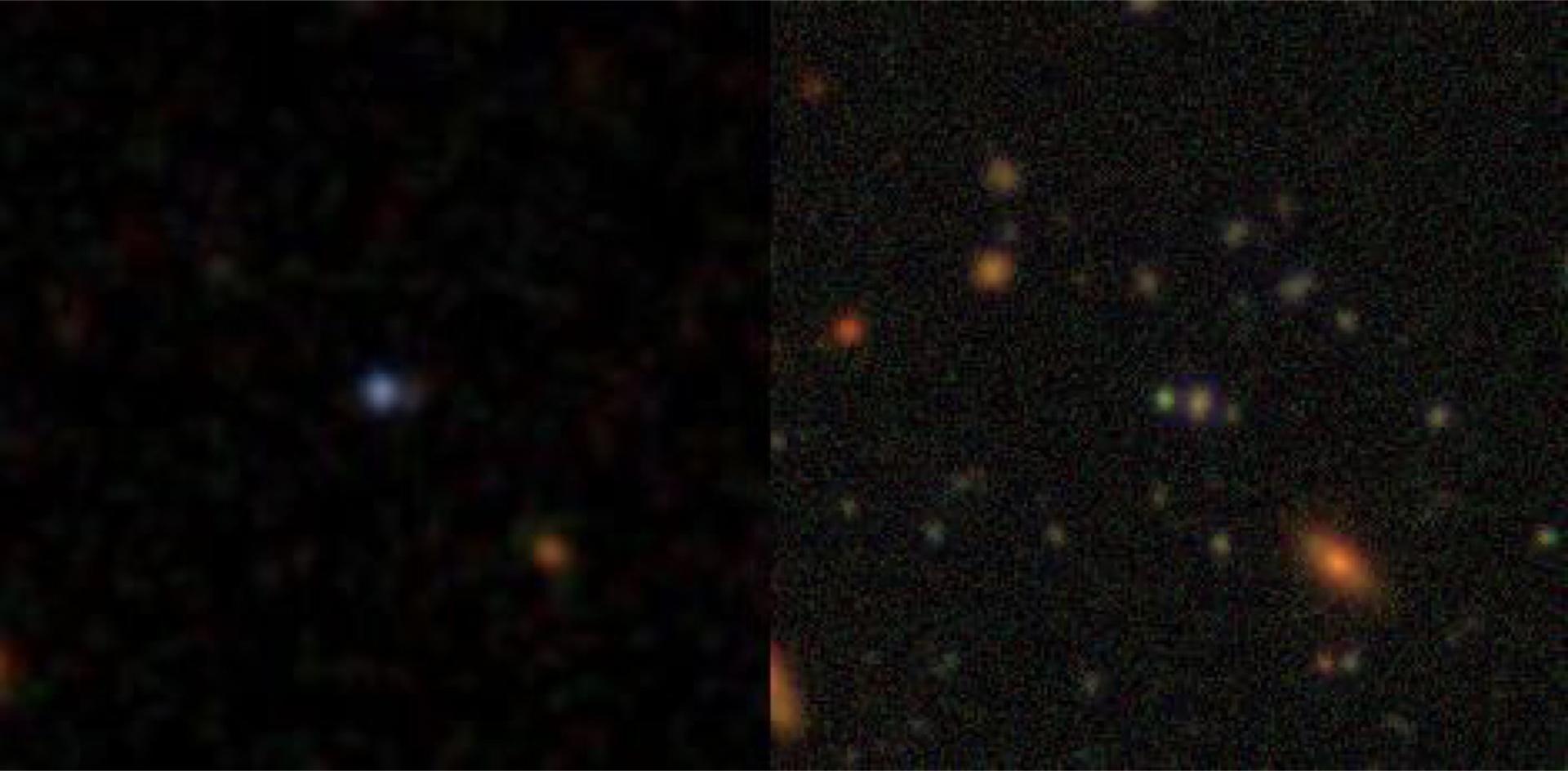
Figure 1: Visible-light images of the galaxy J0218−0036 (redshift 1.8; about 10 billion light-years away), indicated by the yellow arrows. The image on the left was taken by the Sloan Digital Sky Survey (SDSS), and the image on the right by Hyper Suprime-Cam (HSC) on the Subaru Telescope. Because HSC has higher sensitivity than SDSS, many additional faint objects are visible in the HSC image. Comparing the brightnesses in the two images shows that the galaxy faded dramatically between about 2002 (SDSS) and 2018 (HSC). An image without the arrows is available here. (Credit: SDSS, HSC-SSP/NAOJ )
A Sudden Decline in Supermassive Black Hole Activity
Most galaxies host at their centers a supermassive black hole, with a mass hundreds of millions of times that of the Sun. In some cases, surrounding gas is pulled inward by the black hole’s strong gravity. As the gas spirals toward the black hole, it forms a structure known as an accretion disk. Friction in the disk heats the gas to extremely high temperatures, producing enormous amounts of energy. As a result, the center of the galaxy shines very brightly (Figure 2, left). Such luminous regions are known as active galactic nuclei (AGN).
However, if the flow of gas into the accretion disk weakens for some reason, the emitted radiation decreases and the galactic center becomes dimmer (Figure 2, right). The new observations suggest that this galaxy has entered exactly such a phase — one in which the activity of its central black hole has rapidly declined.
Survey Data Reveal Dramatic Fading
The international team—including researchers from the Chiba Institute of Technology, University of Potsdam (Germany), University of Toyama, Instituto de Astrofísica de Canarias (Spain), the National Astronomical Observatory of Japan, and Ritsumeikan University—compared images from the Sloan Digital Sky Survey (SDSS) with those from Hyper Suprime-Cam (HSC) on the Subaru Telescope. They found that the galaxy’s apparent brightness decreased to about one-twentieth of its original level over roughly 20 years (Figure 1). AGN typically vary in brightness by about 30%, so a decline of this magnitude is extremely rare. The team immediately carried out follow-up observations with the Gran Telescopio Canarias (GTC) and launched a comprehensive investigation of the object.
They carried out new optical and near-infrared observations with the Subaru Telescope and W. M. Keck Observatory, as well as radio observations. In addition, they analyzed archival X-ray and infrared data, along with photographic plates taken about 70 years ago, combining information across many wavelengths and time periods (Note 1).
Running Out of Fuel
By comparing the observed changes in optical and infrared brightness with theoretical models, the researchers estimated that the mass accretion rate—the rate at which gas flows from the accretion disk into the black hole—dropped to about one-fiftieth of its previous level in only about seven years (Notes 2 and 3). This suggests that the supply of material feeding the black hole may be rapidly shutting down.
One alternative explanation was that a cloud of dust in front of the accretion disk temporarily blocked the light. However, this possibility was ruled out because it cannot explain the observed changes across the wide range of wavelengths from optical to infrared. Instead, the results indicate that the physical state of the accretion disk itself likely changed dramatically (Figure 2). Exactly what mechanism could cause such a rapid change remains unclear, and further observations and theoretical studies will be needed to understand it.
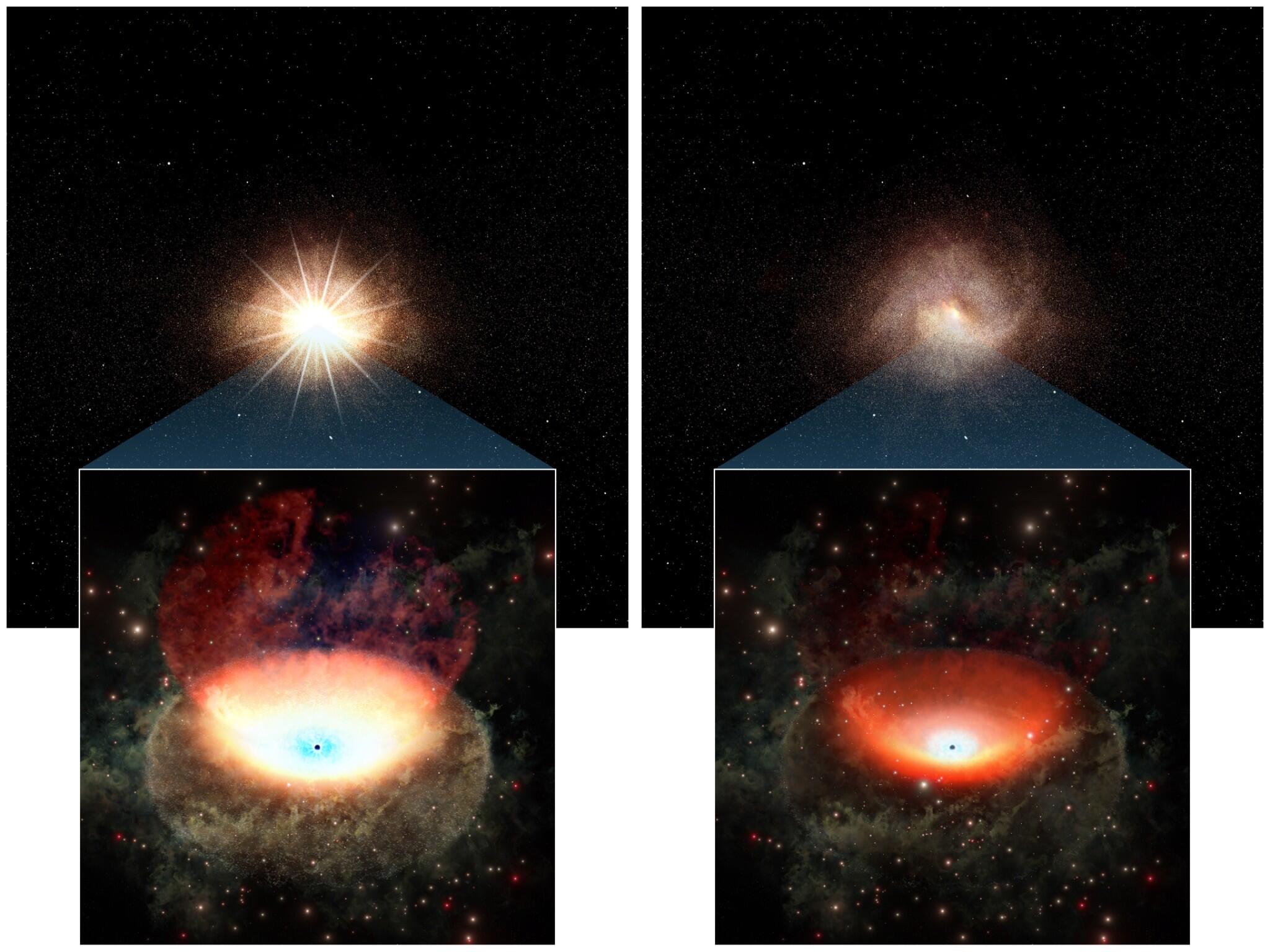
Figure 2: Artist’s impression of an active galactic nucleus during a bright phase (left) and a dim phase (right). The upper panels show the entire galaxy, while the lower panels zoom in on the central region. In the bright phase, the accretion disk around the supermassive black hole (the dark region at the center) and a thick, donut-shaped ring of gas and dust glow brightly. When the flow of gas into the black hole decreases, the central region becomes much dimmer. (Credit: Chiba Institute of Technology)
Faster Than Expected: Rethinking Accretion Models
This discovery shows that the activity of supermassive black holes in galactic centers can change dramatically on timescales of only a few years to a few decades—short enough to be observed within a human lifetime. Until now, mass accretion onto supermassive black holes in AGN was generally thought to vary slowly over tens of thousands of years or longer. The new result challenges this long-standing view.
Tomoki Morokuma, Principal Staff Scientist at the Astronomy Research Center, Chiba Institute of Technology, who led the study, says:
"It is fascinating that an active galactic nucleus can change its brightness so dramatically over such a short period of time, and that this fading appears to be caused by a large change in the accretion rate onto the supermassive black hole. Using wide-field survey data, such as those from Hyper Suprime-Cam, we hope to discover more objects like this and learn how the activity of supermassive black holes shuts down and restarts."
Co-author Toshihiro Kawaguchi of the University of Toyama, who worked mainly on the theoretical interpretation, adds:
"This object shows rapid variability that cannot be explained by standard models. It provides an important test case for developing new theoretical models. We will investigate what physical conditions could reproduce the observed behavior."
The Power of Wide-Field Surveys
Wide-field surveys, which efficiently observe large numbers of objects across wide areas of the sky, have become a major trend in modern astronomy. This study demonstrates that combining data from different wavelengths and different epochs can reveal long-term changes in the activity of supermassive black holes. If many more "fading" or dormant active galactic nuclei are discovered in future wide-field imaging surveys, they could provide important clues to understanding how galaxies and their central black holes evolve together.
These results were published in Publications of the Astronomical Society of Japan (PASJ) on November 4, 2025 (Morokuma et al., "A possible shutting-down event of mass accretion in an active galactic nucleus at z ∼ 1.8"). The images including Figure 1 in this article were also featured on the cover of the Dcember 2025 issue of PASJ.
This work was supported by JSPS KAKENHI Grant Numbers 16H01088, 17K05389, 20H00179, 21H00066, 22H01266, 23K22537, 23K25913, 24K00684, 24H00027, and 25K07370, as well as by the Yamada Science Foundation and the Sumitomo Foundation (Grant Number 2200605).
(Note 1) Active galactic nuclei emit radiation across a wide range of wavelengths—including optical, infrared, and X-ray—which originate from different regions such as the accretion disk, surrounding dust, and hot corona.
(Note 2) Although the observations span about 20 years, the effect of cosmic time dilation means that this corresponds to about 7 years in the rest frame of the galaxy at redshift 1.8.
(Note 3) The observed brightness includes light from both the active galactic nucleus and the host galaxy. By analyzing multi-epoch, multiwavelength data from optical to infrared, the researchers were able to separate these components and show that the AGN itself faded by a factor of about 50.
The Subaru Telescope is a large optical-infrared telescope operated by the National Astronomical Observatory of Japan, National Institutes of Natural Sciences with the support of the MEXT Project to Promote Large Scientific Frontiers. We are honored and grateful for the opportunity of observing the Universe from Maunakea, which has cultural, historical, and natural significance in Hawai`i.
 Guidelines for Use