The discovery of two remarkable substellar companions orbiting distant stars has been announced by an international team of astronomers using the Subaru Telescope’s sharp adaptive-optics imaging together with precision stellar measurements from space-based astrometry. This discovery is the first results from OASIS (Observing Accelerators with SCExAO Imaging Survey) program, which aims to find and characterize massive planets and brown dwarfs.
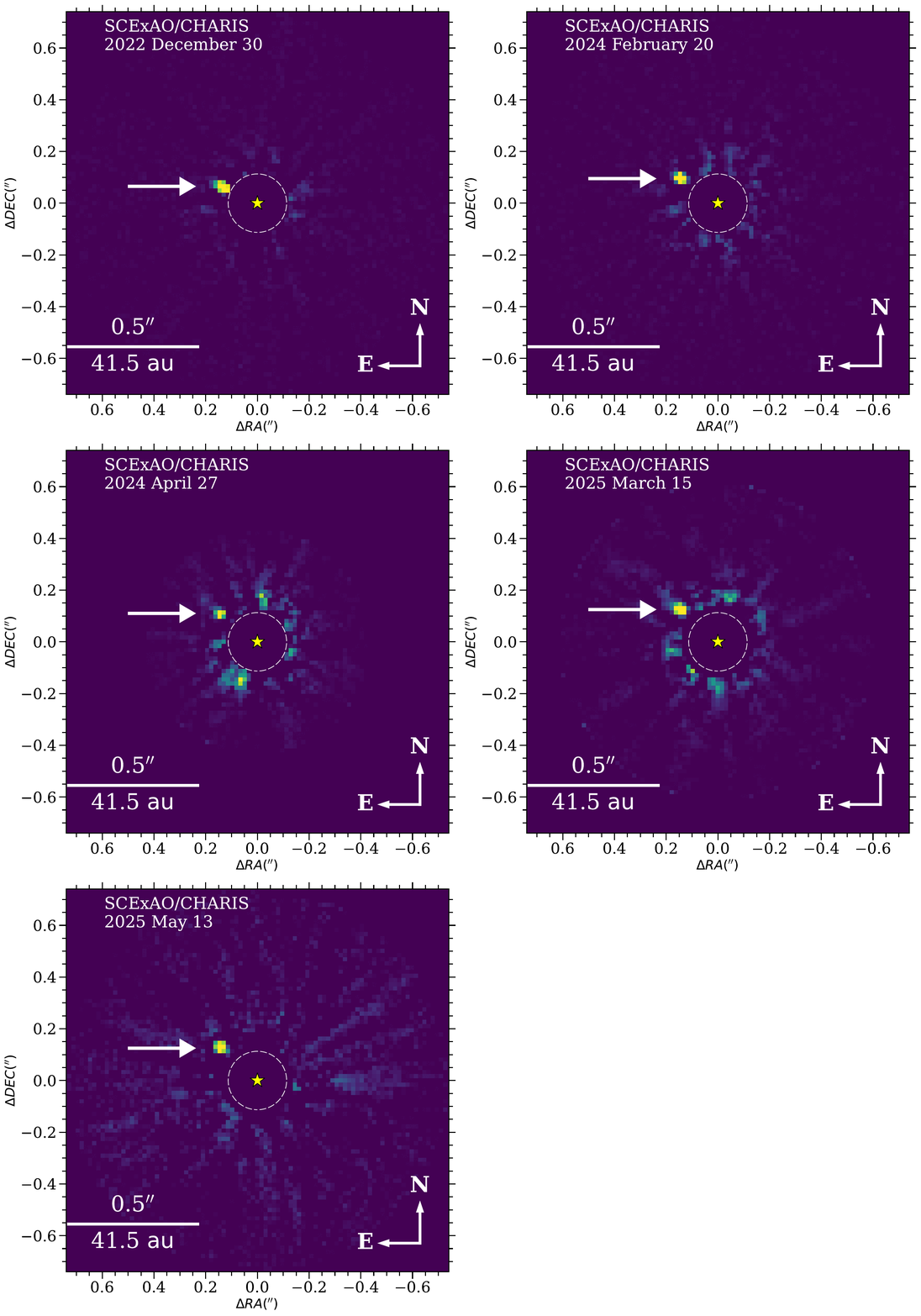


Figure 1: Time lapse movie of the Subaru Telescope images which led to the discovery of HIP 54515 b (indicated by the arrow). The planet’s host star has been blocked in this image. The star’s position is indicated by the star mark. The dotted line shows the outline of the mask used to block the star. High resolution images taken on December 30 2022 and February 20 2024 are available from the links. (Credit: T. Currie/Subaru Telescope, UTSA)
Only about 1% of stars host massive planets and brown dwarfs that can be photographed directly with current telescopes. Even in young planetary systems where these objects are still glowing hot with the energy of having just been formed, making them brighter and easier to detect, they are still much fainter than their host stars and are easily lost in the stellar glare. The key question for astronomers has been: where to look for these objects?
That is where OASIS comes in. The program uses measurements from two European Space Agency missions—Hipparcos and Gaia—to identify stars being tugged by the gravity of unseen companions. OASIS then targets these promising candidates with the Subaru Coronagraphic Extreme Adaptive Optics (SCExAO) system, which provides the exceptional precision and advanced technology needed to actually photograph these hidden companions.
"With OASIS, we are able to find, weigh, and track the orbits of massive planets and brown dwarfs around stars we never thought of looking at before," says OASIS Principal Investigator (PI), Thayne Currie at The University of Texas at San Antonio (UTSA).
The first discovery, HIP 54515 b, is a gas giant planet with a mass just under 18 times that of Jupiter, orbiting a star twice the mass of the Sun.
HIP 54515 b orbits its star at approximately 25 astronomical units (au). This is roughly the same distance as between Neptune and the Sun.
Because the planetary system is so distant—about 275 light-years from Earth—HIP 54515 b appears extremely close to its star in the sky, pushing the limits of current direct imaging technology.
"HIP 54515 b was imaged about 0.15 arc-seconds from its star. That’s roughly how small a baseball would appear from 100 km away, so we needed extremely sharp images enabled by Maunakea and SCExAO’s advanced technology," says Currie.
HIP 54515 b adds to a growing trend of superjovian planets whose orbits are slightly less circular than those of lower-mass Jupiter-like planets. This may suggest that these planets have slightly different formation histories than the gas giants in our Solar System.

The second discovery, HIP 71618 B, also orbits a two-solar-mass star but is a brown dwarf, a type of object that forms like a star but lacks sufficient mass to be a true star. HIP 71618 B is about 60 times as massive as Jupiter, orbits its star at an average distance slightly larger than Saturn’s orbit around the Sun, and follows a highly elongated, elliptical orbit. In addition to astrometry and SCExAO imaging, W. M. Keck Observatory imaging data were crucial to its discovery.
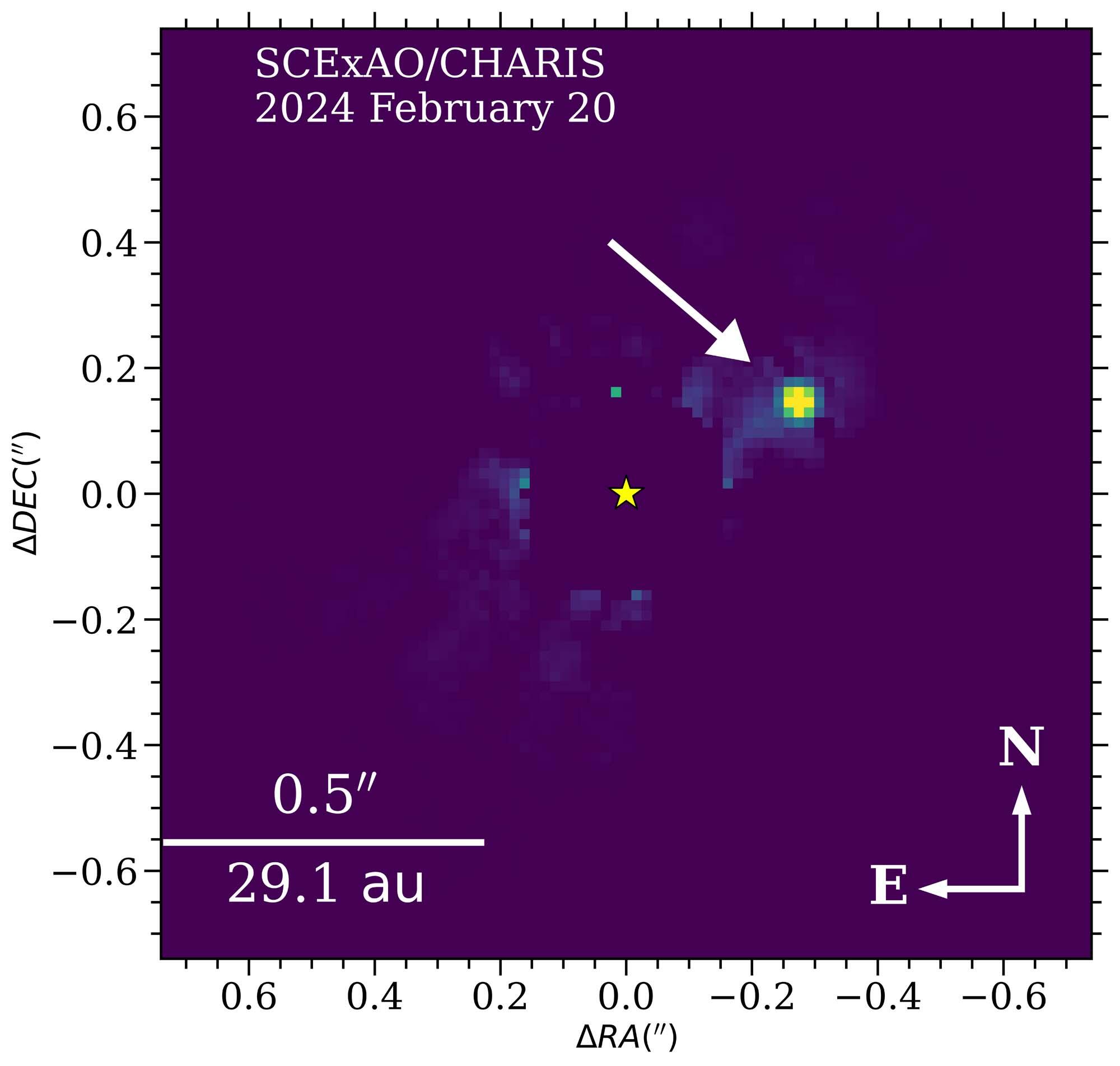
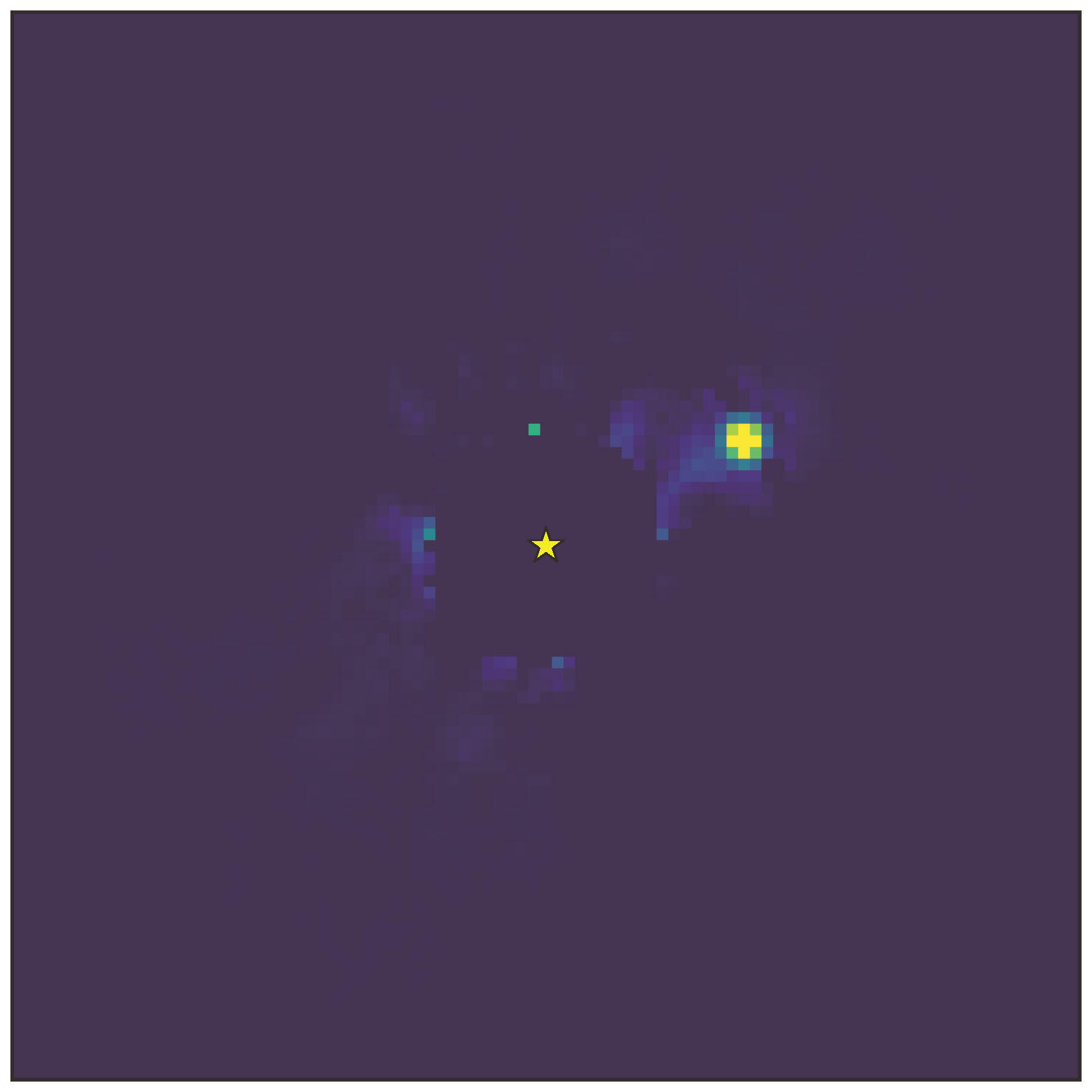
Figure 2: Image of HIP 71618 B (indicated by the arrow) taken by the Subaru Telescope. The planet’s host star has been blocked in this image. The star’s position is indicated by the star mark. The high resolution image and the image without text are available from the links. (Credit: T. Currie/Subaru Telescope, UTSA)
While not a planet itself, HIP 71618 B may play an important role in future searches for Earth-like planets around other stars. This is because it meets the requirements for the Roman Space Telescope’s Coronagraph Instrument technology demonstration, planned for 2027. This experiment will be the first to test advanced planet imaging technologies in a space telescope to suppress the glare of Sun-like stars to see rocky, Earth-like planets ten billion times fainter. The Roman Coronagraph Technology Demonstration has strict requirements for its target stars, and until the discovery of HIP 71618 B, no system was known in the peer-reviewed literature to meet these criteria.
The discoveries of HIP 54515 b and HIP 71618 B showcase how combining space-based precision star-tracking and ground-based direct imaging can reveal planets and brown dwarfs that would otherwise remain hidden. The OASIS program continues to survey dozens of additional candidate systems, with more discoveries expected in the coming years which will deepen our understanding of how planets and brown dwarfs form and how their atmospheres evolve. The discoveries will also contribute to the development of technologies needed to detect habitable, Earth-like worlds in the future.
"Thanks to innovative instruments like SCExAO and Maunakea’s world-leading astronomical observing conditions, Subaru Telescope will continue to be a preeminent observatory even as other telescopes come online, making breakthrough discoveries far into the future," says Dr. Masayuki Kuzuhara (Astrobiology Center), who co-leads OASIS with Currie.
These results appeared in Currie & Li et al. "SCExAO/CHARIS and Gaia Direct Imaging and Astrometric Discovery of a Superjovian Planet 3–4 λ/D from the Accelerating Star HIP 54515" in the Astronomical Journal on December 3, 2025 and El Morsy et al. "OASIS Survey Direct Imaging and Astrometric Discovery of HIP 71618 B: A Substellar Companion Suitable for the Roman Coronagraph Technology Demonstration" in the Astrophysical Journal Letters on December 3, 2025.
OASIS is an international collaboration involving astronomers from institutions across the United States, Japan, Canada, Chile, and Europe, and is supported by the National Science Foundation for its scientific merit and NASA as Key Strategic Mission Support for the Roman Space Telescope. This research was supported by JSPS KAKENHI (Grant Numbers: 24K07108).
The Subaru Telescope is a large optical-infrared telescope operated by the National Astronomical Observatory of Japan, National Institutes of Natural Sciences with the support of the MEXT Project to Promote Large Scientific Frontiers. We are honored and grateful for the opportunity of observing the Universe from Maunakea, which has cultural, historical, and natural significance in Hawai`i.
 Guidelines for Use