


One of the asteroids discovered through COIAS has recently been named Leilani, the first Hawaiian name assigned to a COIAS discovery. COIAS (Come On! Impacting ASteroids!) is a web-based application that enables anyone to search for Small Solar System Bodies (SSSBs), such as asteroids and comets, in images taken by the Subaru Telescope.

Figure 1: Asteroid (870437) Leilani, discovered through COIAS (Credit: Todd Fisher / NAOJ / COIAS Development Team)
COIAS is a web-based application that allows anyone, even those without prior astronomy experience, to discover and report previously unknown SSSBs using images taken by the Subaru Telescope's Hyper Suprime-Cam (HSC), an ultra-wide-field imaging camera mounted on the prime focus. The vast HSC archive still contains many undiscovered objects, and citizen astronomers around the world continue to search for them together. As of July 2026, more than 3,000 people have participated in COIAS, and the project has contributed to the provisional designation of more than 9,300 SSSBs (Note 1).
Once an asteroid's orbit has been accurately determined through follow-up observations, the discoverer is eligible to propose a name to the International Astronomical Union (IAU). Through the cooperation of the Hyper Suprime-Cam Subaru Strategic Program (HSC-SSP) team, COIAS participants who contributed to the discovery are given the opportunity to participate in proposing names. So far, nine COIAS asteroids have been named after family members, meaningful places, and people admired by their discoverers.
Recently, Todd Fisher from the United States proposed the Hawaiian name "Leilani" for an asteroid he discovered through COIAS, and the IAU approved the name. In Hawaiian, lei means "flower necklace," and lani means "heaven" or "sky," together conveying the meaning "heavenly necklace of flowers."
The name honors Leilani Estates, a community in the southeastern part of Hawaiʻi Island that suffered severe damage during the 2018 Kīlauea volcanic eruption, forcing many residents to evacuate. During the eruption, the homes of Fisher's sister, nieces, and close friends were buried beneath lava.
"Rather than remembering only what was lost, I wanted the asteroid to preserve the memory of the place they loved," says Fisher. "I loved the name Leilani, and I thought it was a beautiful name for an asteroid."
Before submitting the proposal, Fisher consulted his sister, parents, and nieces to make sure they supported the idea. "It was important to me to get their feedback before naming something," he recalls.
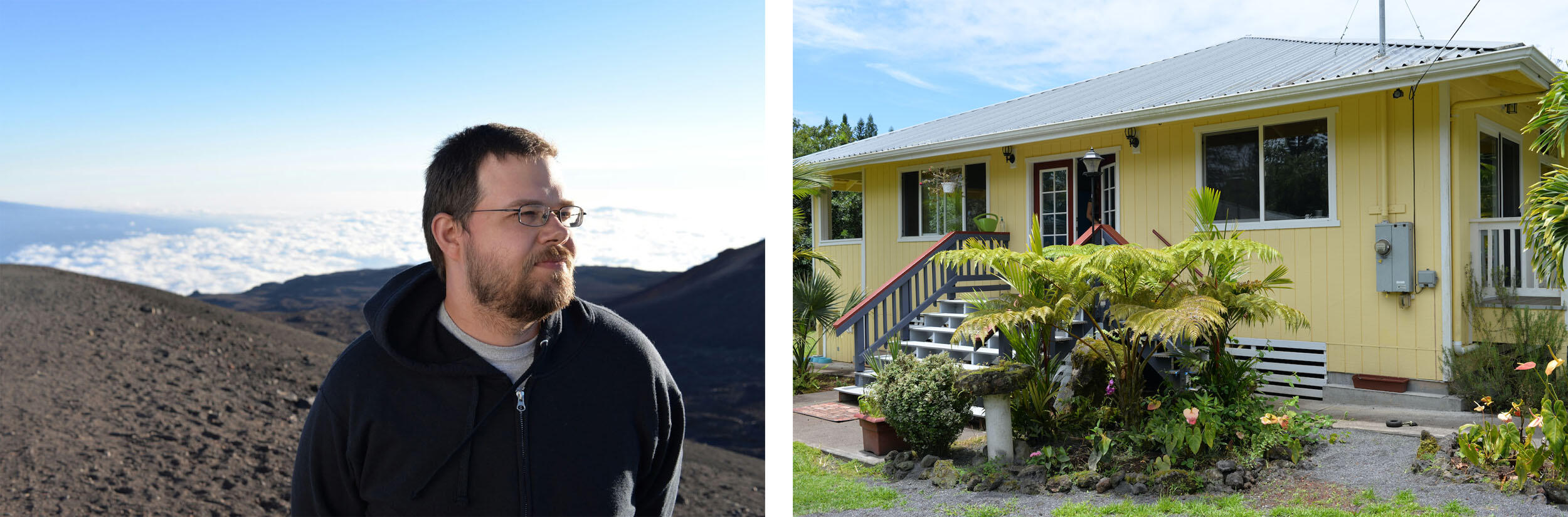
Figure 2: (left) Todd Fisher and (right) Fisher's sister’s home and her family in Leilani Estates before it was buried by lava during the 2018 Kīlauea eruption. (Credit: Kevin Fisher)
The COIAS Development Team is responsible for submitting naming proposals to the IAU. "Because the proposed name was derived from Hawaiian place names and culture, we took particular care to ensure that its spelling and meaning were represented accurately. Since all members of our team are based in Japan, we are especially careful to avoid misunderstandings or inaccuracies when writing about cultures other than our own," explains Kenichi Ito, a COIAS Development Team member. "It was immensely helpful that Fisher carefully reviewed the draft and consulted members of the local community. We also received valuable advice from a Subaru Telescope staff member regarding the meaning and usage of Hawaiian language expressions."
Ito also emphasizes the significance of the naming, "For some time, the COIAS Development Team has hoped to give one of its discoveries a Hawaiian name as a way of expressing our gratitude to Hawaiʻi and the Subaru Telescope, which have made so many asteroid discoveries possible. Leilani is not only the first Hawaiian-language name given to a COIAS asteroid, but also a tribute to the deep connection between Fisher's family and the Leilani Estates community."
Over the past three years, Fisher has examined thousands of archival HSC images through COIAS and, together with volunteers around the world, has contributed to the discovery of numerous asteroids.
Fisher emphasized the importance of collaboration, "I've probably measured thousands of different minor planets, but this is the first one I've personally discovered. However, this discovery was only possible because of many collaborators who helped confirm it, including fellow volunteers, professional astronomers, and major sky surveys that provided additional observations needed to establish the asteroid's orbit."
COIAS gives people around the world the opportunity not only to discover new celestial objects, but also to help name them. The story of Leilani shows that asteroid names can carry more than scientific significance—they can also preserve memories of places, communities, and the people connected to them. In this way, the search for asteroids not only advances our understanding of the Solar System but also helps carry human stories into the future.
Acknowledgments: The online interview with Todd Fisher was conducted in collaboration with Zoë Callahan from Pa‘akai Communications. The full interview with Fisher is published as a Story article on the Maunakea Observatories website.
(Note 1) When a SSSB, such as an asteroid, is discovered, the discovery is reported to the Minor Planet Center, operated by the IAU. If the object's existence is confirmed through follow-up observations conducted on multiple nights, the IAU assigns it a provisional designation (a temporary identifier). Once continued observations over a longer period allow the object's orbit to be determined with sufficient accuracy, it is assigned a permanent number. Only after a permanent number has been assigned can a naming proposal be submitted to the IAU.
 Guidelines for Use