


This summer, Subaru Telescope will welcome a new near-infrared spectrograph, NINJA, for its first on-sky engineering observations. NINJA is a new spectrograph designed for time-critical observations of rapidly evolving cosmic events, such as the electromagnetic counterparts of gravitational-wave sources.
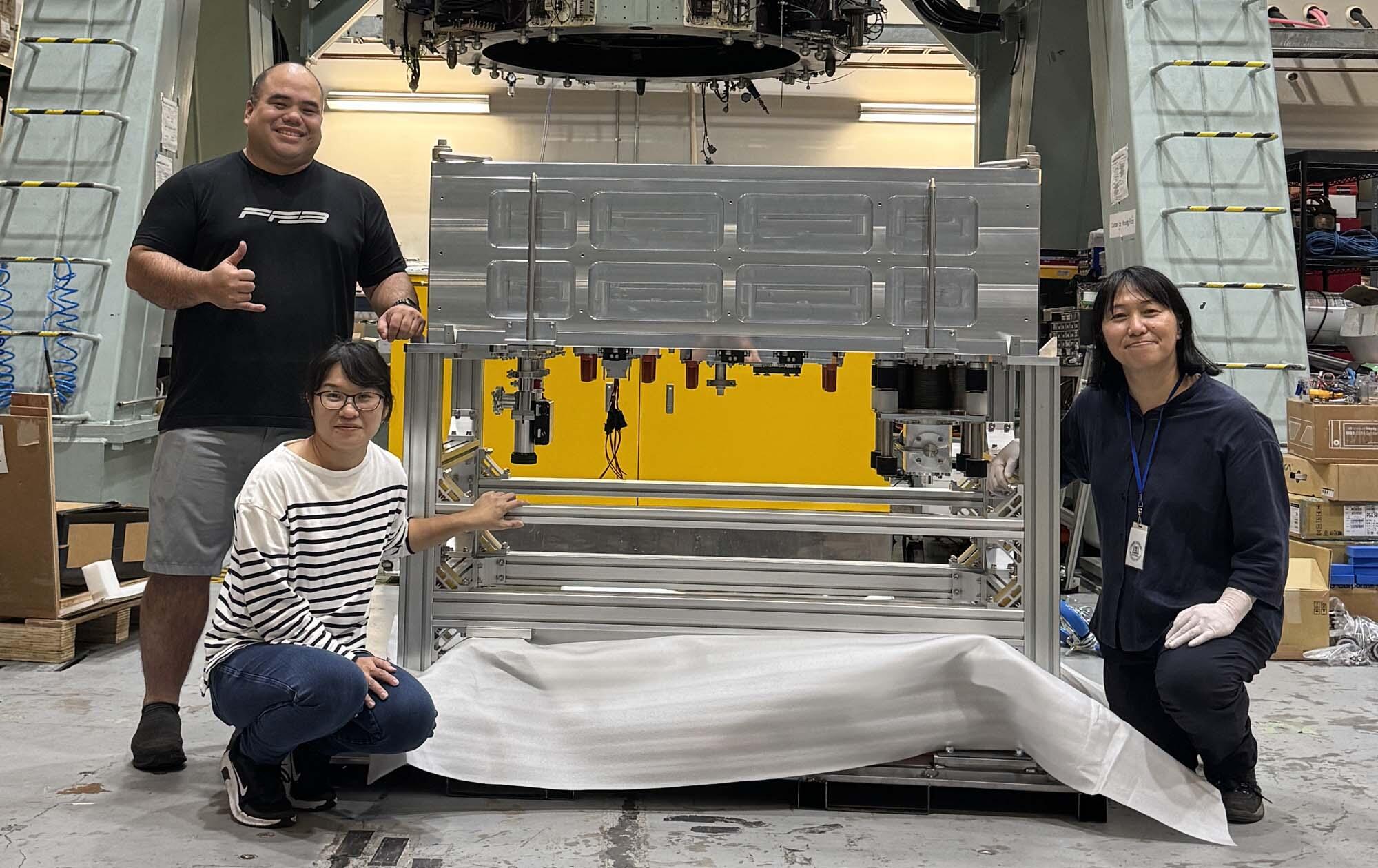
Figure 1: NINJA at the Subaru Telescope Hilo Base Facility in Hawai`i, together with Matthew Wung (left) of the Subaru Telescope Instrumentation and Engineering Division and NINJA team members Dr. Kumiko Morihana (Subaru Telescope; center) and Dr. Chihiro Tokoku (NAOJ Advanced Technology Center; right). (Credit: NAOJ)
Gravitational-wave astronomy has opened a new window on rapidly evolving cosmic events, including neutron star mergers. These transient phenomena change dramatically within days of discovery and fade quickly. Obtaining spectroscopic data as soon as possible is essential for understanding the physics of the merger process and for investigating how heavy elements such as gold and platinum are produced in the Universe.
NINJA (Near-INfrared and optical Joint spectrograph with Adaptive optics) is specifically designed for such time-critical observations, combining three key strengths: rapid response, high efficiency, and high sensitivity.
Rapid Response: Since NINJA will be installed at the Nasmyth focus of the Subaru Telescope, observations can begin immediately without requiring time to change the instruments.
High Efficiency: NINJA delivers simultaneous spectral coverage from 0.85 to 2.5 micrometers in a single exposure. It is the first spectrograph at Subaru Telescope to cover this entire wavelength range at once.
High Sensitivity: When used with the Subaru Telescope's adaptive optics system, which compensates for image degradation caused by atmospheric turbulence, NINJA can observe significantly fainter targets with enhanced sensitivity.
By combining these three strengths, NINJA is expected to make significant contributions not only to the study of transient phenomena such as gravitational-wave counterparts, but also in observations of distant galaxies in the early Universe.
Following the successful completion of instrument-level testing at the Advanced Technology Center (ATC) of the National Astronomical Observatory of Japan (NAOJ) headquarters in Mitaka, NINJA was shipped to Hawai`i in February 2026. This summer, the instrument will take the next step toward scientific operations with its first engineering observations on the Subaru Telescope.
Three graduate students from Waseda University and the University of Tokyo have played central roles in the development of NINJA. They have worked on key technologies that directly affect the instrument's performance, including the precise target acquisition, the control of the cryogenic opto-mechanical systems, and the low-noise readout of extremely faint signals from the infrared detector.
In March 2026, Riku Sato, a Ph.D. student in the Graduate School of Advanced Science and Engineering at Waseda University, conducted post-shipment functional tests of NINJA at the Subaru Telescope Hilo Base Facility. Since NINJA was shipped from Mitaka to Hilo as a fully assembled instrument, complete with its optics, detector, and electrical wiring, these tests were essential to verify that the instrument had not been damaged during transport and was performing as expected.
Sato reflects on the experience:
“It was exciting to watch the instrument gradually take shape at ATC. When we shipped it from Japan, it still didn’t quite feel real that it was actually on its way to Hawai`i. But coming here myself and seeing the instrument after its safe arrival was a very moving experience. I’m looking forward to using NINJA for observations of distant galaxies and other astronomical targets.”
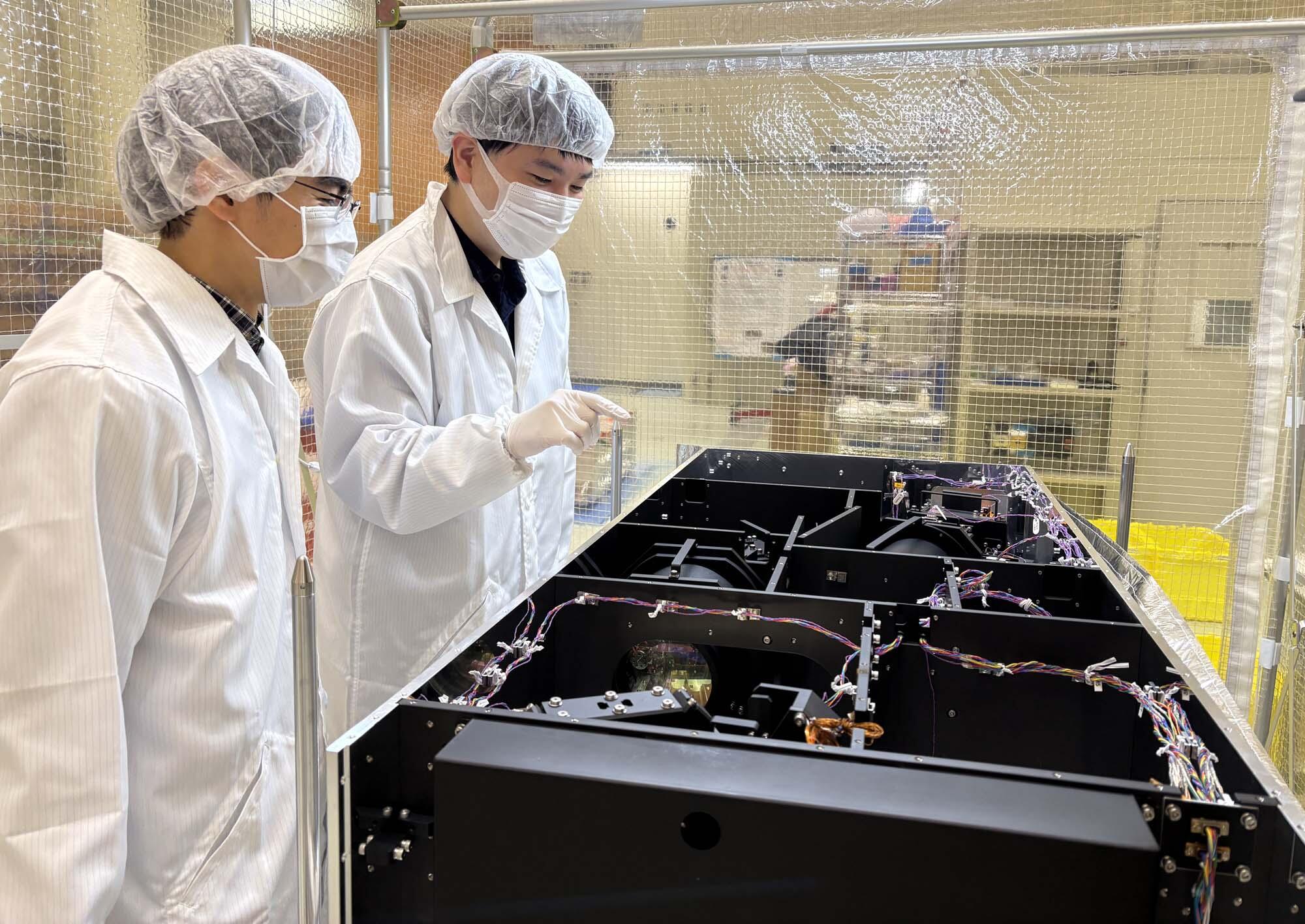
Figure 2: Inspecting the interior of NINJA at the NAOJ Advanced Technology Center before its shipment to Hawai`i: Dr. Takashi Moriya (left) of the NAOJ Division of Science and Riku Sato (center). (Credit: NAOJ)
Sato is currently working on software that will enable NINJA to be operated through the Subaru Telescope’s control system in preparation for the instrument's first observations. Establishing this interface between the telescope and the spectrograph is a key step toward on-sky operation. We look forward to NINJA's future contributions to astronomical research.
The development of NINJA has been supported by JSPS KAKENHI Grant Number JP21H04997, “Study of r-process nucleosynthesis of gravitational wave sources by means of high sensitivity wide-band near infrared spectroscopy.”
The development and testing of NINJA have been conducted in collaboration with the Advanced Technology Center of the National Astronomical Observatory of Japan (NAOJ), making use of its facilities and technical expertise. The integration of NINJA into the Subaru Telescope has been supported by many staff members at Subaru Telescope, who assisted throughout the transportation, integration, and installation process.
Maunakea is a place of profound cultural and spiritual significance to Native Hawaiian and local communities. We are privileged to conduct astronomical research from this mountain and express our gratitude to the communities whose stewardship and support make such work possible. We are committed to carrying out our research with respect for the natural environment and the cultural heritage of Hawai`i.
 Guidelines for Use