Observations with the Euclid Space Telescope and ground-based facilities, including the Subaru Telescope, have led to the discovery of 31 quasars in the early Universe, powered by supermassive black holes. Among them, two objects broke the previous record for the most distant—and therefore earliest—quasars ever observed. Imaging data from the Subaru Telescope’s wide-field camera also contributed to this discovery.
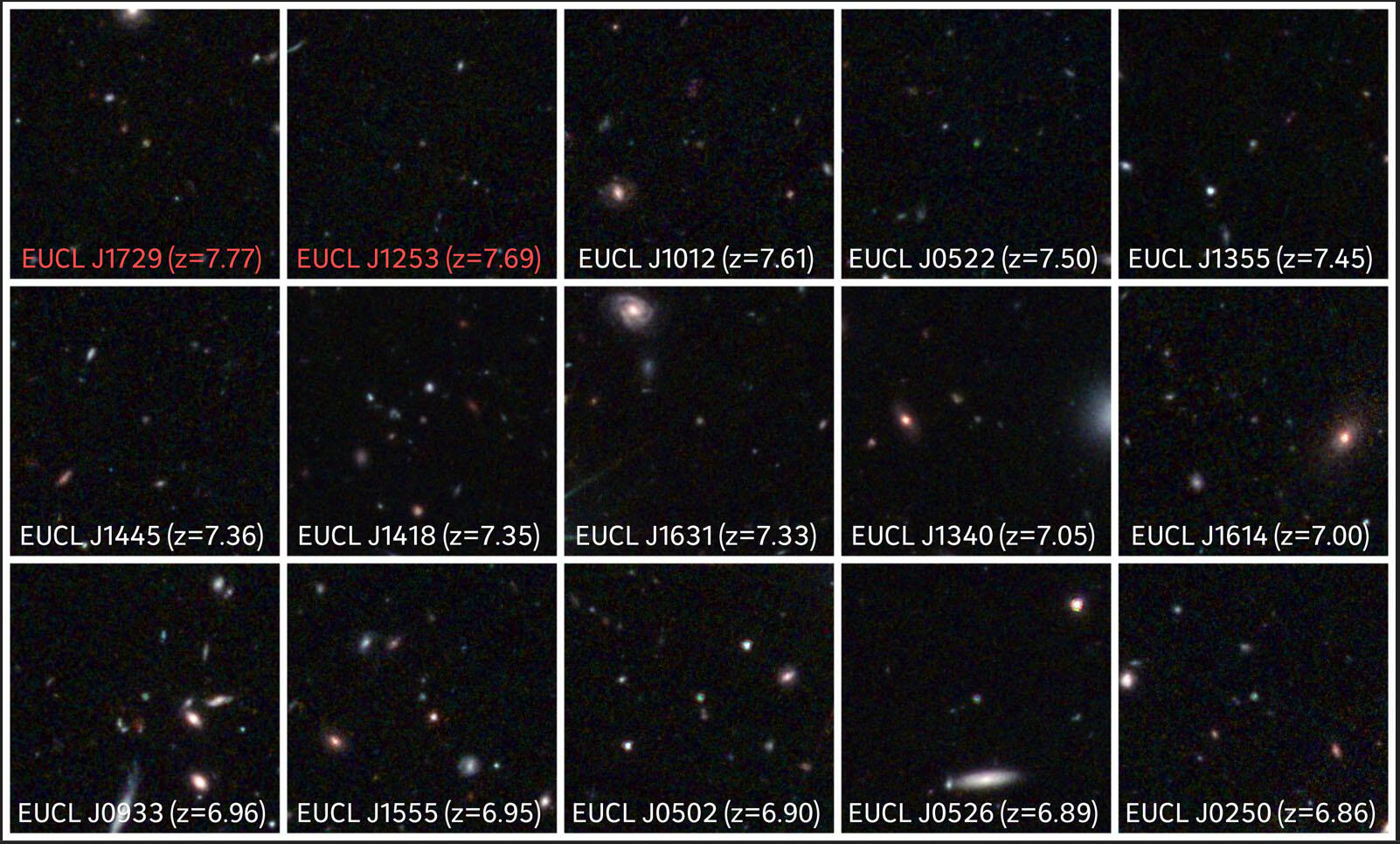
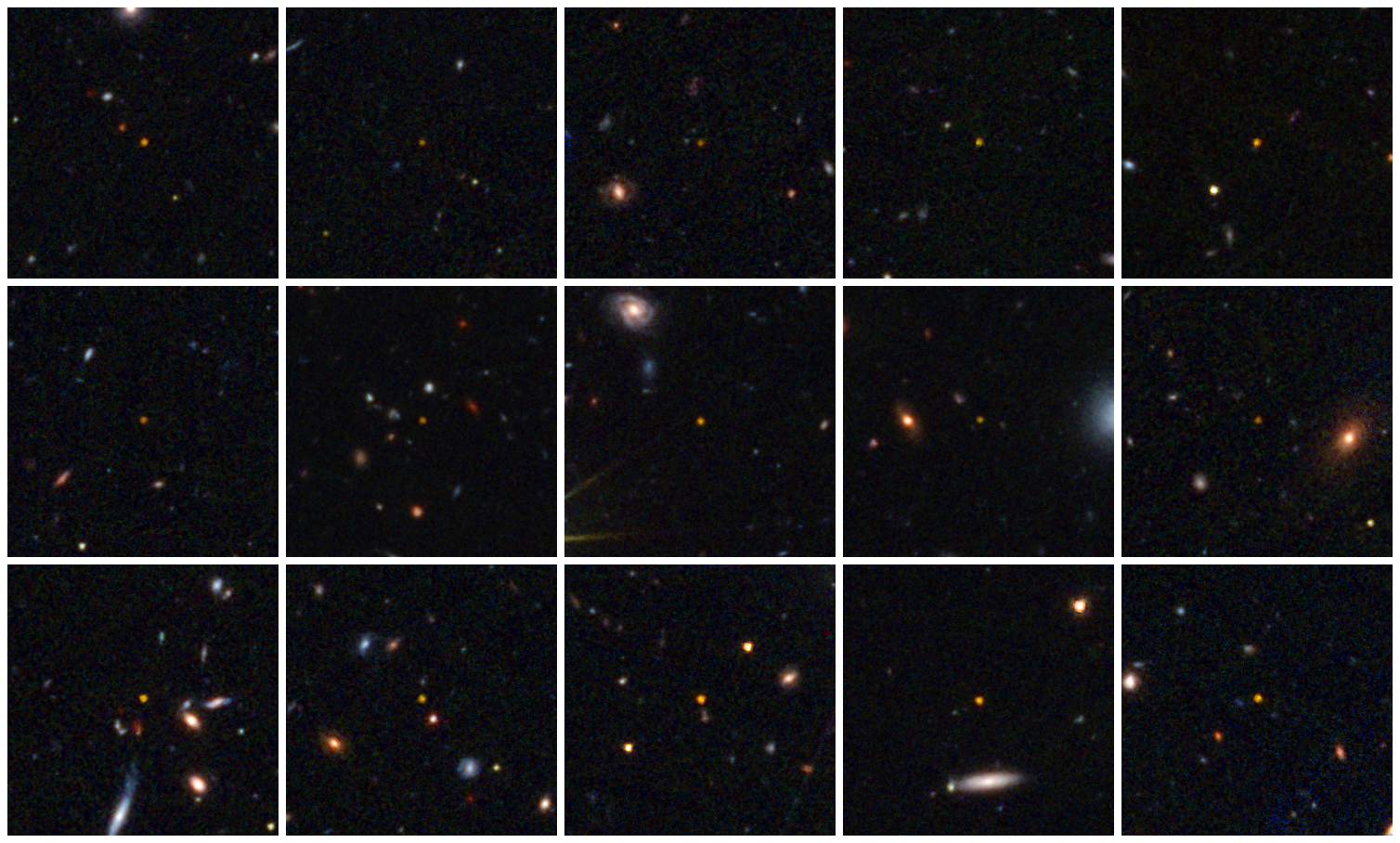
Figure 1: Images of 15 of the 31 newly discovered quasars. They appear as small dots at the center of each image. The two objects marked in red broke the previous record for distance. A version of the image without text is available here (2.5 MB). (Credit: ESA/Euclid/Euclid Consortium/NASA, image processing by the Euclid Science Ground Segment and Antoine Basset (CNES))
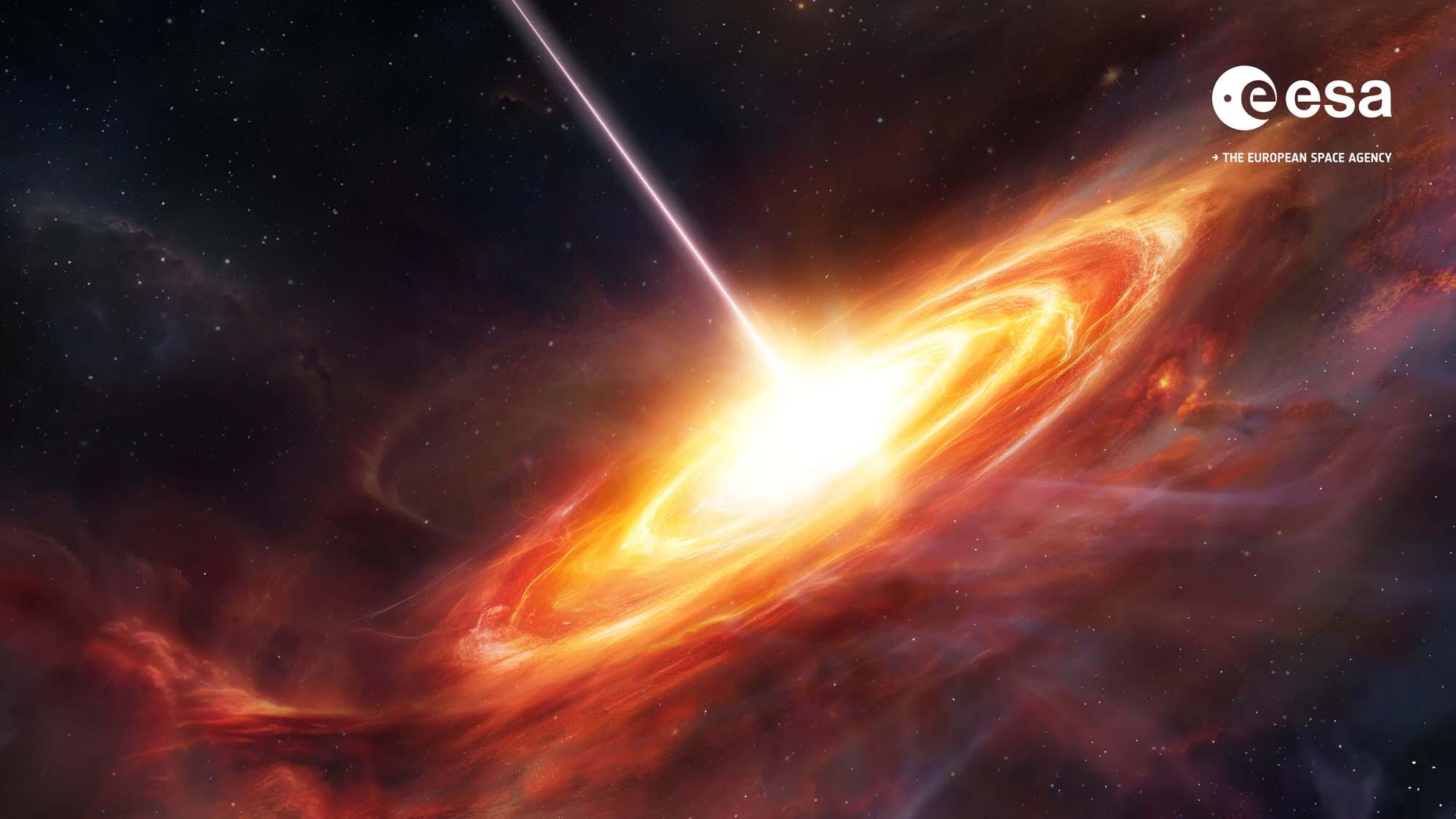
Quasars are extremely luminous objects powered by supermassive black holes at the centers of galaxies. As matter falls onto these black holes, enormous energy is released, producing intense light. A quasar’s brightness can far exceed that of its host galaxy, making quasars important beacons for studying the early Universe (Figure 2).
Quasars in the early Universe act as "time machines," revealing what the Universe was like in its infancy. By studying them, astronomers can gain insight into how the first galaxies and supermassive black holes formed and grew. They are key to understanding how the Universe evolved into its present form.
Astronomers have been searching for quasars in the early Universe for decades. Over the past decade, searches with the Subaru Telescope have identified about two hundred early quasars, especially faint ones. However, at the most distant epoch, more than 13 billion light-years away (beyond redshift 7), the number of known quasars has remained too small to reveal the overall population.
This situation has changed dramatically with the Euclid mission by the European Space Agency (ESA). Launched in 2023, Euclid combines a wide field of view with high sensitivity, enabling it to detect quasars 10 to 100 times fainter than those found in previous wide-field surveys.
Until now, only nine quasars with redshifts greater than 7 were known—but this discovery adds 12 more. Among them, EUCL J172902.75+641018.1 (redshift 7.77) and EUCL J125308.55+705432.3 (redshift 7.69) are the most distant quasars ever found, located over 13 billion light-years away and dating back to just 670 million years after the Big Bang.
This major discovery also leveraged optical imaging data obtained from Hyper Suprime-Cam (HSC) on the Subaru Telescope. Masafusa Onoue (Waseda University), also a member of the international Euclid team, explains, "To fully exploit Euclid’s excellent infrared data, it is essential to combine it with optical observations at shorter wavelengths. In particular, when you search for quasars in the early Universe, you need to identify objects that are bright in the infrared but fade sharply in the optical light. The HSC data were used to narrow down the candidate objects, making a significant contribution to selecting the two quasars that set the new distance record."
Together with other telescopes on Maunakea, the Subaru Telescope supports the Euclid mission by providing observations of the northern sky. The discovery of many distant quasars at this early stage highlights the powerful synergy between Euclid and ground-based observatories.
Euclid, launched in July 2023 and beginning routine survey operations in February 2024, aims to map billions of galaxies and reveal the three-dimensional large-scale structure of the Universe. The current results are based on just one and a half years of data and mark only the beginning (Figure 3). Over its six-year survey, Euclid is expected to discover hundreds of quasars in the early Universe, elucidating how galaxies and supermassive black holes formed and evolved.
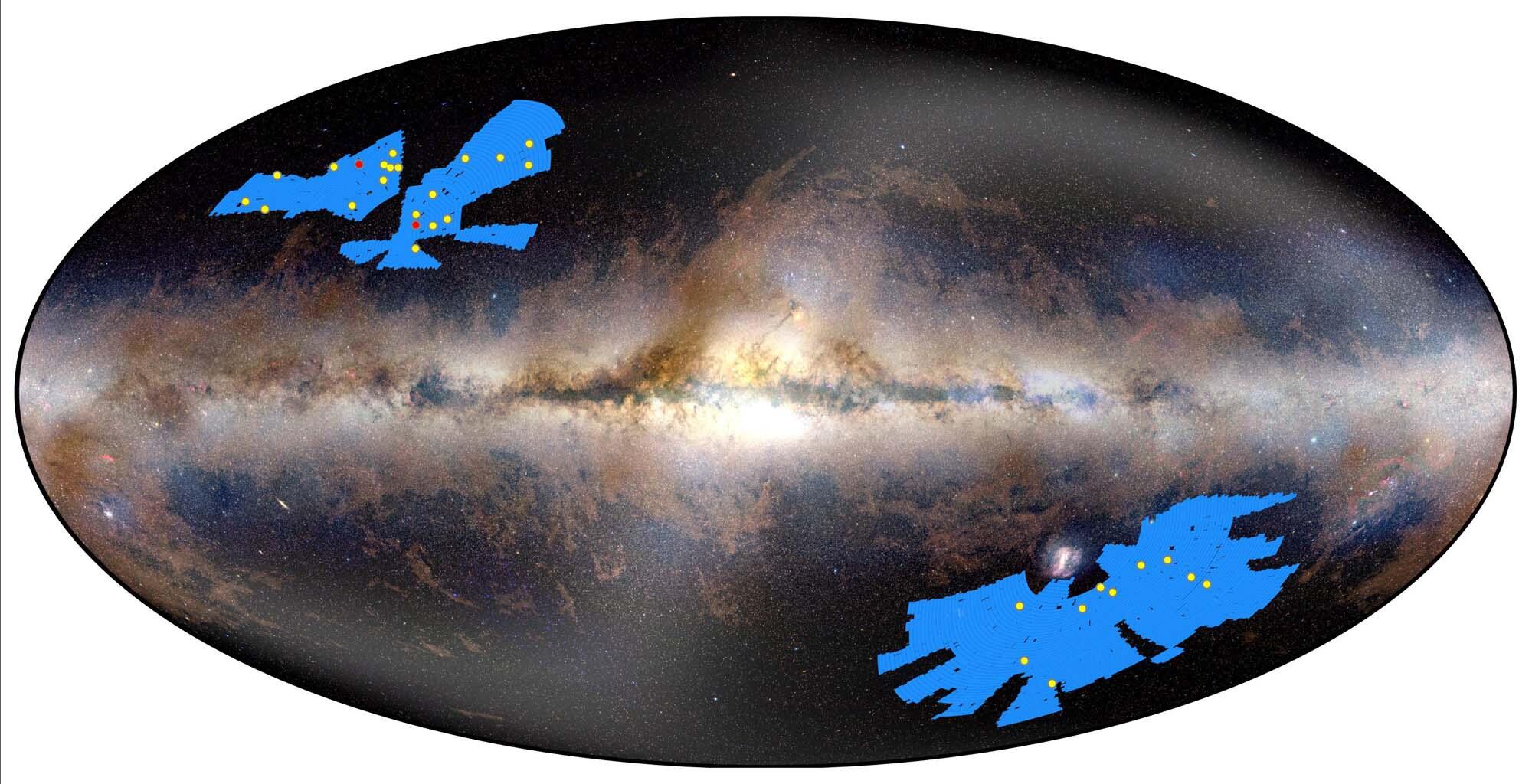
Figure 3: Survey area covered in this study (blue) and the locations of the 31 newly discovered quasars (yellow and red points). The red points indicate the two quasars that broke the previous distance record. Euclid will ultimately survey about one-third of the entire sky. (Credit: ESA/Euclid/Euclid Consortium/NASA/Planck Collaboration/A. Mellinger; Acknowledgment: Jean-Charles Cuillandre, João Dinis)
"Even with previous observations, it has remained a major mystery how supermassive black holes with masses of a billion times that of the Sun could form and grow so rapidly in the early Universe. With this new distance record, that mystery has become even more pronounced," adds Onoue.
Yoshiki Matsuoka (Ehime University), also a member of the discovery team and a longtime leader in searches for distant quasars with the Subaru Telescope, says, "It is remarkable that Euclid has reached, in such a short time, beyond what has been achieved through decades of ground-based surveys. Future observations will undoubtedly discover quasars at even greater distances and earlier cosmic times. For this effort, continued follow-up observations with the Subaru Telescope will remain essential. We look forward to seeing how far back in cosmic history quasars can be found. This will also provide important clues to the origin of supermassive black holes."
These results were published in Astronomy & Astrophysics on July 6, 2026 (Da-Ming Yang et al., "Euclid: Discovery of 31 new quasars at 6.6 < z<7.8").
About the Euclid Consortium:
The Euclid Consortium comprises more than 2,000 members from over 300 institutes in 15 European countries, as well as Canada, Japan, and the United States. Researchers in Japan contribute to Euclid through the WISHES project (Wide Imaging with Subaru HSC of the Euclid Sky), which utilizes Hyper Suprime-Cam on the Subaru Telescope.

About the Subaru Telescope
The Subaru Telescope is a large optical-infrared telescope operated by the National Astronomical Observatory of Japan, National Institutes of Natural Sciences with the support of the MEXT Project to Promote Large Scientific Frontiers. We are honored and grateful for the opportunity of observing the Universe from Maunakea, which has cultural, historical, and natural significance in Hawai`i.
 Guidelines for Use