


Test observations using the next-generation adaptive optics system ULTIMATE-START, developed through collaboration between Tohoku University and the National Astronomical Observatory of Japan (NAOJ), were conducted at the Subaru Telescope in December 2025. By using multiple laser guide stars, the system aims to measure atmospheric turbulence with higher precision and produce much sharper visible-light images from the ground.
Video 1: Laser guide star launch test filmed inside the Subaru Telescope dome. (Credit: NAOJ)
One of the biggest challenges for ground-based astronomical observations is turbulence in Earth’s atmosphere. As starlight passes through the atmosphere, it is distorted by turbulent air—similar to the shimmering effect seen above a hot surface—causing the images of stars to appear blurred. Adaptive optics is a technology designed to correct this problem. It measures atmospheric distortions in real time and rapidly adjusts the shape of a special mirror to cancel them out, allowing telescopes to produce much clearer views of the Universe.
Traditionally, a single artificial laser guide star is created by projecting a laser beam into the upper atmosphere, and the atmospheric turbulence is measured using this as a reference star. However, using only one guide star leaves some regions of the atmosphere poorly measured, limiting how well the distortions can be corrected (Figure 1, left).
A newer technique known as laser tomography adaptive optics creates a constellation of several laser guide stars in the sky and measures their light with multiple wavefront sensors (Figure 2, right). The data are then analyzed using tomography—similar to the technique used in medical CT scans—to reconstruct the distribution of atmospheric turbulence at different altitudes. This makes it possible to apply more optimal corrections and achieve a much higher level of precision than was possible with a single laser guide star.
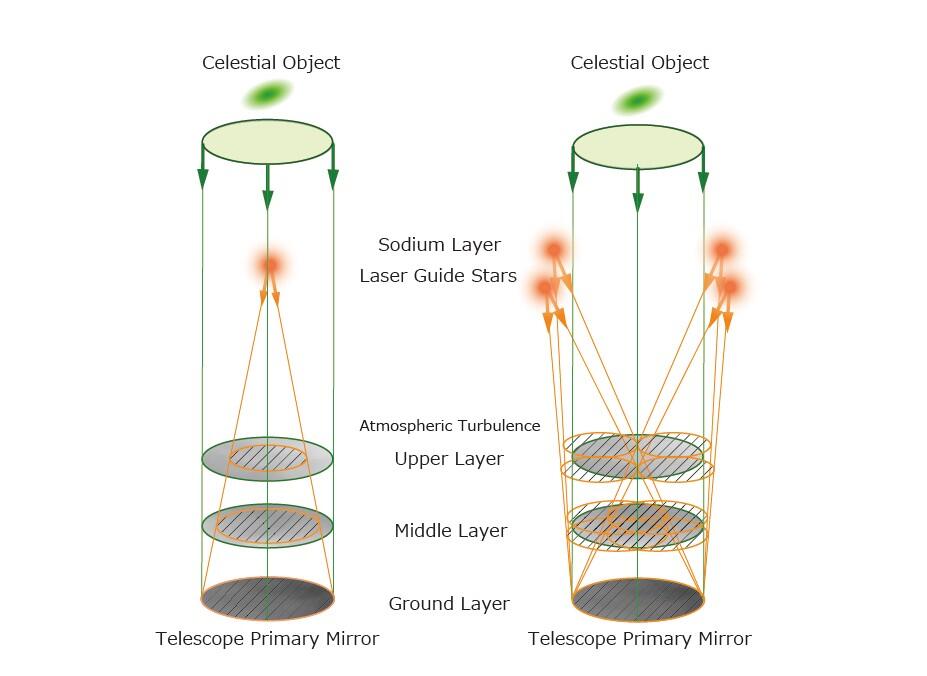
Figure 1: Schematic diagram of atmospheric turbulence correction using laser guide stars. The left panel shows the case with one laser guide star, while the right panel shows laser tomography adaptive optics using four laser guide stars. Green lines represent light from the observed celestial object, and orange lines represent light from laser guide stars created at an altitude of about 90 km. Gray disks represent atmospheric layers through which the starlight passes (upper layer around 10 km, middle layer around 5 km, and ground layer near the surface). Using four laser guide stars expands the regions where atmospheric turbulence can be measured (hatched disks) and allows turbulence at different altitudes to be reconstructed separately. (Credit: Tohoku University / Masayuki Akiyama)
The new adaptive optics system for the Subaru Telescope generates four laser guide stars. A special optical device called a diffractive optical element splits a single laser beam into four directions, forming a square constellation of artificial stars in the sky. The system was developed at NAOJ, and testing began in March 2025. During the recent test observations, measurements of atmospheric turbulence were carried out while switching the diameter of the artificial constellation from 10 to 40 arcseconds (Video 2).
Video 2: Laser guide stars forming an artificial constellation. The video shows the constellation diameter being switched from 10 to 40 arcseconds, followed by sequential changes between 40, 30, 20, and 10 arcseconds. The bright point at the center of the video is the artificial star. The streak extending toward it from the lower right is scattered light along the path of the laser beam being projected into the sky. Because the telescope was fixed during the experiment, background stars appear to drift due to Earth’s rotation. (Credit: NAOJ)
The four laser guide stars are measured by wavefront sensors installed at one of the Nasmyth foci of the telescope. These sensors capture atmospheric turbulence at a rate of 500 times per second. During the test observations, the team successfully detected all four laser guide stars simultaneously using four separate sensors (Figure 2).
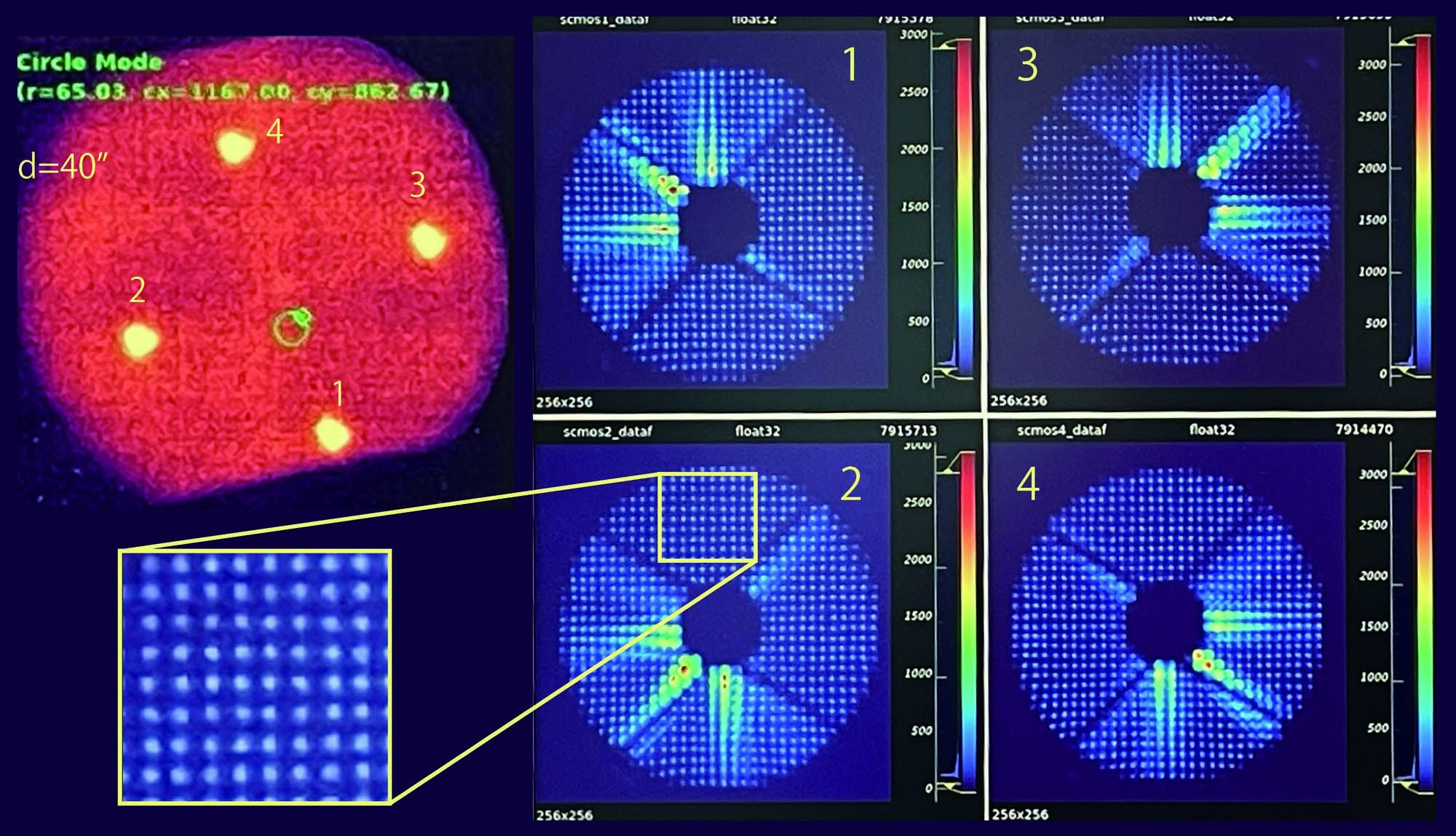
Figure 2: Image of the four-star laser guide star constellation (upper left) and images from the four wavefront sensors that measure the guide stars (right). Stars labeled 1 through 4 correspond to the respective wavefront sensors. The lower left panel shows a magnified portion of the image. Light entering the telescope mirror is slightly distorted by atmospheric turbulence. As a result, the spots in the wavefront sensor images shift continuously from their ideal grid positions. Measuring these shifts allows the atmospheric turbulence to be determined. The three bright streaks seen in each wavefront sensor image are scattered light from the other three laser guide stars and act as background noise in the measurements. (Credit: Tohoku University / Masayuki Akiyama)
In addition, the team conducted adaptive optics tests using a natural guide star—a bright star used as a reference. In adaptive optics, data from the wavefront sensors are used to generate correction signals that drive a deformable mirror, whose surface shape can be rapidly adjusted to cancel the effects of atmospheric turbulence. By combining a wavefront sensor that measures turbulence on a 32×32 grid (1024 points) with a deformable mirror having 60×60 control elements, the system achieved a sharp stellar image of 0.09 arcseconds at a visible wavelength of 589 nanometers (Figure 3).
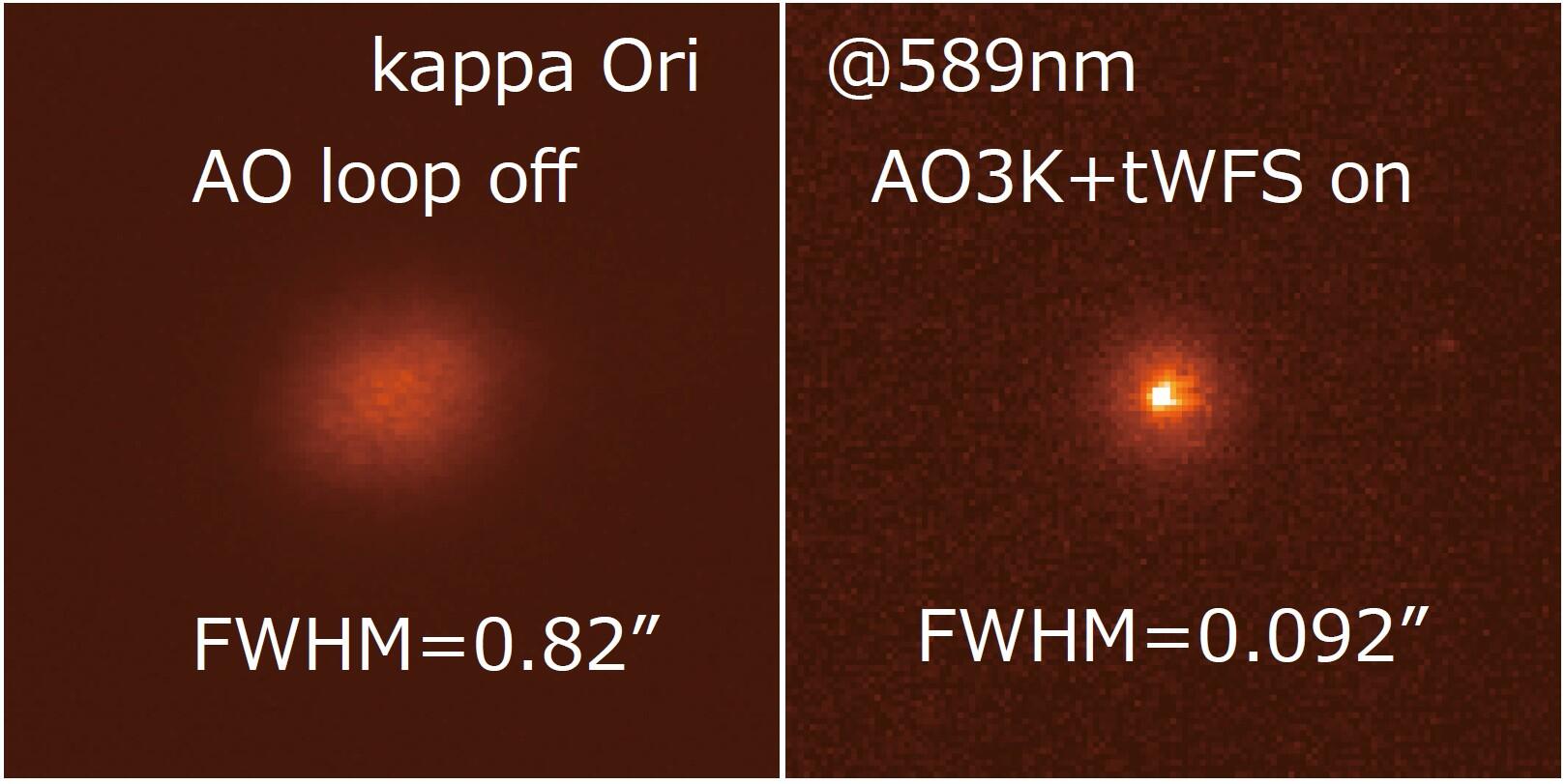
Figure 3: Test observation using Kappa Orionis as a natural guide star (wavelength 589 nm). Without adaptive optics (left), atmospheric turbulence spreads the stellar image to 0.82 arcseconds. With adaptive optics (right), the image improves to 0.09 arcseconds. One arcsecond corresponds to about 1/2000 of the apparent diameter of the full Moon. (Credit: Tohoku University / Masayuki Akiyama)
Development of the wavefront sensor unit for the laser tomography adaptive optics system began at Tohoku University in 2017. After test observations with a prototype consisting of a single wavefront sensor, a full unit with four sensors was completed and transported to the Subaru Telescope’s base facility in Hawai`i in the summer of 2023. Following further adjustments, the system was installed at the telescope’s infrared Nasmyth focus in the summer of 2025.
Video 3: Time-lapse of the installation work for the wavefront sensor unit in August 2025. (Credit: Tohoku University / Masayuki Akiyama)
Hiyori Tanabe, a graduate student at Tohoku University who studied tomographic estimation of atmospheric turbulence and completed her master’s thesis in February 2026, comments:
"I have been involved in the alignment and installation of the wavefront sensors since my undergraduate years, so I am extremely happy that we were able to carry out test observations while I was still a student. I will never forget the moment when starlight first entered the instrument. I hope this laser tomography adaptive optics system will support the research of many scientists in the future."
The next step will be to achieve adaptive optics performance with laser guide stars comparable to that obtained with a natural guide star by advancing tomography-based correction techniques. This technology is expected to enable high-precision correction in visible light—something that has been difficult with laser guide stars until now—and allow observations that fully utilize the capabilities of the telescope. Ultimately, it will make it possible to capture extremely sharp astronomical images from the ground, comparable to those obtained from space.
 Guidelines for Use