


How did the construction of the Subaru Telescope transform Japanese astronomy? A new study provides a quantitative answer by analyzing scientific publications and their citation impact during the telescope’s early years. Drawing on large-scale publication data, the research shows that the Subaru Telescope generated many internationally influential results and significantly enhanced Japan’s global visibility in astronomical research.
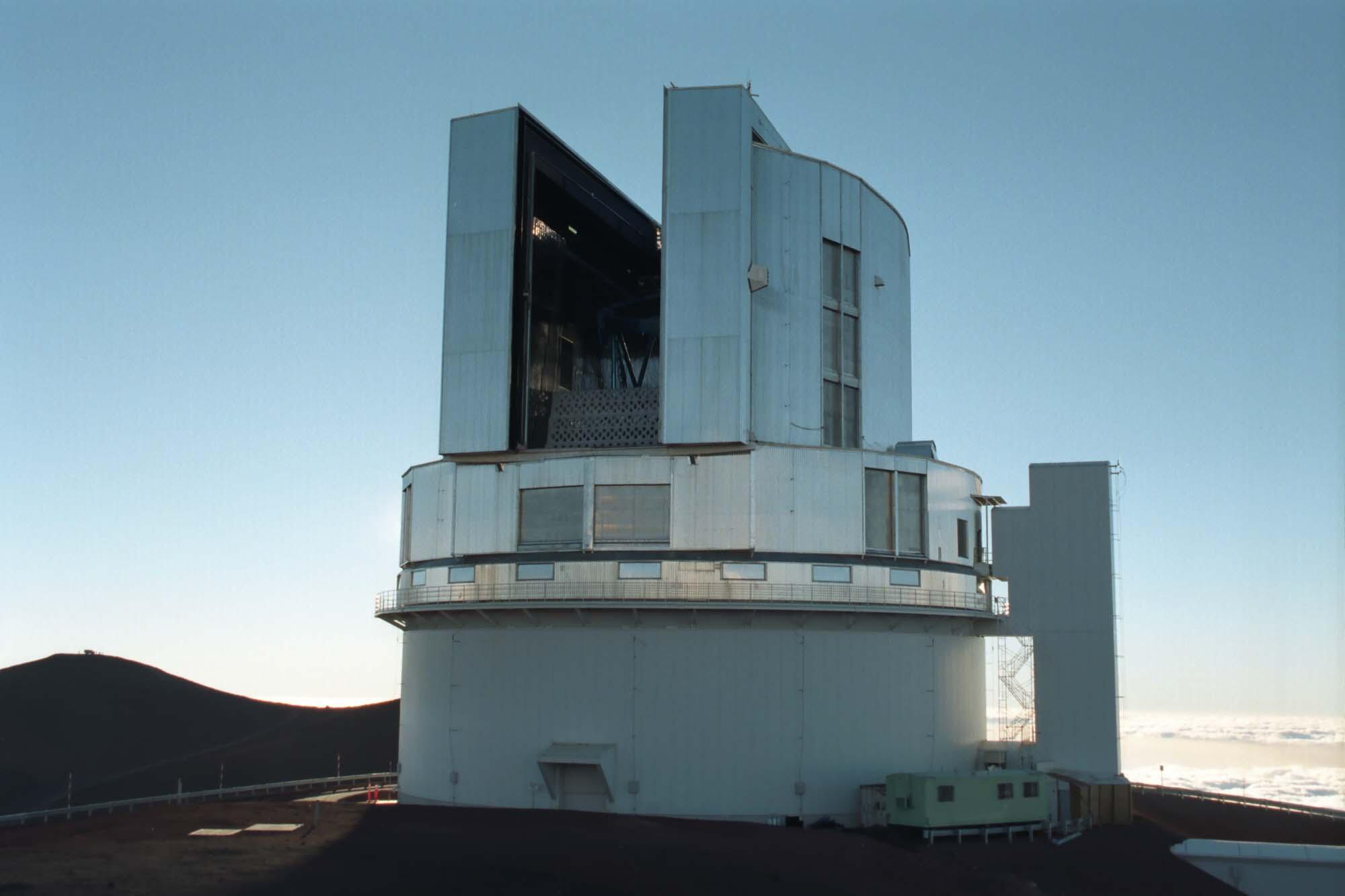
Figure 1: The Subaru Telescope in the evening before its engineering first light, December 24, 1998. (Credit: NAOJ).
To explore the Universe in greater detail, astronomers require ever-larger and more powerful telescopes. For decades, Japanese astronomers aspired to stand at the forefront of world-class astronomy. That ambition became reality in 1999, when the Subaru Telescope began operations in the summit region of Maunakea in Hawai‘i. Equipped with an 8.2-meter primary mirror and state-of-the-art instruments, the telescope quickly attracted worldwide attention, beginning with its stunning first-light images.
Since then, the Subaru Telescope has delivered a steady stream of discoveries across a wide range of topics, including galaxies, stars, and exoplanets. Today, it is recognized as one of the world’s leading optical and infrared telescopes. Yet scientific success is not measured only by spectacular images or headline-making discoveries. Another key indicator is how widely research results are cited by other scientists, reflecting their influence and importance within the global scientific community.
To evaluate the Subaru Telescope’s academic impact, Dr. Hideaki Fujiwara of the Frontier Research Institute for Interdisciplinary Sciences at Tohoku University conducted a comprehensive bibliometric analysis using international publication databases. He examined peer-reviewed astronomy and astrophysics papers published between 1996 and 2007, identifying those based on Subaru Telescope observations and comparing them with Japan-wide and global publication trends.
The analysis focused on several widely used indicators, including the number of publications, total citation counts, and the Field-Weighted Citation Impact (FWCI). FWCI measures how often a paper is cited relative to the world average for papers of the same field, year, and type. An FWCI value of 1 represents the global average, while a value of 2 indicates twice the world-average citation rate.
The results were striking. While the total number of Japanese astronomy papers remained relatively stable during the study period, Subaru Telescope-based publications consistently achieved FWCI values above 2 and showed a markedly higher proportion of highly cited papers (Figure 2).
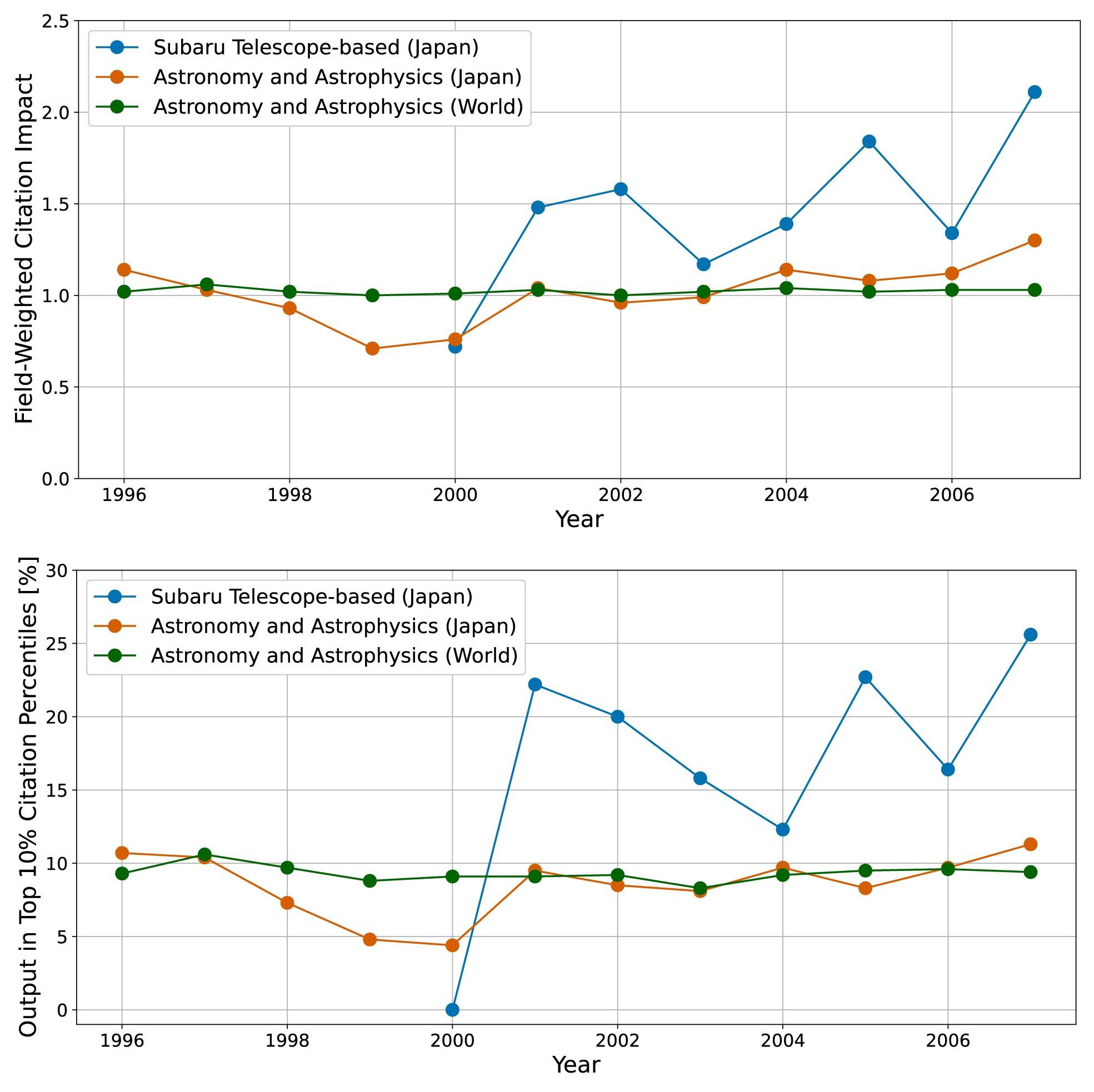
Figure 2: Comparison of citation impact indicators for peer-reviewed astronomy and astrophysics papers: Subaru Telescope-based publications (blue), all Japan-affiliated publications (orange), and global averages (green). The top panel shows FWCI, where 1 represents the world average. The bottom panel shows the proportion of publications in the top 10 percent by citation impact. (Credit: Fujiwara 2025; based on Scopus/SciVal data)
These findings demonstrate that research using data from the Subaru Telescope gained remarkable international visibility and influence. In other words, the telescope did not merely increase Japan’s research output—it elevated the global standing of Japanese astronomy.
Several factors likely contributed to this success. The Subaru Telescope’s advanced instruments enabled observations that were difficult or impossible with other facilities. In addition, its strong emphasis on international collaboration fostered partnerships with researchers worldwide. As a result, Japanese astronomers gained greater access to global research networks and cutting-edge projects, strengthening the long-term foundations of astronomical research in Japan.
This study underscores the broader importance of large-scale scientific infrastructure. Major research facilities such as the Subaru Telescope are not only engines of discovery but also powerful drivers of a nation’s scientific visibility, competitiveness, and influence. The Subaru Telescope’s early achievements clearly illustrate how a single world-class observatory can reshape a country’s presence in global science.
This research was published in Publications of the Astronomical Society of Japan on September 17, 2025 (Fujiwara 2025 “A bibliometric analysis of the scholarly impact of early Subaru Telescope-based publications”).
 Guidelines for Use