


The team behind CIAX—the Cassegrain Instrument Auto eXchanger for the Subaru Telescope—has received the FY 2025 Director General's Prize of the National Astronomical Observatory of Japan (NAOJ) for its long-term contributions to the system's development and stable operation, underscoring the vital role of engineering in cutting-edge astronomical research.
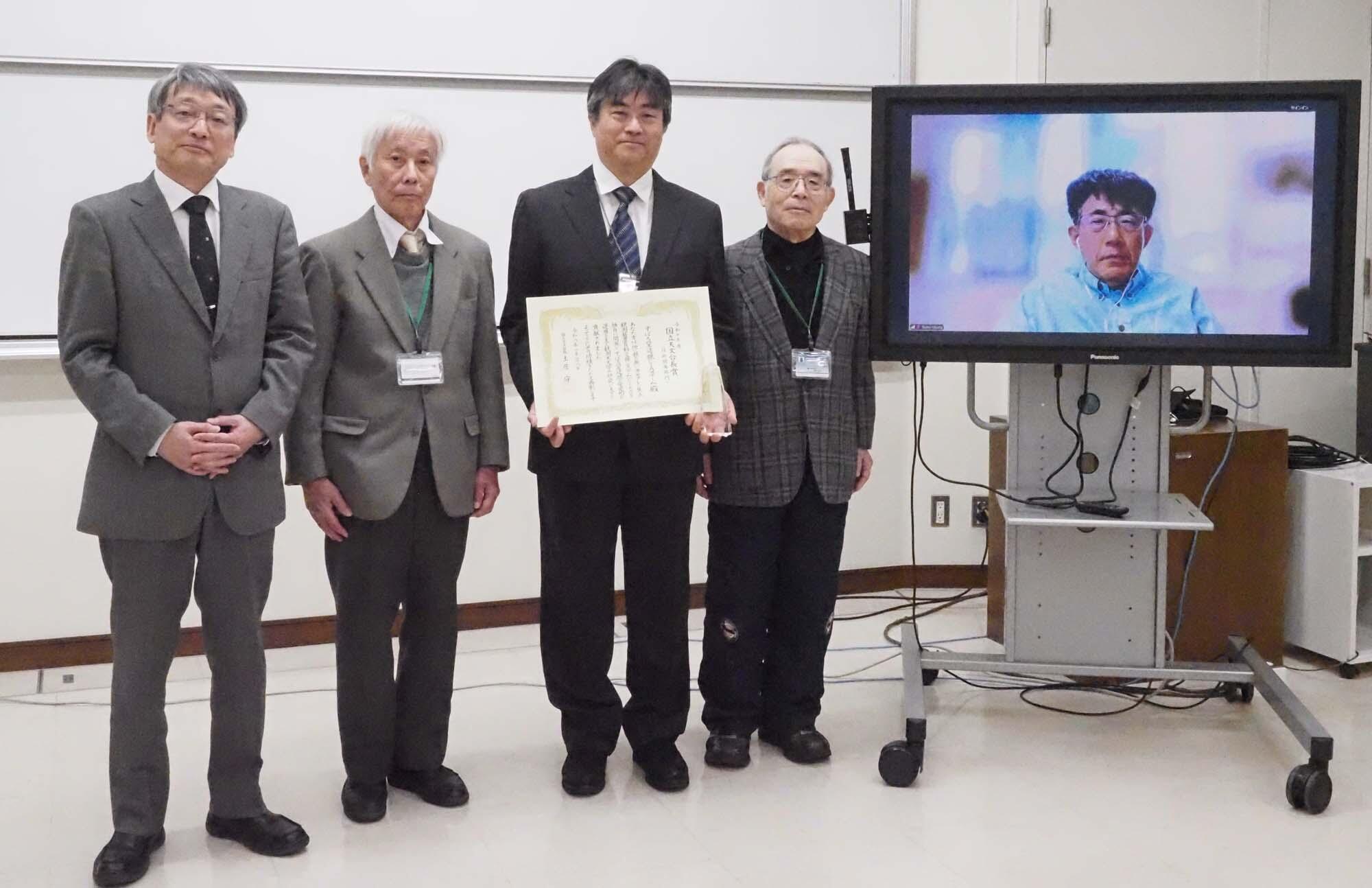
Figure 1: At the award ceremony held on January 28, 2026. From left: Mamoru Doi, Director General of NAOJ; and CIAX team members Yasuo Torii, Koji Omata, Yoshitaka Mikami, and Tomonori Usuda. The NAOJ Director General's Prize is presented annually to individuals or groups who have achieved exceptional accomplishments in research, education, technical development, or administrative activities across the observatory. (Credit: NAOJ)
Engineering Behind the Subaru Telescope's Diverse Observations
One of the defining features of the Subaru Telescope is its ability to conduct a wide range of observations, from visible to infrared wavelengths, using a diverse suite of instruments. Each night's observing plan determines which instrument will be used, and during the day, a dedicated team known as the day crew prepares the telescope and instruments for nighttime operations.
Among the Subaru Telescope's four focal positions, the Cassegrain focus is one of the locations where large and complex instruments are installed. These instruments measure roughly two meters on a side, weigh about two tons, and incorporate intricate electrical wiring and cooling systems. To safely and efficiently exchange such complex instruments, the CIAX system was developed, providing a robotic transport platform for smooth and reliable installation and removal at the Cassegrain focus.
A One-of-a-Kind Automated Instrument Exchange System
Although many large telescopes in the world have a Cassegrain focus, the Subaru Telescope is the only telescope to feature an automated instrument exchange system like CIAX. This unique capability reflects Subaru Telescope's mission to flexibly accommodate a wide range of scientific goals by rapidly switching among multiple instruments.
CIAX was developed in response to three major challenges. First, conventional instrument exchange required significant manpower and time. Second, the summit area of Maunakea—at an altitude of approximately 4,200 meters—presents an extremely harsh working environment. Third, the instruments must be installed with extraordinary precision, to within 0.5 millimeters.
To overcome these challenges, the CIAX team designed an innovative system featuring remote operation, automated sequences that complete the entire exchange process, and carefully structured safety checks at every step. At the time, this represented a groundbreaking approach to instrument exchange in astronomical observatories.
Operations: Where the Real Challenge Begins
For CIAX, completion of development was only the beginning. Through daily operations, the team continuously refined control sequences, monitoring methods, and procedures, learning from real-world experience and addressing unexpected issues. In this sense, CIAX has been nurtured and evolved over time.
Koji Omata (Engineer), who has been deeply involved in both the development and operation of CIAX, says, "The development of CIAX entrusted engineers with great responsibility and autonomy. Being able to learn design, implementation, operation, and improvement as an integrated process was an invaluable experience for me."
Unforeseen challenges were inevitable. Initially, the self-driving platform was designed to be controlled via wireless LAN, but concerns about potential interference with radio observatories at Maunakea required a switch to wired LAN. During an early phase of the development, the team even used fishing rods to route LAN cables in creative ways. The team also faced sensor malfunctions caused by aging components. Since nighttime observations could not be halted, they looked for on-site solutions while simultaneously investigating root causes and implementing permanent fixes.
Through this iterative process, valuable knowledge was accumulated—such as understanding under what conditions certain failures are likely to occur—and was systematically passed on to the day crew and on-site managers. This steady cycle of observation, testing, correction, and refinement has become the foundation of CIAX's current stable operation.
Engineering That Makes Science Possible
Today, CIAX plays an indispensable role in the reliable operation of the Subaru Telescope. The team's achievement in developing and sustaining a one-of-a-kind automated exchange system over many years was highly recognized, leading to the conferment of the NAOJ Director General's Prize.
At the award ceremony, Omata emphasized, "What I hope people take away from this award is that the spectacular results of science are supported by infrastructure that is simply expected to work, without being thought about. That 'taken-for-granted' reliability is built on continuous effort."
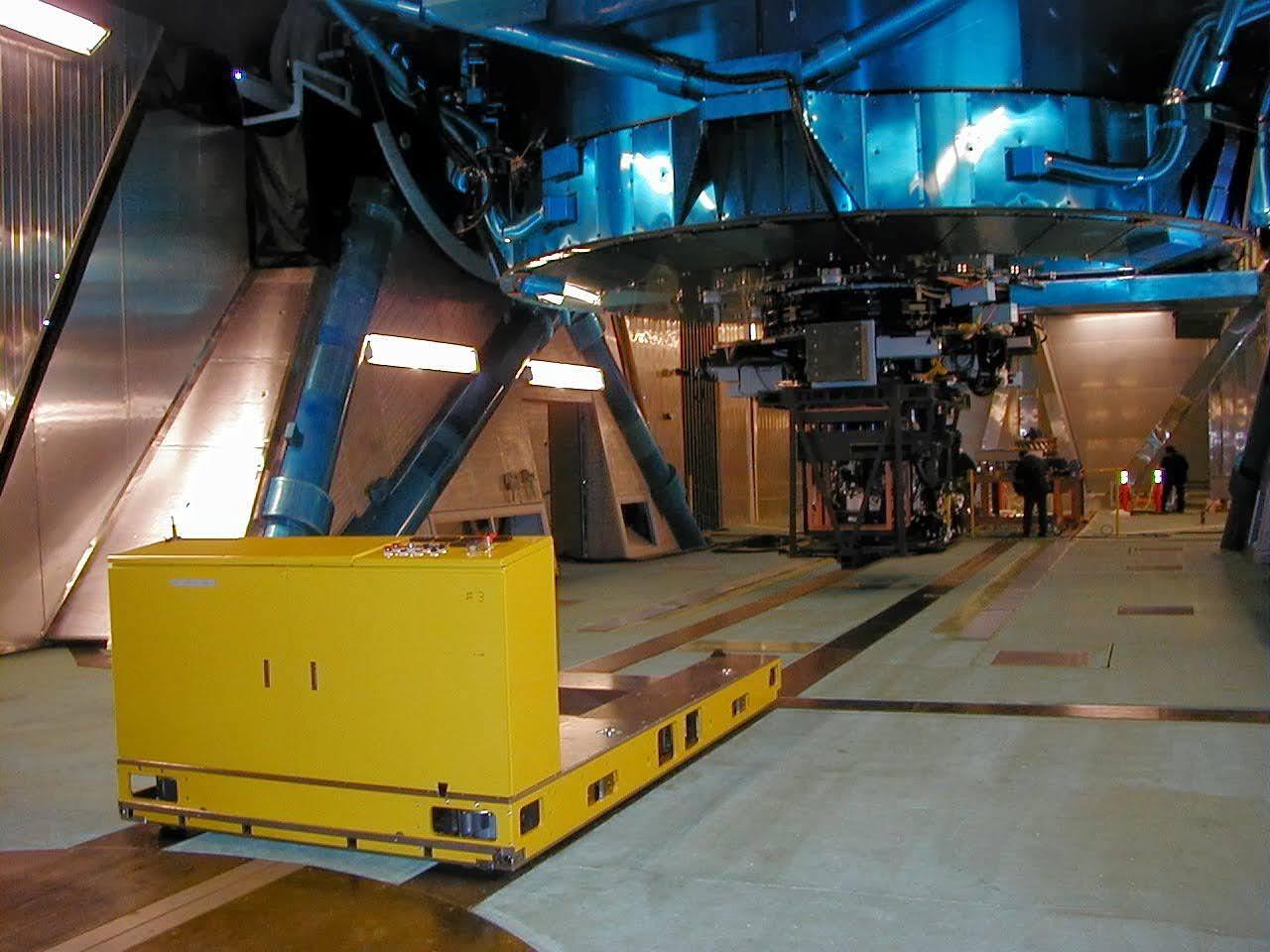
Figure 2: The CIAX robot cart approaching an instrument installed at the Cassegrain focus of the Subaru Telescope. (Credit: NAOJ)
About the CIAX Team
CIAX was developed and refined primarily by staff members of the National Astronomical Observatory of Japan.
Team members:
Koji Omata, Tomonori Usuda, Masami Yutani, Yasuo Torii, Yoshitaka Mikami, Tetsuo Nishino, Takeshi Noguchi, Tetsuo Nishimura
 Guidelines for Use