


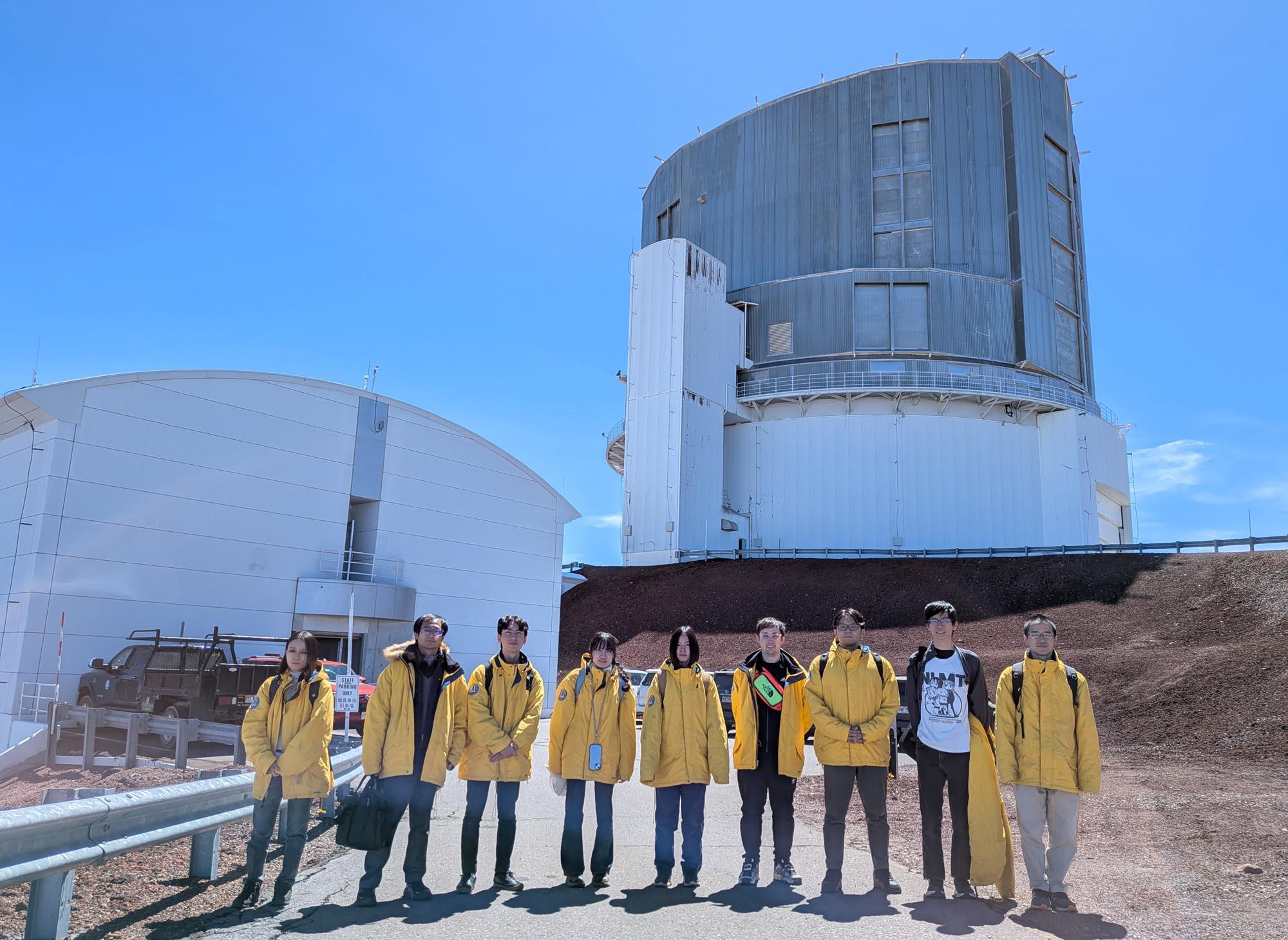
On October 11, 2025, graduate students from the Graduate University for Advanced Studies (SOKENDAI) carried out hands-on observations with the Subaru Telescope as part of a training program. With support from Subaru Telescope staff, the students explored the Universe through world-class observations based on their own research ideas.
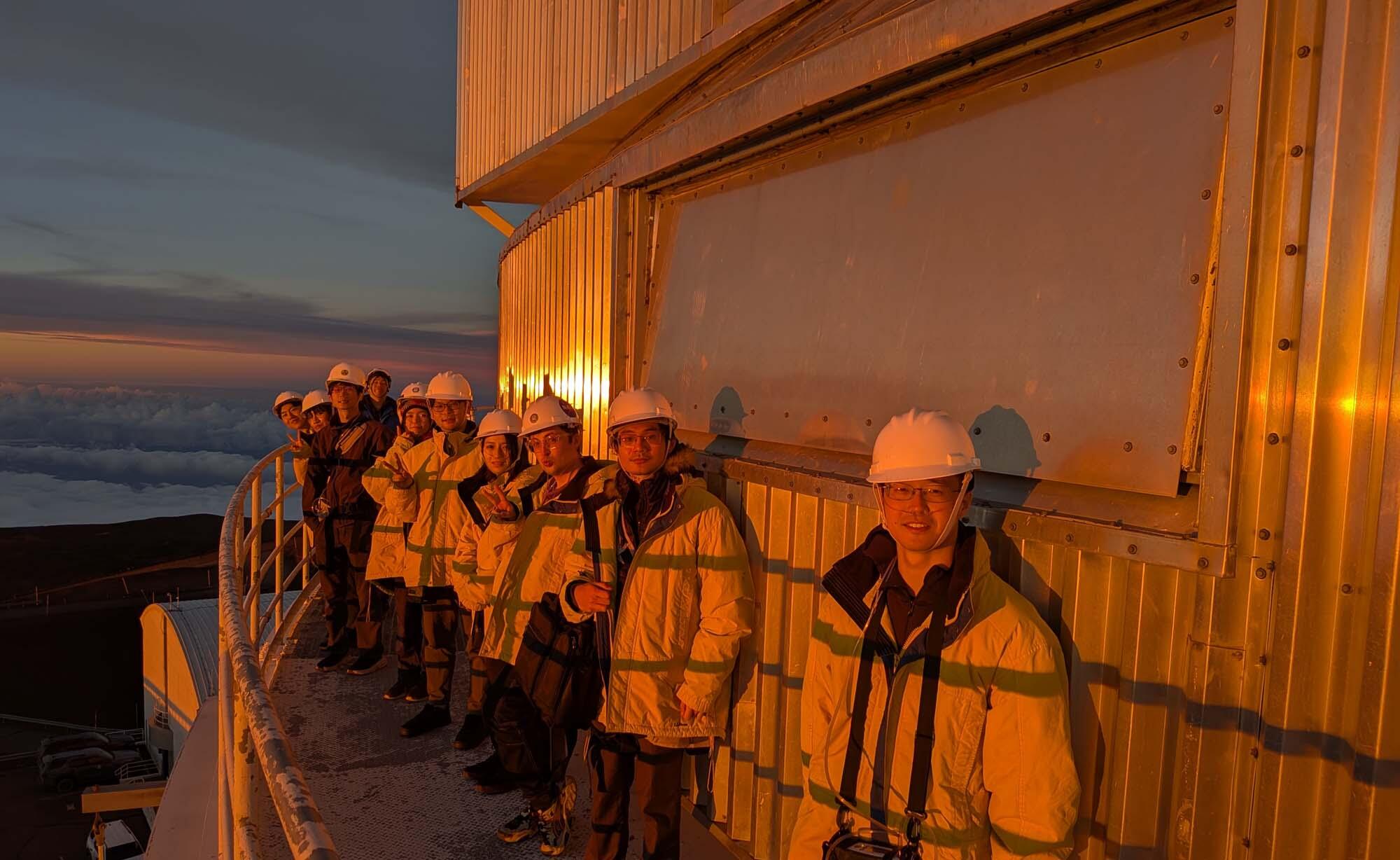
Figure 1: Students participating in an observational training program, standing on the Subaru Telescope catwalk as the Sun sets. (Credit: NAOJ)
Nine students participated in the 2025 training program. Because the telescope schedule allowed for the use of two instruments—the High Dispersion Spectrograph (HDS) and the Multi-Object Infrared Camera and Spectrograph (MOIRCS)—the students were divided into two teams, each working with one of the two instruments.
The HDS team planned two observing programs that took advantage of the instrument’s extremely high spectral resolution in visible light. One project aimed to detect an exoplanet candidate thought to be embedded in a protoplanetary disk. The second focused on measuring the physical properties of an object in the local Universe that may be a counterpart of the so-called “Little Red Dots,” a population of compact, red objects recently discovered in the distant Universe.
Meanwhile, the MOIRCS team proposed three projects using the instrument’s high-sensitivity near-infrared imaging capabilities. These included studying the dust properties of two recently discovered supernovae in a nearby galaxy, imaging faint emissions from molecular hydrogen surrounding a galaxy, and classifying galactic structure based on the distribution of stars in a galaxy’s central region.
In preparation for the observations, the students divided responsibilities among themselves, closely mirroring the workflow of professional observing teams. Their tasks included writing observation scripts, coordinating with support astronomers, keeping detailed observation logs, checking data immediately after acquisition using “quick-look” tools, and making the final decisions during the night based on weather and instrument conditions.
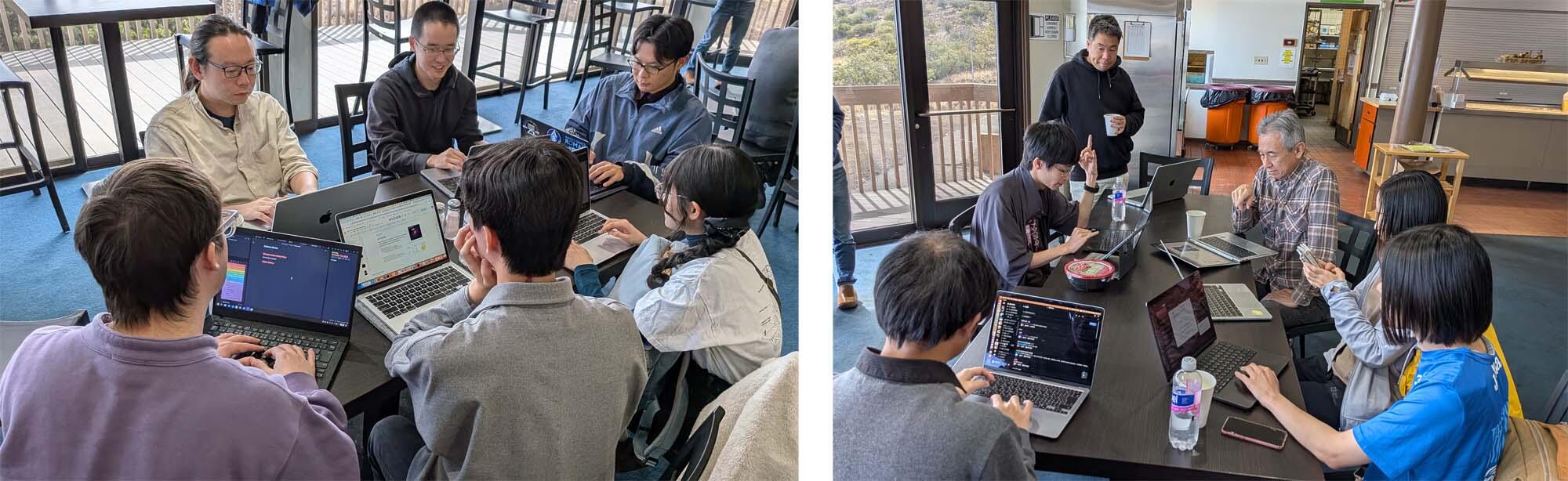
Figure 2: Final discussions held by each team during the daytime before the observations, reviewing procedures and individual roles with support astronomers. (Credit: NAOJ)
On the evening of the observations, thin clouds initially raised concerns about the weather. However, after sunset the clouds gradually dissipated, leaving the sky almost perfectly clear. Atmospheric conditions were excellent, with a seeing value of 0.6 arcseconds, providing very favorable observing conditions on Maunakea.
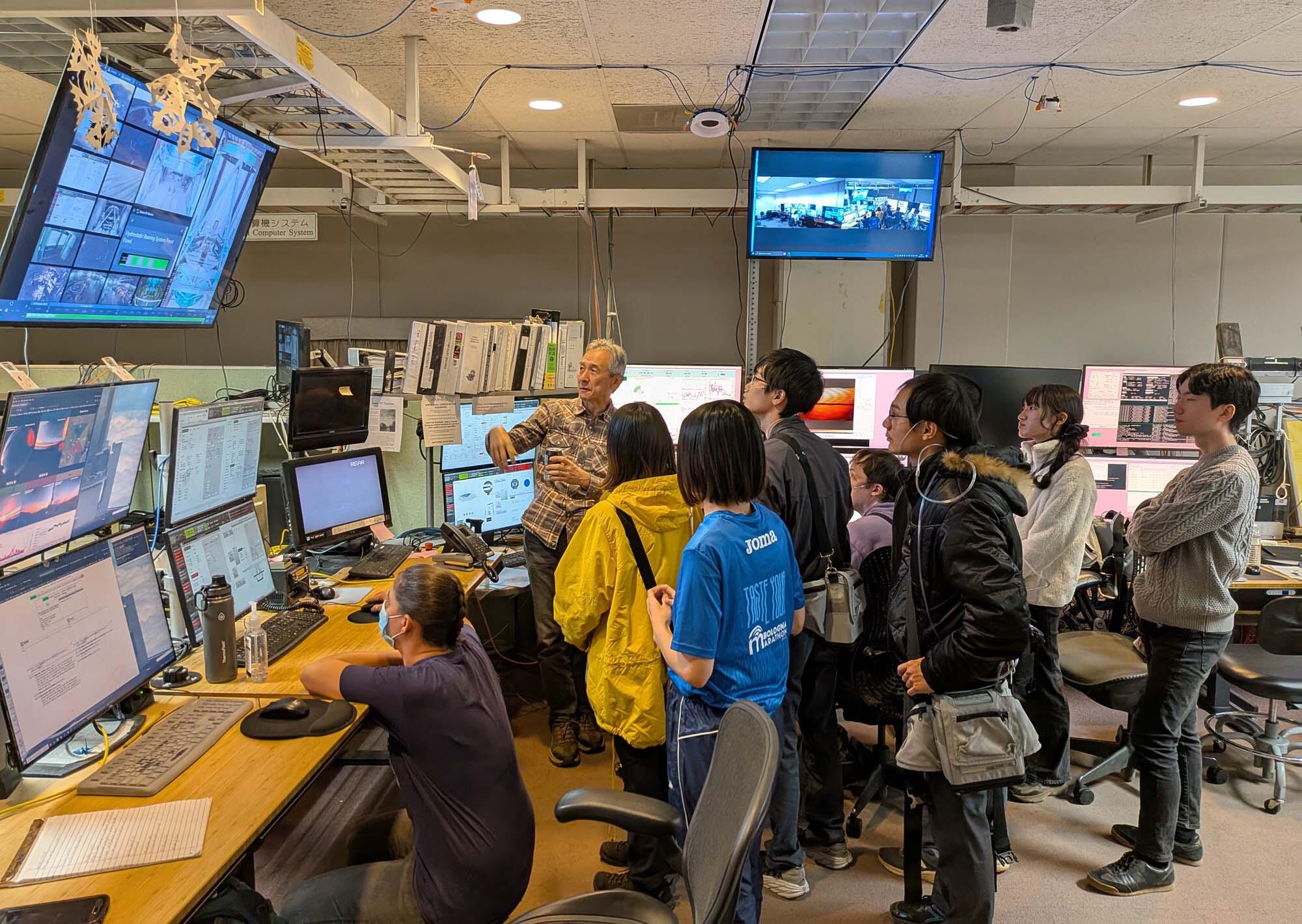
Figure 3: Students observing the setup of the telescope and instruments in the control room before the start of observations. (Credit: NAOJ)
Using HDS, the students successfully detected hydrogen emission lines while applying techniques to reduce instrument-related noise. Some unexpected features appeared in the data, reminding the participants that real observations often bring surprises. The MOIRCS observations also produced largely successful results, capturing faint molecular hydrogen clouds and clearly resolving stellar distributions in the galaxy’s central region. At the same time, the students encountered real-world challenges, such as difficulties in identifying supernova targets and limitations caused by shorter-than-planned observing time.
During the night, several technical issues arose, including instrument-related problems. Thanks to the swift response of the support staff, observations were able to resume safely. Through these experiences, the students learned both the complexity of telescope operations and the value of overcoming difficulties as a team.
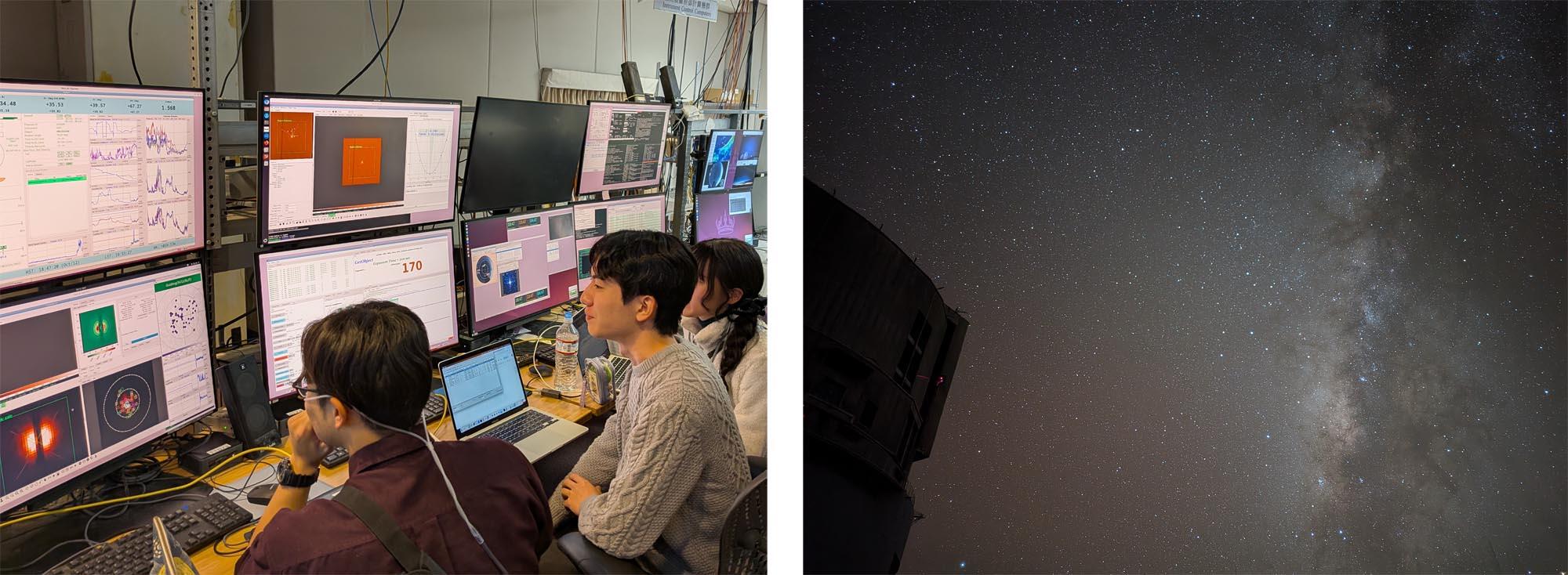
Figure 4: (Left) Checking observational data in the control room. (Right) The night sky and the Subaru Telescope enclosure on the night of observations. (Credit: NAOJ)
On the following day, the students toured the Subaru Telescope, seeing firsthand how the instruments they had used the night before were mounted on the telescope. They also attended a lecture by Satoshi Miyazaki, Director of Subaru Telescope, who explained the unique features of the telescope’s multiple focal points and the technical expertise required to operate and maintain such a complex facility.
Despite having only half a night for observations with the Subaru Telescope, the students successfully obtained data for all five observing projects. After returning to Japan, the students will analyze the data and explore potential scientific outcomes.
The Subaru Telescope observational training is one of the courses offered in the Astronomical Science Program of SOKENDAI. Through this program, students experience the entire process of observational research, from preparation and on-site observations to post-observation data reduction. Such hands-on education plays an essential role in nurturing the next generation of researchers, and Subaru Telescope and its staff are deeply committed to supporting this effort.
 Guidelines for Use