


NASA’s Nancy Grace Roman Space Telescope (Roman) successfully launched from NASA’s Kennedy Space Center in Florida on August 30, 2026 (U.S. Eastern Time). With its wide field of view, Roman is expected to advance studies of cosmic structure formation, dark energy, and the population of planets beyond our Solar System through large-scale surveys of the Universe. Japan is also participating in the Roman mission, including through coordinated observations with the Subaru Telescope, which has allotted 100 nights of observing time for this purpose. By combining the strengths of these space- and ground-based telescopes, researchers aim to open new opportunities for scientific discovery.
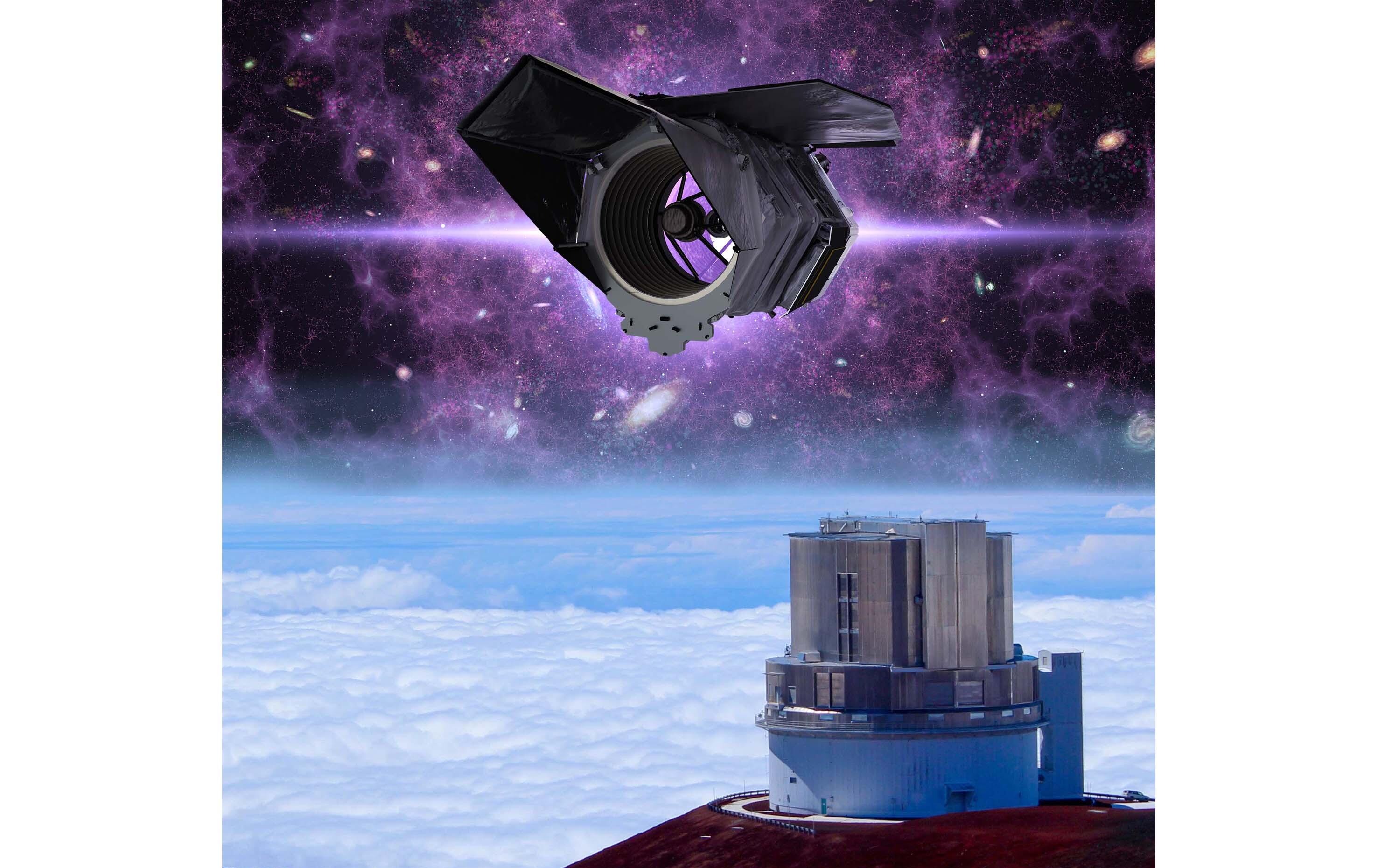
Figure 1: Conceptual illustration of the Nancy Grace Roman Space Telescope and the Subaru Telescope teaming up. (Credit: NAOJ/NASA)
Roman: A Wide View of the Universe
Roman is a 2.4-meter space telescope designed to observe the Universe in optical and infrared wavelengths. Its main instrument, the Wide Field Instrument (WFI), can capture an area of the sky more than 100 times larger than that possible with the Hubble Space Telescope, while maintaining a similar level of resolution. Another instrument is the Roman Coronagraph, which blocks the bright light of a star to reveal much fainter objects around it.
Roman has three major scientific goals. The first is to investigate the history of the Universe’s expansion and the distribution of galaxies, helping scientists understand the nature of dark energy, which is thought to drive the accelerating expansion of the Universe. The second is to conduct a large-scale search for exoplanets in the Milky Way using methods such as gravitational microlensing, revealing how frequently different types of planets occur and how they are distributed. The third is to demonstrate technology for directly imaging planets around other stars using the Roman Coronagraph. This technology will be an important step toward future space telescopes designed to directly observe Earth-like planets.
Japan Joins the Roman Mission
Japan is participating in the Roman mission through the Japan Aerospace Exploration Agency (JAXA), the National Astronomical Observatory of Japan (NAOJ), the Astrobiology Center (ABC), and Osaka University. Japan’s contributions include receiving scientific data through JAXA’s ground stations and developing coronagraph technologies for the direct imaging of exoplanets. The Subaru Telescope’s 100 nights of coordinated observations with Roman are another major contribution.
Combining the Strengths of Roman and Subaru Telescope
Located on Maunakea in Hawaiʻi, the Subaru Telescope combines the light-gathering power of its 8.2-meter primary mirror with a field of view wider than Roman’s. Roman, meanwhile, has the advantage of conducting its high-resolution infrared survey from space. These complementary capabilities allow researchers to combine wide-field observations from the ground and space in ways that would not be possible with either telescope alone.
For example, Roman may identify large numbers of distant galaxies or other objects in its surveys and the Subaru Telescope can then cover the entire breadth of one Roman observation with one of its own observations to quickly and efficiently obtain spectra of selected objects to measure their distances and study their physical properties in greater detail. Roman’s observations can also be combined with the extensive survey data already collected by the Subaru Telescope, allowing researchers to study previously observed objects from a new perspective.
By combining observations from the two telescopes, researchers can pursue new opportunities in cosmology, galaxy evolution, and exoplanet research. Researchers in Japan and the United States are currently discussing detailed observing programs in these and related fields, with coordinated observations expected to begin in 2027 or later.
From Ground-Based Astronomy to Space — and Beyond
Japan has a long history of research using ground-based telescopes, such as the Subaru Telescope, in areas closely related to Roman’s scientific goals, including dark matter, galaxy formation and evolution, and exoplanets. Participation in Roman provides an opportunity to bring these strengths in ground-based astronomy into space and to work with researchers around the world to produce cutting-edge scientific results.
The scientific knowledge and international research networks gained through the Roman mission can also be passed on to the next generation of researchers. This experience will help build a foundation for Japanese researchers to participate in future large-scale space telescope missions.
Looking Ahead to Roman and Subaru Telescope
On August 26, shortly before Roman’s launch, JAXA held a media briefing at its Tokyo office. Yusei Koyama, Associate Professor at NAOJ’s Subaru Telescope and Executive Advisor to the NAOJ Director General, attended the briefing.
Speaking about the Subaru Telescope’s coordinated observations with Roman, Koyama says, "The 100 nights of observations with the Subaru Telescope are recognized as a major contribution from Japan to Roman. Subaru has been in operation for more than 25 years, and we are very proud that such a long-standing facility is expected to make a significant contribution to this state-of-the-art space telescope."
For more than 25 years, the Subaru Telescope has been exploring the Universe from Maunakea. Now, its wealth of observing experience and technological expertise will be combined with Roman’s new view of the Universe from space.
By bringing together the strengths of telescopes on the ground and in space, researchers may reveal aspects of the Universe that have remained hidden from view.
 Guidelines for Use