Press Release
Jupiter's Moon Had A Far-Flung Past
December 23, 2004
The first ground based infrared spectrum of Jupiter's moon Amalthea reveals that it must have formed far from its current location. This new result, based on observations with the Subaru telescope and the NASA Infrared Telescope Facility by a team of researchers from the National Astronomical Observatory of Japan, the University of Hawaii, and the University of Tokyo, sheds new light on our Solar System's turbulent past.
| Planets
like Earth and Jupiter formed from the disk of
gas and dust swirling around the Sun at the time
of its birth. Rocky planets like Earth formed
in the high temperature environment close to the
Sun, while large gaseous planets like Jupiter
formed in the cooler regions farther away. Similarly,
Jupiter, the largest planet in the solar system,
probably had its own disk of gas and dust. The
four moons of Jupiter discovered by Galileo (Io,
Europa, Ganymede, and Callisto) are likely to
have been born from this disk. |
 Amalthea and Jupiter's Ring Image (375 KB) Information |
The origin of the four small inner moons remain a mystery, however. They have orbits compatible with the hypothesis that they formed in orbit around Jupiter like the Galilean moons. On the other hand, their small irregular shapes and their comparatively low reflectivity and low densities resemble asteroids and suggest that they were captured by Jupiter's gravitational pull just like the outer moons.
The mystery persists because of the challenge inherent in observing Jupiter's small inner moons from Earth. The moons are small and therefore faint, and they are obscured by the bright glare from Jupiter. Although NASA's space probes Voyager and Galileo have captured detailed images of Jupiter's small inner moons, these data have been insufficient for resolving the question of their origin.
Naruhisa Takato from the National Astronomical Observatory of Japan and his collaborators have now had success in obtaining the first infrared spectrum of two of Jupiter's small inner moons, Amalthea and Thebe. To obtain a spectrum over a wide range of infrared wavelengths, the group combined the strengths of two instruments on two telescopes on the summit of Mauna Kea, Hawaii. For high resolution spectroscopy at wavelengths longer than 3 μm ,the group used the Infrared Camera and Spectrograph on the Subaru telescope. For shorter wavelengths, the group used SpeX on the NASA IRTF, which has broad wavelength coverage.
The new spectrum of Amalthea shows
the characteristic signatures of water. The most likely
location of this water is within water containing hydrous
minerals. Such minerals typically form in low temperature
environments, ruling out the possibility that Amalthea
could have formed in the high temperature environment
of Jupiter's immediate neighborhood while the planet
was forming and where Amalthea
now is.
If Amalthea did not form near its present location, where did it come from? The surface of Amalthea resembles regions of Callisto that are not covered by ice. This suggests that Amalthea may have been one of the many small "micro-satellites" orbiting Jupiter that was sucked into an inner orbit when the Galilean moons formed. However, the spectrum of Amalthea has similarities with asteroids orbiting the Sun, suggesting that is was a "micro-planet" that was pulled into Jupiter's orbit when Jupiter itself was forming.
Takato says "although we think Jupiter's moons formed as an assembly of many smaller bodies, the same way we think planets formed from 'planetesimals', until now we have not found any example of the original building blocks of a planet's moon. However, our results strengthen the argument that Amalthea is one of the few remaining pieces of the material that formed the Galilean moons. Amalthea may have ended up in orbit close to Jupiter rather than get incorporated into a larger moon or Jupiter itself. If this is the case, Amalthea would be the first known example of a 'satellitesimal.'"
References:
These results were published in the December 24, 2004,
edition of the journal Science Vol. 306, 2224 - 2227.
 |
Figure
1: The Orbits of the Jupieter's Small
Inner Moons Amalthea orbits Jupiter in 12 hours at a distance corresponding to two and a half times the radius of Jupiter. Just like Earth's moon, Amalthea is tidally locked to Jupiter so that it rotates once in the time it takes to revolve around Jupiter. Due to this synchronous rotation, the same side of Amalthea is always facing Jupiter. Small micro-meteorites constantly bombard Jupiter's four inner most moons, Thebe, Amalthea, Metis, and Adrastea. The dust generated by this bombardment is the most probably source of Jupiter's ring. (Note: These images show the size of the orbits to scale but not the sizes of the moons.) (Images of Jupiter and its satellites from NASA/JPL-Caltech) |
|
 |
Figure
2: Jupiter's Four Small Inner
Moons and Callisto The Galileo space probe imaged of all four of Jupiter's inner moons. From the upper left, this image shows Metis, Adrastea, Amalthea, Thebe. A wedge of the the Galilean moon Callisto is included in the image for comparison. The relative size ratios of each of the moons are approximately correct. Amalthea has an irregular potato-like shape approximately 270 x 165x 150 km (167 x 102 x 93 miles) in dimension. Its volume is comparable to 40 times the island of Hawaii. (Images of satellites from NASA/JPL-Caltech) |
|
 |
Figure
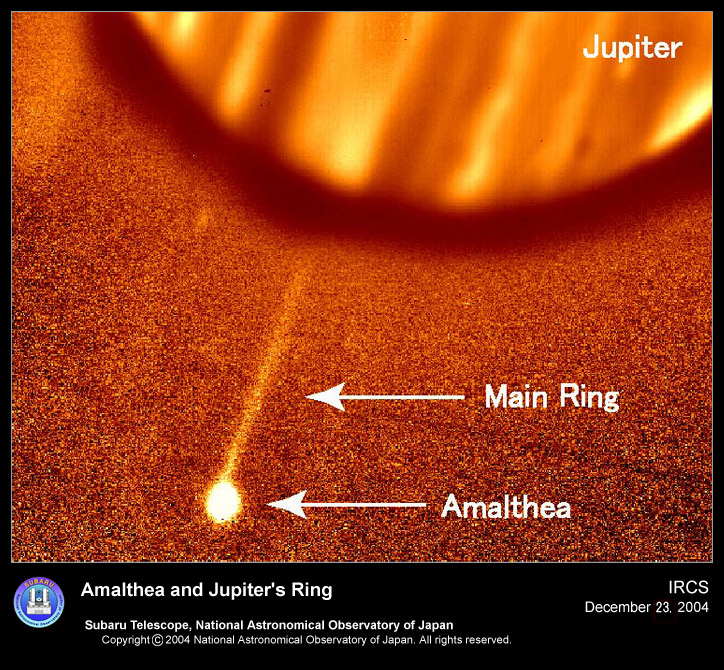
3: Amalthea and Jupiter's Ring This is a 2.2 μm image of Amalthea from the Infrared Camera and Spectrograph on Subaru telescope. (2002/12/10 12:49 UT; 5 sec exposure). Amalthea is the bright object in the lower left corner and Jupiter occupies the upper half of the image. The straight streak between Jupiter and Amalthea is Jupiter's ring seen edge-on. |
|
 |
Figure
4: A Comparison of the Reflectivity
of Amalthea, Thebe, Callisto and Asteroids Amalthea (red line) and Thebe (blue line) [have reflective spectra similar to those seen in regionsof Callisto where there is little water ice (black line). The dip in the spectrum around 3 µm indicates the presence of water containing minerals. The spectrum at wavelengths shorter than 2.5 µm is similar to "D-type" asteroids (pink region), a type of asteroid common in the vicinity of Jupiter's orbit around the Sun. |
|
 |
Figure
5: A Comparison of the Reflectivity
of Amalthea and Meteorites This graph compares the reflective spectrum of the Tagish Lake (green), Murchison (blue), and Ivuna (red) meteorites with the spectrum of Amalthea (black). The most likely parent body of the Tagish Lake meteorite is a D-type asteroid. The other two meteorites are a type of meteorite (carbonaceous chondrite) which originates from another family of asteroids (C-type) that preserve some of the original building blocks of the solar system. The spectrum of the Ivuna meteorite (dashed red line) is scaled to allow a comparison of the shape of the spectra at 3 μm and longer wavelengths. |
|
