|
| Subaru Telescope Observations and the CoRoT Mission Unveil the Future of the Sun |
 |
May 17, 2013 |
A team of astronomers has found the farthest known solar twin in the Milky Way Galaxy-- CoRoT Sol 1, which has about the same mass and chemical composition as the Sun. Spectra from the High Dispersion Spectrograph (HDS) on the Subaru Telescope showed that CoRoT Sun 1 is about 6.7 billion years old while space-derived data from the CoRoT satellite indicated a rotation period of 29 +/- 5 days. This newly discovered, evolved solar twin allows astronomers to uncover the near future of the Sun. |
|
|
|
|
| Discovery of a Blue Supergiant Star Born in the Wild |
 |
April 10, 2013 |
A duo of astronomers has discovered a blue supergiant star located far beyond our Milky Way Galaxy in the constellation Virgo. Over fifty-five million years ago, the star emerged in an extremely wild environment: within the long trail of gas stripped from galaxy IC 3418 as it sped rapidly into the Virgo cluster and interacted with the hot plasma of the surrounding intra-cluster medium. The research revealed unprecedented views of the star formation process in this intergalactic context and showed the promise of future investigations of a possibly new mode of star formation, unlike that within our Milky Way. |
|
|
|
|
| Gravitational Lensing in the Peculiar "Magatama" Galaxy |
 |
March 31, 2013 |
A team of astronomers has investigated the effect of gravitational lensing on the properties of the background galaxy in an overlapping system of two young galaxies lying in an extremely close line of sight. The two galaxies were once thought to be a single strangely shaped galaxy that looked like a "magatama", an ancient, comma-shaped Japanese amulet made of stone. The team's research showed that the effect of gravitational amplification would be 20% at most and that the gravitational lensing effect from the young foreground galaxy does not affect the luminosity of its background galaxy. |
|
|
|
|
| Soccer Balls in Interstellar Space |
 |
March 5, 2013 |
An international team of astronomers led by Masaaki Otsuka has detected the C60 fullerene (molecules of carbon with 60 atoms arranged in patterns resembling a soccer ball) in the dying star M1-11. Data from the Subaru Telescope, the Spitzer Space Telescope, the Very Large Telescope, the 1.88 m telescope at the Okayama Astrophysical Observatory, and the Japanese infrared astronomy satellite AKARI all contributed to this finding, which takes scientists closer to understanding the prevalence and formation of C60 in space. |
|
|
|
|
| 3-D Observations of the Outflow from an Active Galactic Nucleus |
 |
February 18, 2013 |
A Japanese team of astronomers has used the Subaru Telescope to observe a distant gravitationally-lensed quasar and probed an active galactic nucleus in its central region. Looking through multiple sight lines, the astronomers obtained a 3-D view of the quasar and discovered complex small structures inside the outflows from the galactic nucleus. These outflows will spread widely and eventually affect the evolution of the host galaxy. |
|
|
|
|
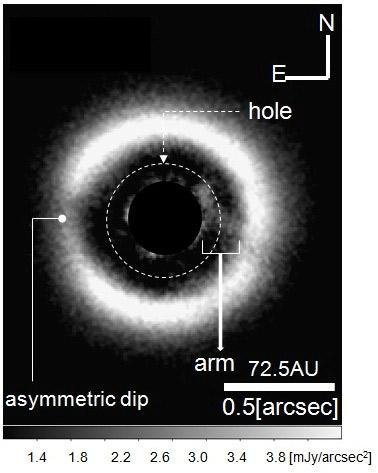
| Direct Infrared Image of an Arm in Disk Demonstrates Transition to Planet Formation |
 |
February 7, 2013 |
An international team of astronomers has used the Subaru Telescope to capture the first vivid infrared image of a curved arm of dust extending over a hole in a disk around a young star (J 1604). This feature indicates the probable existence of unseen planets within the hole. The image shows the dynamic environment in which planets may be born and gives information about constraints on the distance at which planets can form from a central star. |
|
|
|
|
| The Origin and Maintenance of a Retrograde Exoplanet |
 |
January 24, 2013 |
Astronomers have used the Subaru Telescope to show that the HAT-P-7 planetary system, which is about 1040 light years from Earth in the constellation Cygnus, includes at least two giant planets and one companion star. The discovery of a previously unknown companion (HAT-P-7B) to the central star (HAT-P-7) as well as confirmation of another giant planet (HAT-P-7c) orbiting outside of the retrograde planet HAT-P-7b offer new insights into how retrograde planets may form and endure. |
|
|
|
|
| Shedding Light on the Power of M 82's Superwinds |
 |
January 18, 2013 |
An international team of astronomers has discovered that outflows of gas from starburst galaxy M 82 collide with a "cap" of gas clouds 40,000 light years away from the galactic disk. Shockwaves from M 82's central starburst region are the most likely source of the bright clouds within the cap. This research provides an important clue about the wind's power. |
|
|
|