Press Release
A Chain Cluster: Witnessing the Formation of a Rich Galaxy Cluster 7 Billion Years Ago
December 22, 2003
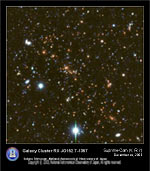 Low Res. (65 KB) High Res. (293KB) |
Object: Galaxy Cluster RX J0152.7-1357 Distance: Approximately 7 billion light years Telescope : Subaru Telescope (Effective Diameter 8.2m) Focus: Prime Focus Instrument: Suprime-Cam Filters : V (0.55micron),R (0.65micron), i' (0.77micron) Color Composition: Blue =V, Green = R, Red = i' Observation Date: UT, 26 Sep 2003 (V), 27 Sep (R), 26 Sep (i') Exposure Time: 120min (V), 116min (R), 75min (i') Field of View: 3arcmin x 3arcmin Orientation: North up, East left On Sky Location: Constellation Cetus |


Galaxies tend to be clustered in the Universe -- such systems are called a `galaxy cluster'. A scientific research project called PISCES (PI: T. Kodama (NAOJ)) is currently being undertaken with Subaru Telescope, which is aimed to obtain a panoramic view of cluster formation and the galaxy evolution therein.
This image was taken as a part of this project, showing a central region of a rich cluster located 7 billion light years from us. The field size is about 4.5 million light years on a side on this cluster scale, corresponding to twice the distance between our Milky Way Galaxy and our next neighbor Andromeda Galaxy. It is notable that the hundreds of red galaxies are clustered within this limited volume of the Universe.
Most of the reddish galaxies in the image are supposed to be associated with this cluster, and they show a chain-like structure composed of three main clumps and stretching from NE (top left) to SW (bottom right). Such filamentary structure extends to even outside of this image. This suggests that we are witnessing the rich cluster in the process of formation by accreting galaxy groups along the chain-like structure and growing to a larger system. During the course of this cluster assembly, the individual galaxies therein are also influenced by the change of their environments with time. Such formation processes of a galaxy cluster and the related galaxy evolution will eventually determine galaxy properties, such as morphology and star formation, which are known to be strongly dependent on the local number density of galaxies.
Also, a large number of blue, arc-shaped galaxies are seen in the image. These are background galaxies on the other side of the cluster whose light is bent and stretched due to the gravitational lensing effect by the cluster. By analysing these lensed objects in detail (number, shapes, 2-D distribution, and so on), we are able to map out the total mass distribution of the cluster which is dominated by the invisible dark matter. From this analysis, we can also learn the effect of dark matter on galaxy formation.
This image shows only a small fraction (~1%) of the entire Subaru image taken with the large format camera at prime focus. The wide field of view of the camera is very unique, part of the reason why this distant cluster project on Subaru is attracting attention from all over the world.
