MOIRCS Information for Imaging Mode
OPE File Information
Please read the following documents before your observation.
Sample OPE file for imaging observation can be downloaded here. (Last update 2026-04-27)
- The appearance may be strange with no line break under the Windows browser -- you may change .ope to .txt if it happens.
- Edit the following lines suggested as ">>> To Users:" in the ope file and send back to the primary SA beforehand. You don't have to care too much about the detail of the numbers (exposure time, dither length, etc). They will be adjusted on site.
Observing Time Table Template is also available here.
-
Sharing the plan is very important for better understanding of your plan among the observing staff. Fill it and send back to the Support Staff before your observing run starts.
-
Description of an OPE file: Guide to Observing with MOIRCS (PDF: Last update: 2016-07-27)
- The list of the current filter and grism configuration alias can be found here (Last update: 2026-08-25)
- Recent dome flat setting log can be found here (internal only).
Optical Distortion and Mosaicking
The optical distortion pattern for the MOIRCS is expressed well by the third-order polynomial as a function of the distance from the optical center (xc=881, yc=1008 for chip 1, xc=1124, yc=1024 for chip 2). The distortion coefficients could change by the thermal cycle of the main dewar, as we would move the internal focus adjustment system. The mosaicking rule (position/magnification of channel-2 image relative to channel-1 image) may also be changed by the process. The users should be aware of these effects during the observation and data reduction. The SA can give you the geotran database file (for IRAF) for correcting distortion and mosaicking two channels. However, the file is created based on the single observation, and so it might be changed by any reasons (e.g. the effect of the gravitational flexure, main dewar thermal cycle, shock during the instrument exchange, unexpected power outage).
Dates below indicate the thermal cycle of the main dewar after the upgraded MOIRCS. Note that we moved the detector box every time before June 2016.
- Jan to March, 2016 (3 times)
- Late May, 2016
FYI: Dates below are for the old MOIRCS before 2016.
The default mosaic rule might also change with the elevation or the rotator angle. The measured shift of the relative ch1-ch2 position from the canonical value (e.g., the one provided by MCSRED) is typically ~2 pixels at 30 degree elevation. It will also be affected by the differential atmospheric dispersion when the image is taken at low elevation (<30 deg).
Stray Light from Nearby Bright Stars (updated in Feb 2012)
If your observing field is close to very bright (JHK < 2 mag) stars, the data may suffer from significant contamination by those stars, like the examples below. It is caused by the reflection of the light from the star by the center cone of the secondary mirror. After the replacement of the center cone in 2010, the behavior of the stray light has been changed. The characteristics described below are for the stray light since 2010. For more detail, some reports are available from the dedicated website (Japanese only).
The light tends to contaminate the field when the bright star is located between 2.5 to 0.5 degrees from the target. Even though the stray light does not always happen in that range, it will always affect the data significantly if the target lies in the 75 arcmin ± 4 arcmin area from a bright star (K < 2 mag vega). The area 120 - 140 arcmin away from a bright star could also be affected with fairly high probability (~50%).

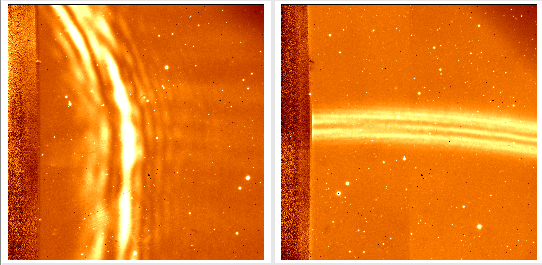
We strongly recommend checking whether there are such bright stars or not before the observation. If there is such a star within 2.5-0.5 degree from your target, please prepare the backup targets beforehand.
The Website below (VizieR) is very useful for checking. All (potential) observers should check whether your targets have such bright nearby stars beforehand.
- VizieR -- "2MASS All-Sky Catalog of Point Sources (Cutri+ 2003)"
- Put the target coordinate, and set 2.5 degree Radius to "Target Dimension" tab. Add the magnitude constraint to JHK < 2, and check the "Distance" at the "Compute" menu on Preference tab at the left.
Objects listed below are known to have the problem with high probability.
- SXDS field
- Rho Oph
- Abell 1689
- 4C 23.56
It has been known that the use of the optical secondary mirror can effectively eliminate the stray light, with only the minimal effect being observed as the rise of thermal background in K-band window (, while Y~H windows have no problem). In 2018 we installed the new cold head with the stray-light blocker, and confirmed that it eliminates the stray light very effectively. Thus the observations with the broadband filter and some narrowband filters (H2, CO, BrG, Fe2, and NB119) now do not need to worry about the stray light coming from the center cone. However, for some NB filters (NB1550, NB1657, NB2071, NB2095, NB2315, OC_ZJ, and OC_HK) the problem unfortunately still remains until we can find the chance to install the new stray light blocker for them.
Those who want to request the use of the optical secondary mirror by the reason should explicitly put comments on the "Instrument Requirement" section of the proposal. Note that we cannot guarantee the use of the optical secondary if the scheduling constraints are tough. For more detail, contact SA.
Effect of the Moon for Imaging Mode
The effect of the Moon on the background level in near infrared is generally smaller than optical wavelength. But the sky tends to be brighter than dark night a bit especially in bluer band. This trend is more significant when there is a cirrus in the sky.
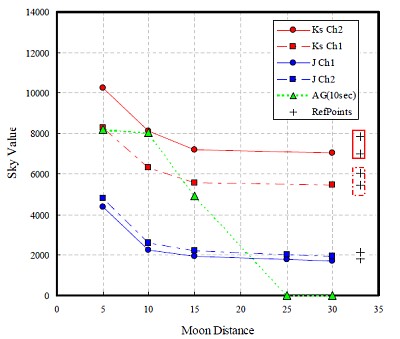
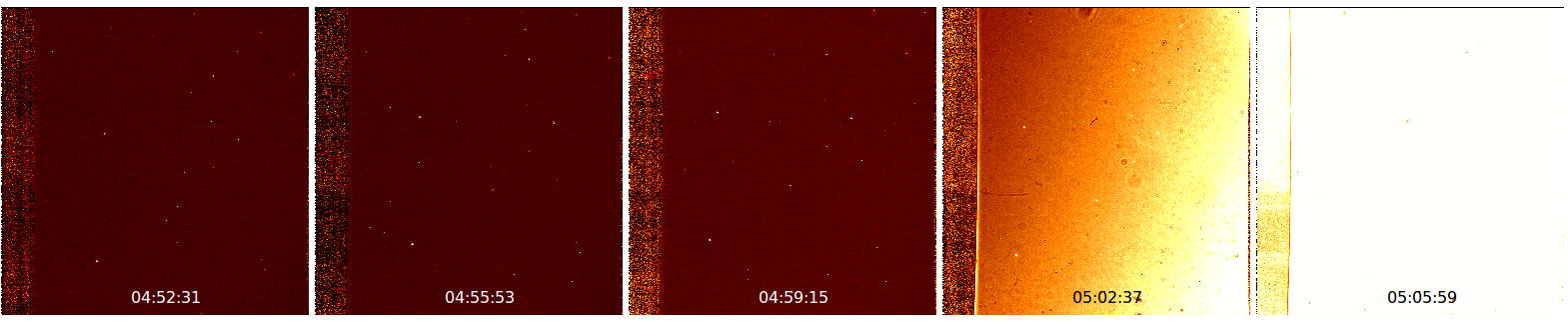
The figure below is an example of the sky background brightness near the full moon. In the figure, the plus marks at >30deg are the reference sky magnitudes measured far away from the moon. The rise of sky level is almost negligible at >15 degrees, while at 10 degree a clear effect is observed in all bands measured. We note however that, even at 15 to 20 degrees separation, we sometimes see the sudden rise of the background due to the stray light which possibly comes from the 2ndary mirror support structure (e.g., bottom figure).
The important note for the spectroscopic observation is the effect on the autoguider (AG). The AG is operated in R-band wavelength, the rise of the sky background is much higher. The automatic sky estimation of the AG system often fails at roughly <15 degrees, and it occasionally happens even at 25 degrees away. If the observation uses the autoguider, <30 degree from the moon may be with high risk of AG failure. Of course the effect of the scattered moonlight will be much stronger if the condition of the sky is not clear. The moonbow at ~22deg will give the additional rise to the AG background level for cirrus night.
Thus, we can say that the effect of the moon on the MOIRCS data is negligible if your target is away from the moon by >20 degrees on clear condition. But if you plan to use the AG (for Y, NB119, and all the spectroscopic observation), the separation must be at least >30 degrees.
It is the PI's responsibility to check the separation between the moon and your targets when submitting the proposals. Please explicitly state the observing dates you want to avoid the assignment on the "Scheduling Requirement" section of the proposal.
- Figure:
- [Upper] The measured background level of the sky as a function of the distance from the full moon. Crosses at >30 degrees are the reference sky level measured further away from the moon at the same night.
- [Lower] An example of the stray light suddenly appeared during the observation. The data shown were taken roughly every 3 minutes from left to right, and only ch2 data is shown here. At that time, the moon was 15 degrees away. The rise of the sky was about 20 times higher (rightmost image) than the earlier level (leftmost images).
Notes on the Autoguider Users
You may require the use of the Autoguider (AG) for more accurate tracking if the single exposure is longer than 3 minutes. The users of some NB filters or Y-band filters might have to consider this. We strongly recommend the AG users to check the availability of the suitable stars for Autoguider before you finalize the observing coordinates. You can find the more detailed description about the Autoguider Issue below.
Flat Fielding
(!! This is for OLD MOIRCS before 2016 !! We will update the information for new MOIRCS situation soon.)
The dome flat in J band shows a tilt along x direction with a level of ~6%. In H-band a similar level of tilt is also suspected. These tilt patterns should be removed from the raw dome data using the sky flat. On the other hand, the sky flat generally contains some level (< a few %) of the effect by the fringe pattern caused by filter substrate.
The sky under the narrowband imaging observation is usually not "flat". This is because the central wavelength is the function of the angle of incidence to the filter, or approximately, the distance from the pointing center. The use of dome flats for NB data is recommended, especially if the observation is aimed at high-accuracy photometry.
If the sky during an exposure varies rapidly due to clouds etc, you will see a tilt pattern at each detector quadrant on the image. It is the artificial pattern caused by the CDS readout method. If such pattern appears frequently and strongly on your data, the accuracy of the sky flat by these datasets will become poor, though it depends on the level of tilt patterns on your dataset (low-level pattern is usually seen). We recommend using the dome flat as well as the sky flat if the sky changes significantly during your observation.
Fringe Patterns
The data taken by some filters (NB119, Fe2, H2, NB1550, K_CONT, STD_K, OC_HK, OC_ZJ) may occasionally show a fringe pattern. Due to the move of the pattern during the exposure (possibly by the instrument flexure), sometimes it is difficult to subtract the pattern by the simple scaled median-sky subtraction, as shown below.
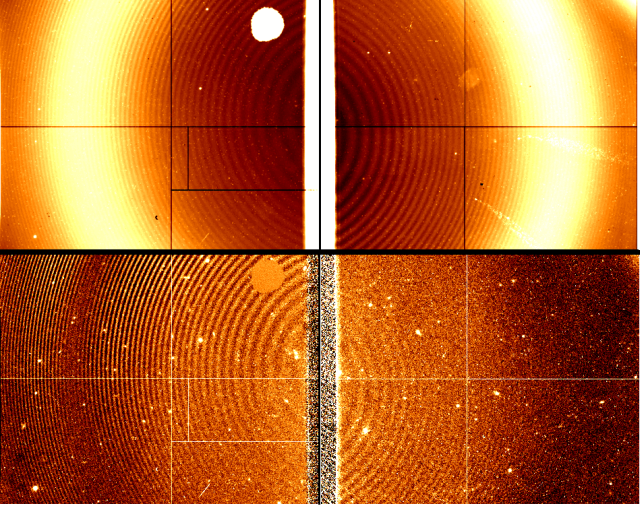
In the above figures, the top two images show the data taken by the H2 NB filter flatfielded by the dome flats (left is channel 1, right is channel 2). A clear fine fringe pattern is seen. This is caused by the parallel-plane interference of the night emission lines inside the filter substrate.
The bottom two frames are after the scaled median-sky subtraction. The fringe pattern is stronger for the upper left area of channel 1 as well as the lower-left area of the channel 2. Thus, more complex pattern subtraction is necessary.
In order to remove these patterns, a novel method was developed by Dr. Wei-hao Wang for his reduction program (see the Data Reduction below). A similar method was also introduced by Kajisawa et al. (2011, PASJ, S63, 379). If you have the problem by this, you may contact these authors for some help.
Note that the large ring-like pattern is caused by the two strong OH night lines at 2.118um and 2.125um. This is due to the position-dependent shift of the transmission curve. For more, see the NB filter information.
Information about Troubled Data
Some of the fits header information after the detector and control system upgrade in 2016 are known to be incorrect. As of July 2016, it has been known that all the time-related keywords are inaccurate. The exposure start time is the same for ch1 and ch2. However, it is not in all the data taken.
(for old MOIRCS before 2016) The periods with any kind of troubled data are summarized in the Spectroscopy Information page.
- Jump to the Spectroscopy Information Page.
Data Reduction Packages
- "MCSRED2", a simple IRAF-based data reduction pipeline, is being developed by the Ichi Tanaka (MOIRCS SA). The software is for the data taken after 2016 (after the detector upgrade).
- MCSRED2 public homepage.
Note: The old MCSRED (for the data before 2016) is also available at the same homepage.
- "SIMPLE", an IDL-based data reduction package by Dr. Wei-Hao Wang.
- Note that the program is prepared for the old MOIRCS data. One of the great features in the package is that it includes the fringe-suppression software invented by him. You can download the package from the website below.
-
The SA greatly appreciates the author for his great contribution for MOIRCS users!
Questions/comments are welcomed. Please contact each author.
- Subaru Data Reduction School occasionally uses MOIRCS data for teaching material. You can find the most recent school text below (for old detector).
- Imaging Data Reduction Manual [ Eng(2012) / JP(2012) ]
If you are developing your own software and want to put the link to your software website here, please contact the SA. We greatly appreciate your contribution.
Please note that all data on these pages are subject to change. Any questions/comments should be directed to the SA (Ichi Tanaka: ichi [at] subaru.naoj.org ; change " [at] " to @).