
FOCAS CCD Upgrade Plan
Information about the new CCDs (7/30/2010)
Check this page for the updated information of the new CCDs.
Notice to prospective FOCAS users
We are conducting an upgrade work of FOCAS CCD.
The upgraded FOCAS detector system is under evaluation and the replacement will be done in June 2010. It will be offered to a normal observing mode from the S10B only when the system is fully tested. The performance of the new system will be presented in this page.
Observers are basically asked to prepare for their proposals by assuming the current system parameters such as the system throughput, read noise, and readout time. Submission of proposals assuming characteristics of the upgraded system is also acceptable on a ** risk-shared basis only **.
Please be advised that observations allocated on the assumption of the upgraded system will have to use the current system instead of the new one, if the performance of the upgraded system is not fully confirmed by the beginning of any observing run.
Major changes in the upgrade
In the forthcoming upgrade work, the following changes will be made which are relevant to observations and data reduction.
- Fully-depleted-type CCDs (FDCCDs)
Current CCDs (MIT/LL) will be replaced with fully-depleted-type 2Kx4K CCDs by Hamamatsu Photonics K.K.
- A new front-end electronics for the CCD operation
A new front-end electronics (Mfront2) will be installed in replacement of the current M-Front system.
Although CCD characterization and optimization of readout parameters are still going on, we expect the following differences compared to the current system.
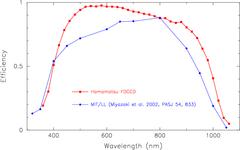
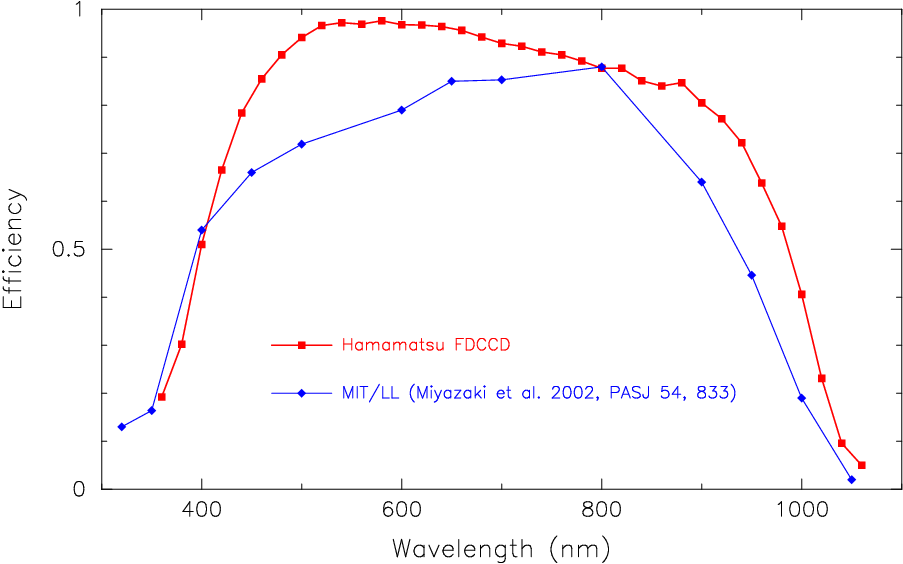
- higher quantum efficiency (QE)
In most of the wavelength range observable with FOCAS, the quantum efficiency will be improved especially at the longest wavelength. Below is the QE of one of the FOCAS new CCD measured with the CCD evaluation system at the Advanced Technology Center, NAOJ.
- less fringing
The amplitude of the fringing pattern will be largely reduced.
- faster readout
The readout time will be about four times faster than the current system.
- better cosmetics
- larger impact of cosmic-rays
Due to the thickness of the new CCDs (200μm) and small lateral diffusion, the number of pixels which are affected by cosmic-rays will be larger than the current system. Multiple exposures and shorter exposure time are recommended for the new CCDs.
Copyright © 2000-2009 Subaru Telescope, NAOJ. All rights reserved.