Instructions for applying for FOCAS MOS time
1. Pre-image for designing MOS mask
At present, MOS observations can be made with
- preimages with FOCAS
- HSC images
- SuprimeCam imags
- deep images with high astrometric accuracy
However we strongly recommend the first three cases.
In addition, if the observers have catalogs of the target fields with very high astrometric accuracy (relative error below 0.1 arcsec when compared to the world-coordinate system), it is possible to design MOS mask by creating artificial images of the target fields mimicking the FOCAS pixel scale (0.1038'').
You can request a preimaging by either FOCAS or HSC. If preimages are necessary, please describe explicitly about it in your proposal (Entry 16 'Instrument Requirements') including the instruments (FOCAS or HSC), the filter and exposure time information. The observation will be performed by observatory staff 1-3 months before the MOS observations are scheduled, and the data will be sent to the observers. The observers should use the Mask Design Pipeline tool to prepare their MOS masks and send the MOS design data to the FOCAS support scientist at least one week ahead of their MOS observing run. If you have some special requests in the imaging for designing the MOS masks, consult support astronomer before submitting the proposal.
2. Technical Tips
- The Mask Stocker Unit (MSU) can house up to 10 plates. However, one or two long slit masks are installed for standard star observation, leaving 8 or 9 slots for custom designed MOS plates. Please consult the support scientist when more than 8 mask plates are needed.
- The irregularity in configuring the width and the length of the slits is less than 10 um rms, corresponding to 0.02''.
- The maximum number of slits assignable on a mask plate depends on the selected field and the mode of observation but is typically about 30.
- Tilted slits (for, e.g., extended objects each of which have different orientation in the sky) are available, although angle of the tilt should not exceed 30 deg. from the nominal angle (perpendicular to the dispersion direction) to avoid degradation of the spectral resolution.
- The size of a typical slit is 400 um x 5000 um (0.8'' x 10''). Each slit may have different slit width, length, and the position angle.
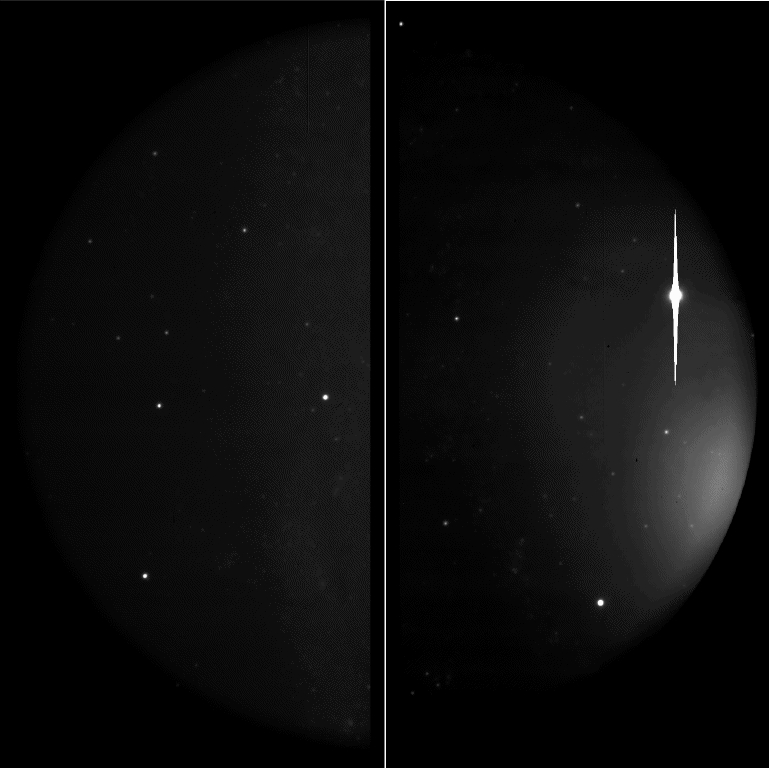
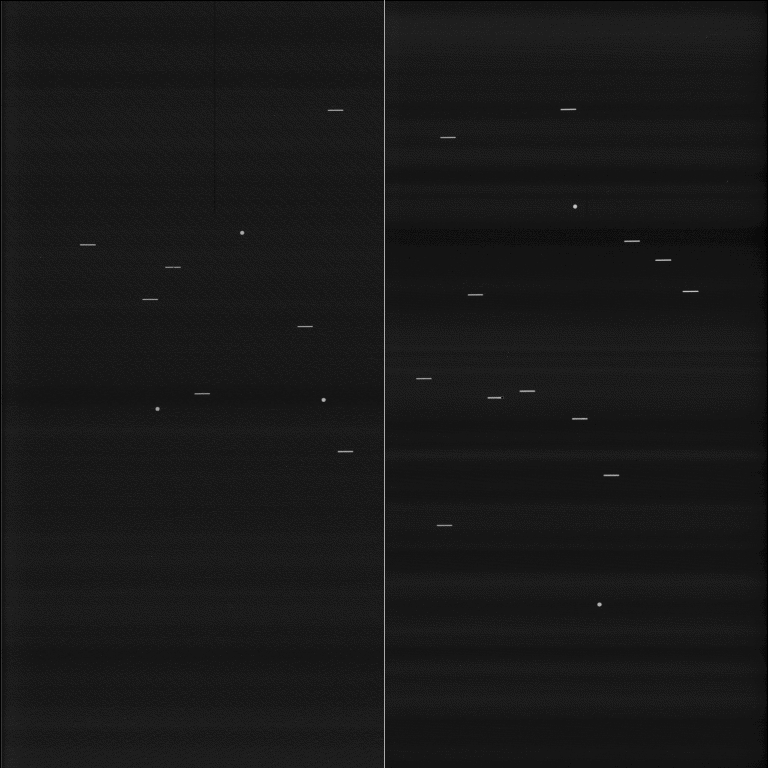
- At least 5 stars in the magnitude range 18 < [V, R, I] < 22, distributed over the field, are required to align the mask plate. For example, here is a FOCAS image of a field, together with the slit mask showing the locations of the 5 stars used for alignment.
- Typical positioning error of the slits on the target objects is about 0.1'' rms.
3. MOS Preparation Procedure
- FOCAS imaging of the MOS field (carried out by observatory staff)
- Perform preliminary data reduction of the field images
- Measure your target positions to make a target list
- Design the MOS mask plate using the Mask Design Pipeline (MDP) based on the target list to make slit lists (Observer should finish up to Step 4 at least one week before the MOS observing run. Ask for the help of support astronomer to accomplish Step 4.) For spectroscopy with the 600_650nm grism and 1200_950nm, there is a considerable shift of spectral images along the slit direction (+222 pixel and -190 pixel width from CCD chip1 to chip 2 for 600_650nm and 1200_950nm, respectively). (Note also that there are similar, but smaller, shifts in other VPH grisms. See the grism page for the detail.) For spectroscopy with the echelle grism, the dispersion direction is opposite to others. Be careful about them.
- Fabrication of MOS mask plates using the MOS Laser Cutter based on the slit lists
- Install the MOS mask plates in the Mask Stocker Unit
- Install the Mask Stocker Unit in the MOS Unit of FOCAS
4. MOS Observation Procedure
The following procedure is followed to perform a MOS observation. All steps, except for the step 6, are installed in the SOSS system as abstract commands. Your support scientist will help the pointing procedure (from 1 to 8 below). The overhead for each MOS observation is at least 10 minutes (typically 15 minutes).
- Pointing
- Imaging the slit mask
- Imaging the field
- Adjustment of telescope pointing
- Re-imaging the field
- Evaluation of MOS alignment
- Final adjustment of telescope pointing
- Final imaging for confirmation
- MOS exposure
5. Additional Remarks
- Basic parameters (field center, exposure time, filter, etc.) of the FOCAS imaging observation for MOS mode must be described in your proposal. Applicants can choose which filter to use for their imaging observation, although R-band is recommended as the most sensitive.
- The FOCAS imaging observation for the MOS mode can be made at any position angle to optimize the slit arrangement on a single mask. The position angles of MOS observations can be different from those of the imaging observations.
- The Mask Design Pipeline (MDP) program is written in IDL, and will be available for MOS observers.