Performance of Subaru AO188
The performance of AO is characterized by a Strehl ratio (a peak intensity normalized by that of a PSF without any turbulence) and FWHM of the PSF. These depend on the AO guide star magnitude, seeing, sky background and angular separation between the target and guide star. In general, performance of the AO system is better with a brighter guide star, at a better seeing, or longer wavelength. In the following is a summary of the AO188 performance in the NGS and LGS modes. For an overview on the performance of the new NIR WFS-AO3k mode, please refer to the NIR WFS website.
NGS mode performance
- Reference
- "Performance of Subaru adaptive optics AO188" Minowa et al. 2010, Proc. SPIE 7736, Adaptive Optics Systems II, 77363N
1. On-source Strehl ratio and FWHM
The plots below show the Strehl ratio and FWHM as a function of AO guide star magnitude and observed wavelength. Please note that the performance shown here would be the best cases since these data were taken under good natural seeing condition of 0.4 arcsec. We also show a FWHM as a function of seeing based on the data obtained by AO36 (Oya et al. 2004, SPIE Proc., 5490, 409), for your information. Seeing statistics at Subaru are shown here.
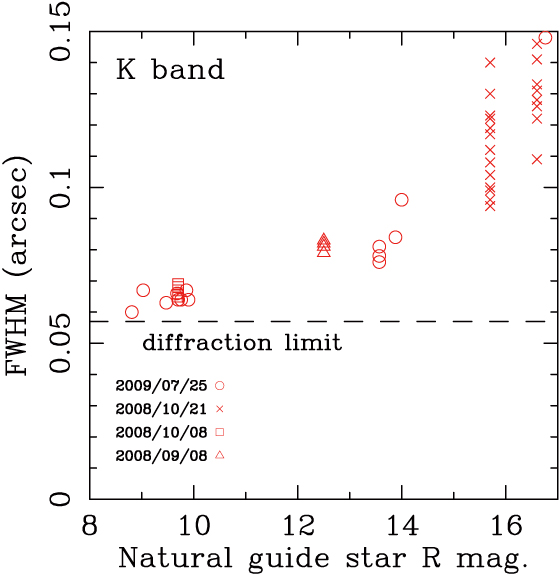
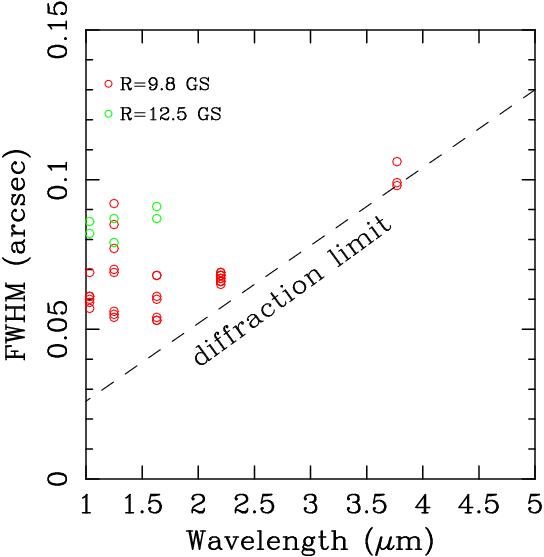
FWHM as a function of R-magnitude of the NGS and the observed wavelength under good seeing condition of 0.4 arcsec.
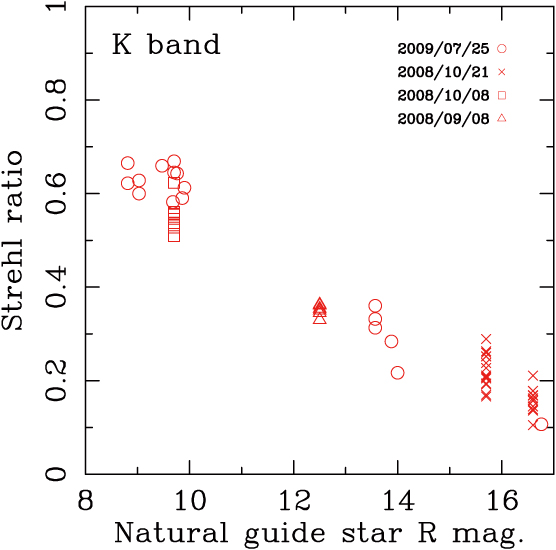
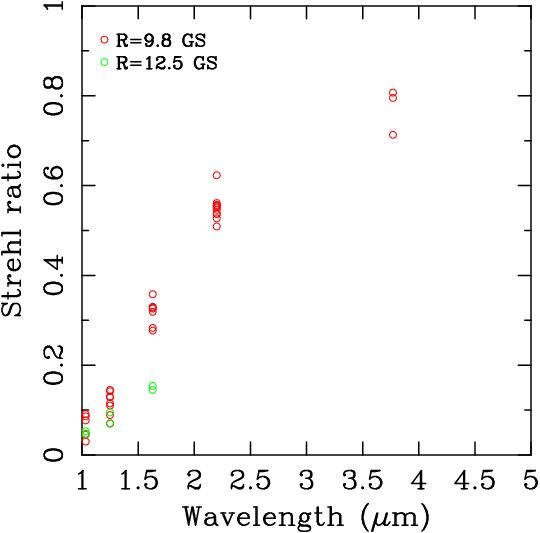
Strehl ratio (SR) as a function of R-magnitude of the NGS and the observed wavelength under good seeing condition of 0.4 arcsec.
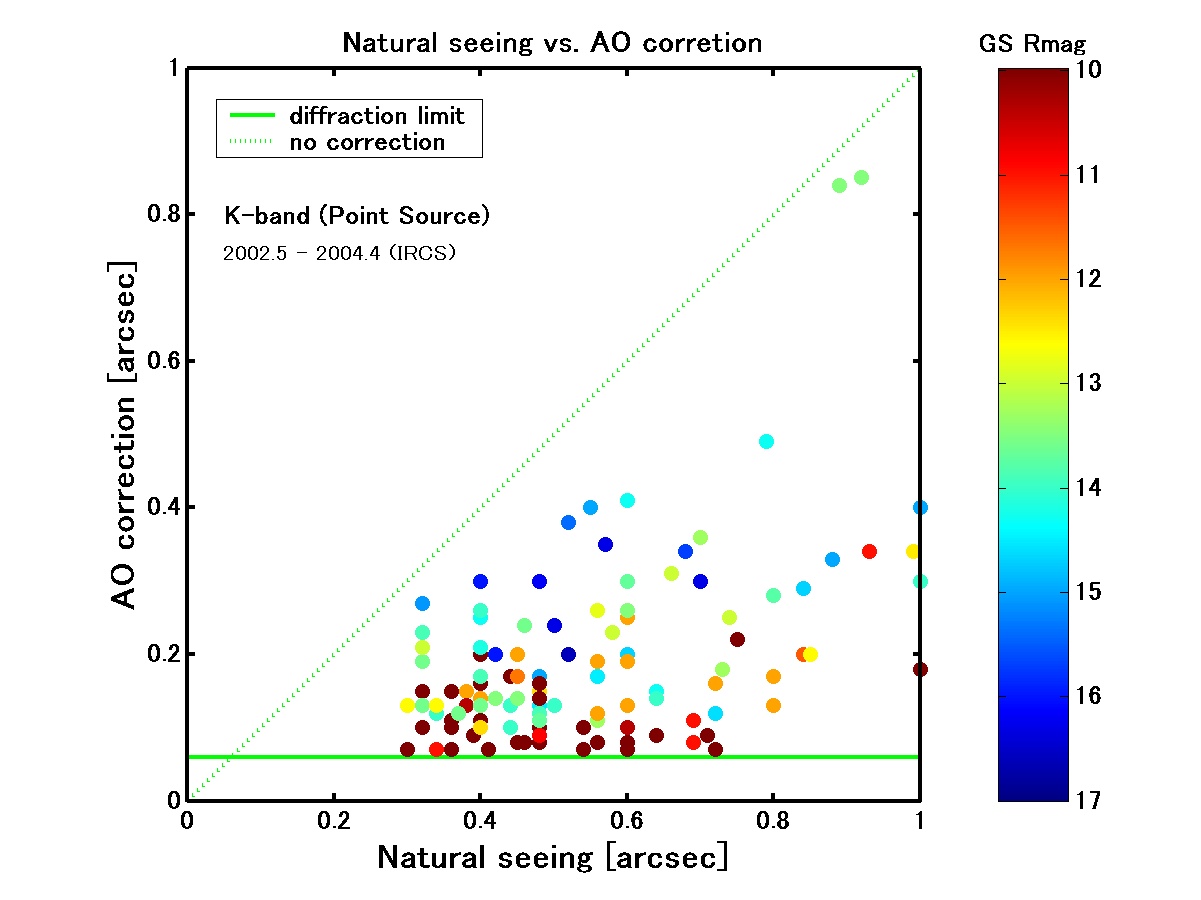
Natural seeing vs. FWHM of AO corrected PSF. The data points are color-coded along the guide star magnitude. Note that this plot is based on the data obtained by AO36.
2. Encircled energy
The plot below shows the encircled flux of the point sources obtained by AO188 with an R=9.0 guide star at 0.5-0.6 arcsec seeing condition. The half-flux radius, within which half of the total flux is contained, is 0.1 arcsec for JHKL'M' band, 0.2 arcsec for shorter z band, and 0.5 arcsec for normal seeing condition. The higher flux concentration due to the AO correction resulted in much higher sensitivity. The expected sensitivity gain by AO188 for point sources is about 2.0 mag for K band in best case (SR~0.5).

3. Isoplanatic field
The performance of AO correction degrades gradually with increasing distance from a guide star because the angular correlation of atmospheric turbulence becomes lower with increasing distance from a guide star (anisoplanatism). The isoplanatic angle (in which atmospheric turbulence should be considered approximately uniform) of AO188 would be around 30 arcsec in radius, although these values may vary from night to night, or even during a night (see figures below).
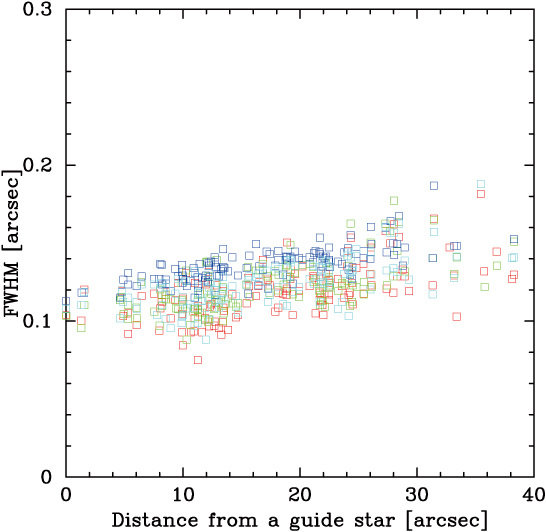
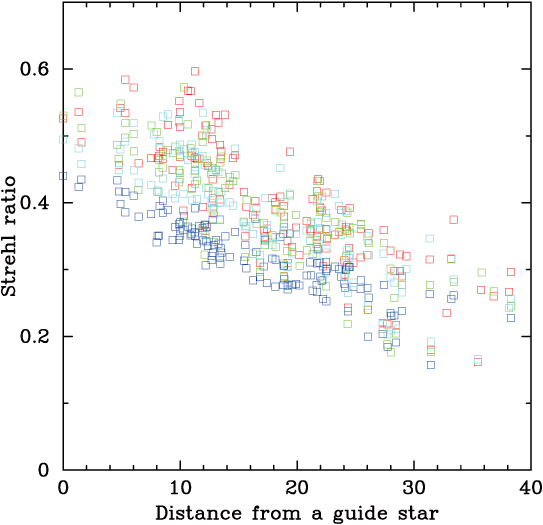
Variation of stellar FWHM and Strehl ratio within IRCS 52mas mode field of view as a function of distance from a guide star. The results are based on snapshots of a globular cluster M15 taken under good seeing condition. The color difference shows the difference between frames that were continuously taken at approximately 20 seconds intervals.
LGS mode performance
- Reference
- "Subaru laser guide adaptive optics system: performance and science operation" Minowa et al. 2012, Proc. SPIE 8447, Adaptive Optics Systems III, 84471F
1. LGS brightness

The brightness of the LGS with the new laser guide star system (from S23A) is around 8.5 mag in R band at high elevation. This brightness becomes fainter with decreasing telescope elevation (or increasing the distance between the sodium layer and telescope). At the elevation 30 deg, the LGS brightness is reduced by 1 mag in R band. The brightness of the LGS also depends on the condition of the sodium layer in the Earth's atmosphere.
2. Strehl ratio and FWHM
The plots below shows the FWHM and Strehl ratio of the point source observed as a function of the tip/tilt guide star R-band magnitude and the observed wavelength. In general, the performance of the LGS mode is better with a brighter tip/tilt guide star, at a better seeing, or longer wavelength. To get a meaningful AO correction, the faintest limit of the tip/tilt guide star is around 18mag in R band. The performance of the LGS mode also becomes worse at lower elevation, since the brightness of the laser guide star becomes fainter at lower elevation as shown above.
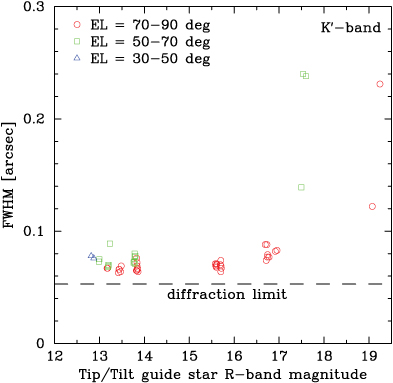
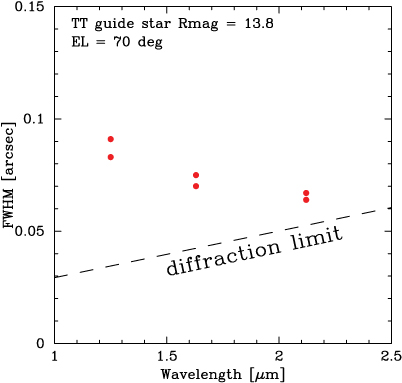
FWHM as a function of R-magnitude of the tip/tilt guide star and the observed wavelength under the seeing condition of 0.3-0.6 arcsec.
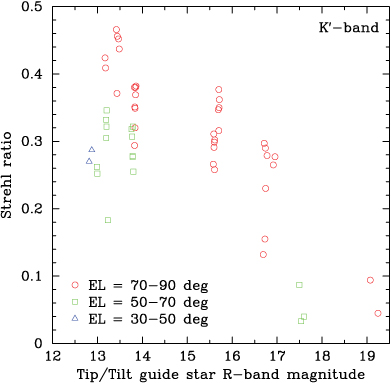
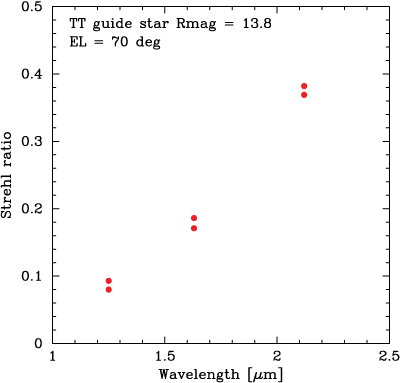
Strehl ratio (SR) as a function of R-magnitude of the tip/tilt guide star and the observed wavelength under the seeing condition of 0.3-0.6 arcsec.
3. Isoplanatic field
The performance of the tip/tilt correction becomes worse with increasing distance between the science target and tip/tilt guide star, although the strehl ratio degradation for the LGS mode as a function of the distance is expected to be slower than that for the NGS mode.
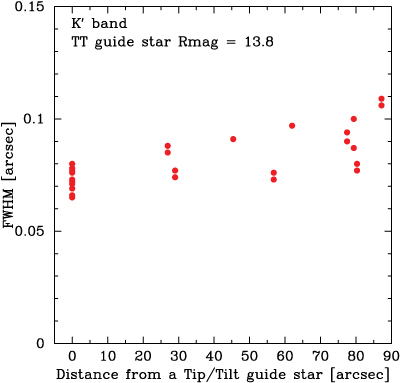

Variation of stellar FWHM and Strehl ratio as a function of distance from a tip/tilt guide star. The results are based on K'-band snapshots of star cluster field taken under good seeing condition.